
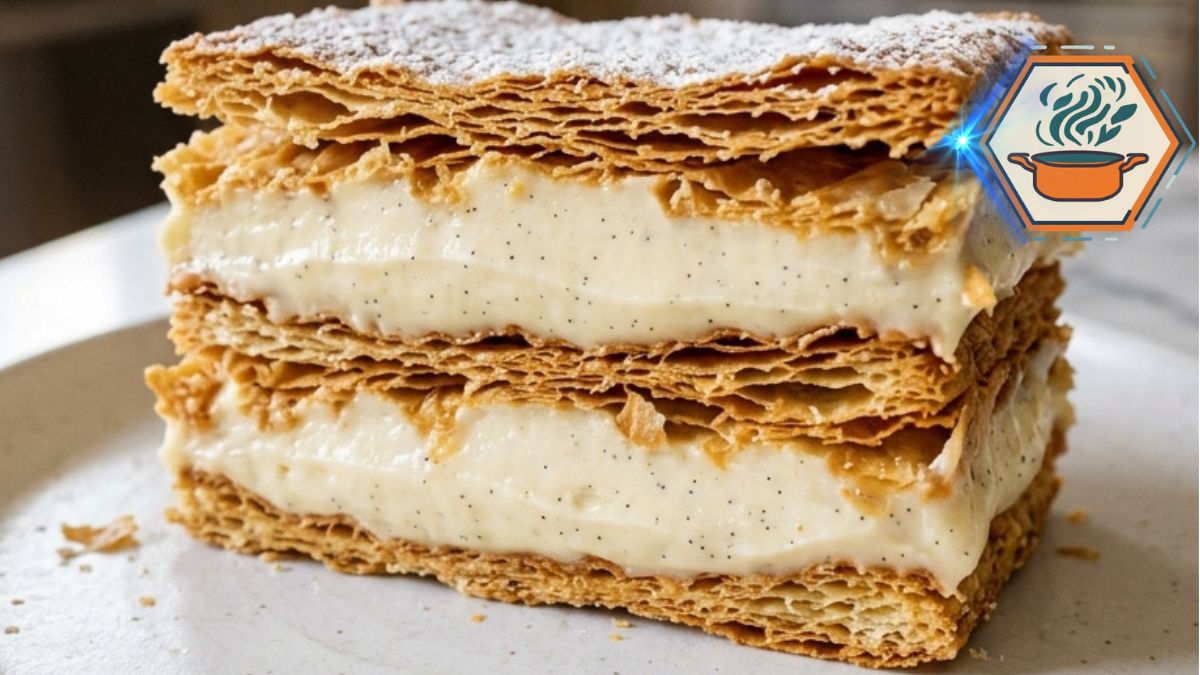
The first time you see a beautiful Vanilla Custard Mille-Feuille in a pastry case, it can feel almost too perfect to make at home. The golden layers are thin and crisp. The vanilla cream sits between them in smooth, generous ribbons. Then a snowy coat of powdered sugar makes the whole pastry look like it came straight from a French bakery.
Yet this elegant dessert is built from two familiar elements: puff pastry and vanilla pastry cream. Mille-feuille is a classic French pastry made from layers of puff pastry separated by pastry cream. Larousse describes the traditional mille-feuille as layered puff pastry filled with pastry cream and finished with powdered sugar. That simple structure is exactly what we are making here.
The secret is not adding complicated ingredients. It is controlling texture. The pastry needs enough time in the oven to become deeply golden and dry rather than pale and soft. The cream needs to be thick enough to support the pastry without running out the sides. Even the cooling time matters. For more baking inspiration, you can also browse the recipes and guides at Recipes Mind.
This version is designed to give you the same visual style as the pastry shown above: rectangular pieces, three crisp pastry layers, two thick layers of pale vanilla custard, visible vanilla specks, and a simple powdered-sugar finish.
Affiliate disclosure: As an Amazon Associate I earn from qualifying purchases.
JUMP TO
Vanilla Custard Mille-Feuille
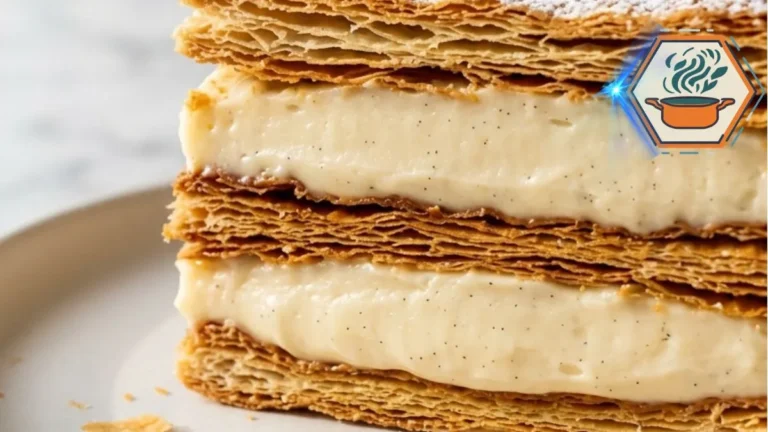
A classic Vanilla Custard Mille-Feuille made with crisp, caramelized puff pastry and thick homemade vanilla pastry cream. Three delicate pastry layers surround two generous layers of silky custard, finished with powdered sugar for an elegant French bakery-style dessert.
- Total Time: 4 hours 5 minutes
- Yield: 8 pastries
Ingredients
Puff Pastry
- 2 sheets all-butter puff pastry, thawed but still cold
- 2 tablespoons granulated sugar
- All-purpose flour, only if needed for rolling
Vanilla Pastry Cream
- 2 cups (480 ml) whole milk
- 4 large egg yolks
- 1/2 cup (100 g) granulated sugar
- 1/4 cup (30 g) cornstarch
- 2 tablespoons (28 g) unsalted butter
- 2 teaspoons pure vanilla extract
- 1 teaspoon vanilla bean paste, optional but recommended for visible vanilla specks
Finishing
- Powdered sugar, for dusting
- Vanilla bean seeds, optional
Instructions
- Preheat the oven. Preheat to 400°F (200°C). Line a large baking sheet with parchment paper.
- Prepare the pastry. Unfold the thawed puff pastry while it is still cold. If needed, roll it very lightly to create an even sheet. Do not make it paper-thin.
- Dock the pastry. Prick the surface evenly with a fork. Sprinkle a thin, even coating of granulated sugar over the pastry.
- Keep the pastry flat. Cover with another sheet of parchment paper. Place a second baking sheet on top. This limits excessive puffing and gives the pastry the flatter layers needed for mille-feuille.
- Bake. Bake for about 18–20 minutes. Carefully remove the upper tray and parchment. If needed, bake uncovered for another 3–5 minutes, watching closely, until the pastry is deep golden brown, dry and crisp. Baking time can vary by pastry brand and oven.
- Cool completely. Transfer the baked pastry to a wire rack. Never assemble the dessert while the pastry is warm.
- Prepare the custard base. Whisk the egg yolks and sugar in a heat-safe bowl. Add the cornstarch and whisk until completely smooth.
- Heat the milk. Heat the whole milk in a saucepan over medium heat until steaming. It should be hot but does not need a vigorous boil.
- Temper the yolks. Slowly pour about one-third of the hot milk into the yolk mixture while whisking constantly. Gradually add the remaining milk.
- Thicken the pastry cream. Return the mixture to the saucepan. Cook over medium heat, whisking continuously and reaching the corners of the pan. Once it thickens and begins bubbling, continue cooking briefly while whisking.
- Add vanilla and butter. Remove from the heat. Whisk in the butter, vanilla extract and vanilla bean paste until the pastry cream is smooth and glossy.
- Chill correctly. Transfer the cream to a shallow container. Press food-safe wrap directly against its surface to prevent a skin. Refrigerate until completely cold, about 2–3 hours.
- Cut the pastry. Using a ruler and sharp serrated knife, trim the pastry into equal rectangles. You need three matching pastry rectangles for each finished mille-feuille.
- Assemble. Place one pastry rectangle down. Add a thick, even layer of cold vanilla pastry cream. Top with a second pastry rectangle, another layer of cream and a third pastry rectangle.
- Chill before cutting. Refrigerate the assembled pastries for 30–45 minutes. This helps the cream firm up and makes cleaner cuts possible.
- Finish. Dust generously with powdered sugar shortly before serving. Cut with a sharp serrated knife using gentle back-and-forth movements rather than pressing straight down.
Notes
- Keep puff pastry cold until it goes into the oven.
- Use all-butter puff pastry when available for richer flavor.
- The second baking tray is important for the flat bakery-style appearance.
- Do not rely only on the 18–20 minute timer. The pastry should be deep golden, not pale.
- If necessary, remove the upper tray for the final 3–5 minutes to deepen the color and dry the surface.
- Cool the pastry completely before filling.
- The pastry cream must also be completely cold.
- Vanilla bean paste gives the filling the visible black vanilla flecks seen in the reference image.
- For the reference-photo appearance, use three pastry rectangles and two thick layers of vanilla cream.
- Add powdered sugar near serving time so it remains white and visible.
- Assemble relatively close to serving for the crispest texture.
- Use a serrated knife with a gentle sawing motion to avoid squeezing out the custard.
- Prep Time: 40 minutes
- Additional/Chill Time: 3 hours
- Cook Time: 20–25 minutes
- Category: Dessert
- Method: Baking
- Cuisine: French
- Diet: Vegetarian
What Is Vanilla Custard Mille-Feuille?
Mille-feuille roughly refers to the many thin leaves or sheets created by laminated puff pastry. The dessert is also known as a Napoleon in some countries.
The classic structure is beautifully simple. Crisp puff pastry alternates with pastry cream. A traditional version commonly has three pastry layers and two layers of cream.
That contrast is the heart of the dessert.
You get:
- Crisp, flaky pastry
- Rich butter flavor
- Cool vanilla custard
- Delicate caramelized notes
- A light powdered-sugar finish
Our version uses store-bought all-butter puff pastry. This saves hours of folding and chilling dough while still giving you the flaky structure that makes this dessert special.
Puff pastry works because thin layers of dough and fat create separation as the pastry bakes. Steam contributes to the rise and the layers become crisp in the oven.
Why This Recipe Works
Many homemade mille-feuille recipes look simple on paper but leave out details that become important once you start baking.
One common problem is pastry that balloons into uneven pillows.
Another is pastry cream that looks thick in the saucepan but becomes loose after cooling.
And then there is the famous mille-feuille cutting problem: you press the knife down and the custard escapes from both sides.
This recipe addresses those details.
The pastry is baked between trays. That keeps the sheets relatively flat while they become crisp. This technique is also used in other modern mille-feuille recipes.
A little granulated sugar on the pastry helps create a more caramelized surface.
The custard contains cornstarch for structure. Butter is added after cooking for richness and a smoother mouthfeel.
Finally, the assembled pastries are chilled before cutting. That short rest firms the cream and makes neat portions much easier.
Ingredients for Vanilla Custard Mille-Feuille
For the Puff Pastry
- 2 sheets all-butter puff pastry, thawed but still cold
- 2 tablespoons granulated sugar
- A small amount of flour for the work surface, only if needed
Choose an all-butter puff pastry when possible. Butter contributes flavor that becomes especially noticeable in a dessert with so few ingredients.
The pastry should be thawed enough to unfold without cracking, but it should still feel cold.
If it becomes very soft or sticky, refrigerate it for 10 to 15 minutes before baking.
For the Vanilla Pastry Cream
- 2 cups (480 ml) whole milk
- 4 large egg yolks
- 1/2 cup (100 g) granulated sugar
- 1/4 cup (about 30 g) cornstarch
- 2 tablespoons (28 g) unsalted butter
- 2 teaspoons vanilla extract
- 1 teaspoon vanilla bean paste, optional
The vanilla bean paste is optional for flavor, but it also creates those tiny dark vanilla specks visible in bakery-style cream. If you want that classic bakery appearance, a good-quality vanilla bean paste works especially well. I use it when I want both a strong vanilla aroma and visible vanilla flecks in the custard.
Whole milk gives the custard a richer texture than low-fat milk.
For Finishing
- Powdered sugar, as needed
- Extra vanilla bean seeds, optional
There is no heavy icing in this version. Powdered sugar keeps the top clean and elegant while allowing the crisp pastry to remain the main feature.
How to Make Vanilla Custard Mille-Feuille
1. Prepare the Oven
Preheat your oven to 400°F (200°C).
Give the oven enough time to reach the correct temperature before adding the pastry. Puff pastry benefits from entering an already hot oven.
Line a large baking sheet with parchment paper.
2. Prepare the Puff Pastry
Unfold the cold puff pastry carefully.
If the sheets are very thick, gently roll them to even out the surface. Do not aggressively roll them thin.
Place the pastry on the parchment-lined tray.
Prick the surface lightly and evenly with a fork. This is called docking. It helps control large air pockets.
Sprinkle a thin layer of granulated sugar over the surface.
Now place another sheet of parchment over the pastry. Set a second baking tray on top. Two sturdy half-sheet baking pans make this technique much easier because the upper tray sits evenly over the pastry.
This upper tray is important.
Without it, puff pastry wants to rise dramatically. That is wonderful for many recipes, but not for mille-feuille. Here we need relatively flat, compact layers that can hold custard.
3. Bake Until Deep Golden
Bake for about 18 to 20 minutes, then check the pastry.
Ovens and pastry brands differ, so treat the color as an important signal.
If the pastry is still pale, it needs more time.
For an especially crisp and caramelized finish, carefully remove the upper tray and parchment for the final few minutes. Return the pastry to the oven until the surface becomes an even, rich golden brown.
Watch it closely because the sugar can darken quickly.
You want a pastry that looks golden and dry, not blond and doughy.
Once baked, transfer it to a rack and let it cool completely.
Do not add pastry cream to warm puff pastry.
Making the Silky Vanilla Pastry Cream
While the pastry cools, prepare the cream.
This is where the dessert gets its soft, luxurious center.
1. Mix the Yolks
Place the egg yolks in a heat-safe bowl.
Add the granulated sugar and whisk until combined.
Add the cornstarch and whisk again until the mixture is smooth. Scrape around the sides and bottom of the bowl so no dry starch remains.
2. Heat the Milk
Pour the whole milk into a saucepan.
Heat it over medium heat until it is steaming and hot but not aggressively boiling.
If you are using vanilla bean paste, you can add part of it to the milk.
3. Temper the Eggs
Do not pour all the hot milk into the yolks at once.
Instead, slowly pour about one-third of the hot milk into the egg mixture while whisking constantly.
Then gradually whisk in the remaining milk.
This brings the eggs up in temperature more gently.
4. Cook the Custard
Pour everything back into the saucepan.
Cook over medium heat while whisking continuously, paying particular attention to the corners and bottom of the pan.
At first, the mixture will look like milk.
Then it will begin to thicken quickly.
Once thick and bubbling, continue cooking briefly while whisking so the starch is properly cooked and the custard has a smooth, stable consistency.
Remove it from the heat.
Add the butter, vanilla extract, and remaining vanilla bean paste.
Whisk until glossy and smooth.
The finished pastry cream should be considerably thicker than pouring custard. It needs enough body to stay between the pastry layers.
How to Cool Pastry Cream Correctly
Transfer the hot pastry cream into a clean, shallow container.
Place food-safe wrap directly against the surface of the cream. Direct contact prevents a skin from forming.
Let it lose some initial heat, then refrigerate until completely cold.
Plan for roughly 2 to 3 hours of chilling.
Do not try to assemble the mille-feuille with warm custard.
Warm pastry cream can soften the puff pastry quickly. It is also less stable and can squeeze out during assembly.
Once cold, whisk the pastry cream briefly until smooth. Do not beat it excessively.
If you enjoy custard-based French desserts, our guide to crème brûlée and custard explains another popular way custard appears in classic desserts.
Cutting the Pastry Layers
Once the pastry is completely cool, decide on the final dimensions of your pastries.
For the rectangular bakery-style appearance shown in the photo, use a ruler as a guide.
Trim uneven outer edges with a sharp serrated knife.
Then cut the pastry into matching rectangles.
You need three pieces of pastry for each finished mille-feuille.
Use a gentle sawing action rather than pressing the knife straight down.
The goal is to preserve those delicate flaky edges.
Keep the best-looking pieces for the top layers.
Assembling the Mille-Feuille
Now comes the satisfying part.
Place one crisp pastry rectangle on your work surface.
Pipe or spoon a generous, even layer of cold vanilla pastry cream over it.
For the clean appearance in the reference dessert, spread the cream almost to the edges while keeping the thickness even.
Add the second pastry rectangle.
Top it with another thick layer of pastry cream.
Finish with the third pastry rectangle.
The final structure should be:
- Crisp puff pastry
- Thick vanilla cream
- Crisp puff pastry
- Thick vanilla cream
- Crisp puff pastry
Press only very lightly.
Do not crush the pastry to force the layers together.
Repeat with the remaining pieces.
The Important Chill Before Slicing
Here is one small step that can make a major visual difference.
Place the assembled pastries in the refrigerator for 30 to 45 minutes.
The custard will firm slightly and grip the pastry layers.
When you are ready to portion them, use a sharp serrated bread knife. A long serrated blade lets you use a gentle sawing motion instead of pressing down and crushing the delicate pastry layers.
Hold the pastry gently and move the knife back and forth with a light sawing motion.
Avoid pushing straight down.
That downward pressure can crack the top pastry and force the custard out of the sides.
For the cleanest finish, wipe the knife between cuts.
Add the Powdered Sugar Last
Dust the tops generously with powdered sugar shortly before serving.
This creates the soft white finish seen on classic bakery pastries.
Do not dust them too far in advance. Moisture can gradually dissolve powdered sugar and make the finish look patchy.
A fine-mesh sieve gives the most even coating.
How to Keep Mille-Feuille Crispy
The biggest enemy of assembled mille-feuille is moisture.
Pastry cream naturally contains plenty of moisture. Once it touches puff pastry, the crisp layers slowly begin absorbing it.
That means timing matters.
For the crispest result:
- Bake the pastry until deeply golden.
- Cool the pastry completely.
- Chill the pastry cream completely.
- Assemble reasonably close to serving.
- Keep the finished dessert refrigerated.
- Add powdered sugar shortly before serving.
If you need to work ahead, make the components separately.
Bake and cool the puff pastry. Store the unfilled pastry in an airtight container once fully cool.
Make the pastry cream separately and refrigerate it.
Then assemble the dessert closer to serving time.
Common Mille-Feuille Mistakes
The Puff Pastry Is Soft
The pastry was probably underbaked or filled too far ahead.
Look for a deep golden color before removing it from the oven. Pale puff pastry often contains more remaining moisture and will not give you the same crisp bite.
The Pastry Rose Too Much
Make sure you place the second baking tray over the pastry.
Docking can help, but the weighted tray is what gives this style of mille-feuille its flatter shape.
The Custard Is Runny
Measure the cornstarch accurately and cook the pastry cream until it clearly thickens.
Also allow it to chill fully before assembly.
The Cream Has Lumps
Whisk continuously during cooking, especially once the mixture starts thickening.
If you notice small lumps immediately after cooking, you can pass the hot pastry cream through a fine-mesh sieve before adding the final butter and vanilla.
The Layers Slide When Cutting
The filling may be too warm, or the assembled dessert may need more chilling.
Refrigerate it for 30 to 45 minutes before slicing.
Then use a serrated knife instead of pressing a chef’s knife straight through the layers.
Serving Ideas
This dessert looks elaborate enough for a celebration but does not need much decoration.
Serve it for:
- Mother’s Day
- Easter
- Afternoon tea
- Birthdays
- Brunch
- Holiday dessert tables
- Bridal or baby showers
- Dinner parties
Fresh strawberries or raspberries can be served on the side, but they are not necessary.
The vanilla cream and caramelized pastry deserve to remain the focus.
A cup of espresso, coffee, or black tea is an excellent partner because its slight bitterness balances the sweet cream.
Make-Ahead and Storage Tips
The pastry cream is a good component to prepare ahead because it needs time to chill anyway.
The baked pastry can also be prepared earlier.
For best texture, keep the two components separate until relatively close to serving.
Once assembled, refrigerate the mille-feuille in a covered container.
Keep in mind that the pastry will gradually soften in the refrigerator. This does not necessarily make the dessert unpleasant, but you will lose some of the crisp contrast that makes fresh mille-feuille so good.
Freezing a fully assembled custard mille-feuille is not my first choice. Thawing can affect both the pastry’s crispness and the custard’s texture.
Why Simple Ingredients Matter Here
Mille-feuille is a useful reminder that a dessert does not need a huge ingredient list to feel special.
There is nowhere for weak ingredients to hide.
Good puff pastry gives you buttery, fragile layers.
Whole milk and egg yolks create richness.
Real vanilla gives the cream its signature aroma.
A small amount of sugar on the pastry adds caramelized flavor rather than simply making the dessert sweeter.
Then powdered sugar provides the final visual touch.
It is a simple formula, but each part has a clear job.
Frequently Asked Questions
What is mille-feuille made of?
Classic mille-feuille is made with layers of puff pastry and pastry cream. Traditional versions commonly use three pastry layers with two layers of cream, then finish the top with powdered sugar or icing.
Is mille-feuille the same as a Napoleon?
The names are often used for closely related pastries. “Napoleon” is a common name for mille-feuille in the United States and some other regions.
How do I stop puff pastry from rising too much?
Bake it beneath a second baking sheet. The weight limits excessive expansion and creates the flatter pastry sheets needed for neat layers.
Why is my mille-feuille soggy?
Moisture from pastry cream gradually moves into the pastry. Underbaked pastry can also soften faster. Bake it until deeply golden, cool both components completely, and assemble closer to serving time.
Can I make Vanilla Custard Mille-Feuille the day before?
You can prepare the pastry and vanilla cream separately the day before. For a crisper result, assemble them later rather than leaving the completed pastry filled for a full day.
Can I use frozen puff pastry?
Yes. Store-bought puff pastry makes this recipe much more practical for home bakers. Choose an all-butter version when available and follow its thawing directions.
How do I cut mille-feuille without crushing it?
Chill the assembled pastry for 30 to 45 minutes. Then use a sharp serrated knife and a gentle sawing movement. Do not push straight down through the pastry.
How do I get visible vanilla specks in the cream?
Use vanilla bean paste or seeds from a vanilla bean. They create the tiny dark flecks seen in the cream of many bakery-style vanilla desserts.
Should mille-feuille be served cold?
This custard-filled version should be kept refrigerated. For the best eating texture, serve it chilled but not frozen.
Final Kitchen Note
A beautiful Vanilla Custard Mille-Feuille is really a lesson in patience.
Let the puff pastry become properly golden. Let it cool.
Cook the vanilla cream until it is thick. Let that cool too.
Build the layers gently. Then give the assembled pastry one final short chill before cutting.
Those quiet waiting periods are what turn two basic components into a dessert with crisp, defined layers and silky vanilla cream.
When the fork finally breaks through that powdered top, you should hear the pastry crack before reaching the soft custard underneath.
That contrast is the whole point.
And once you know how to control the pastry, cream, temperature, and cutting technique, this French bakery classic becomes much less intimidating to make at home.