
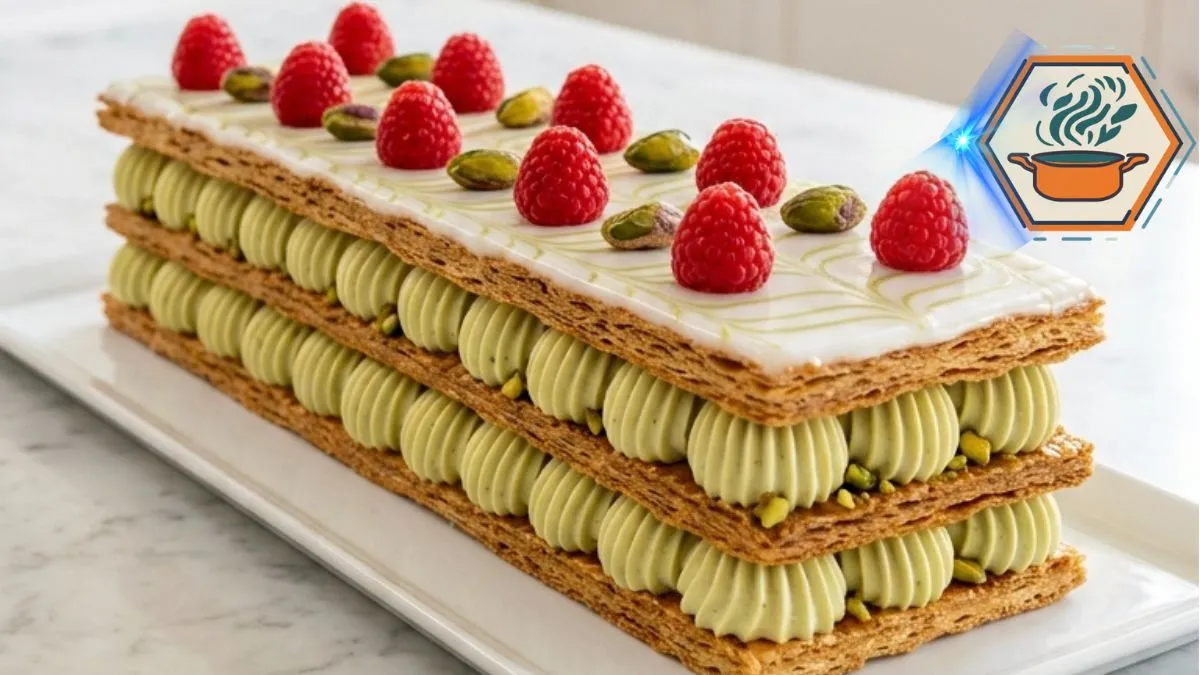
The first cut into a Pistachio Raspberry Mille-Feuille tells you whether you got it right. The knife passes through a glossy decorated top. Then comes that unmistakable crack. Thin sheets of golden pastry break apart before the blade reaches soft, pale-green pistachio cream. A fresh raspberry brings a sharp, fruity finish. It is crisp, creamy, nutty, and fresh in the same bite.
A mille-feuille can look intimidating, but its structure is surprisingly simple. The name refers to its many thin pastry layers. The classic dessert pairs baked puff pastry with pastry cream. One of the most important techniques is keeping the pastry controlled while it bakes. Traditional methods often prick the dough and bake it beneath another tray so it stays thin and even.
This recipe keeps that classic idea but adds pistachio paste, whipped cream, raspberries, and a feathered pistachio glaze. Fresh raspberries are more than decoration. Their tart flavor cuts through the rich cream. When buying them, choose dry, firm berries without mold and refrigerate them promptly. The USDA’s SNAP-Ed raspberry guide recommends using fresh raspberries within one or two days. Pistachios add richness, color, and a deep roasted-nut character. Nuts also provide unsaturated fats, protein, fiber, and other nutrients, according to the Harvard Nutrition Source.
JUMP TO
Pistachio Raspberry Mille-Feuille
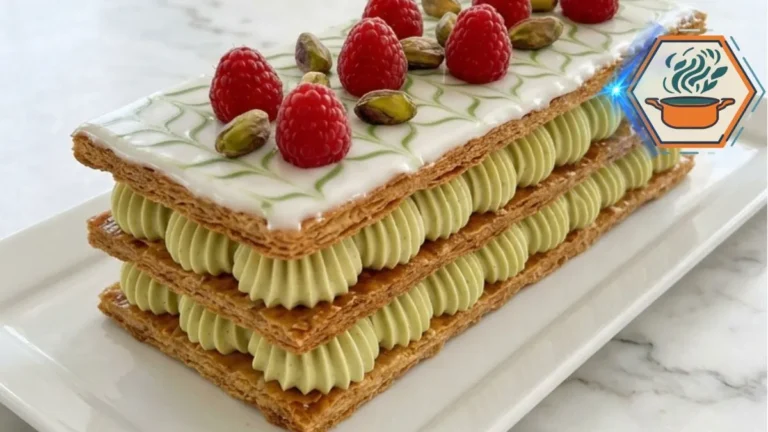
| A bakery-style Pistachio Raspberry Mille-Feuille with thin caramelized puff pastry, silky pistachio cream, fresh raspberries, pistachios, and a classic feathered glaze. |
- Total Time: 3 hours 50 minutes
- Yield: 10 servings
Ingredients
Pastry
- 2 sheets all-butter puff pastry, thawed but still cold
- 2 tablespoons granulated sugar
- 2 to 3 tablespoons powdered sugar, for caramelizing
- All-purpose flour, only as needed for rolling
Pistachio Cream
- 2 cups (480 ml) whole milk
- 4 large egg yolks
- ½ cup (100 g) granulated sugar
- ¼ cup (30 g) cornstarch
- ¼ teaspoon fine salt
- 3 tablespoons (42 g) unsalted butter
- ½ cup (about 120 g) pistachio paste
- 1 teaspoon vanilla extract
- ¾ cup (180 ml) cold heavy whipping cream
Glaze & Decoration
- 1½ cups (about 180 g) powdered sugar, sifted
- 2 to 3 tablespoons whole milk
- 2 tablespoons pistachio paste, slightly warmed
- 10 to 12 fresh raspberries
- 10 to 12 whole shelled pistachios
- 2 tablespoons finely chopped pistachios
Instructions
- Preheat the oven. Heat the oven to 400°F (200°C). Line a large baking sheet with parchment paper.
- Prepare the puff pastry. Keep the pastry cold. Gently roll each sheet to about ⅛ inch (3 mm) thick if needed. Prick the surface evenly with a fork.
- Bake it flat. Sprinkle lightly with granulated sugar. Cover with parchment paper and place a second baking sheet on top. Bake for 20 to 25 minutes.
- Finish browning. Remove the upper tray and parchment. If the pastry is still pale, bake uncovered for another 5 to 10 minutes until deeply golden and crisp.
- Caramelize the surface. Dust lightly with powdered sugar. Return uncovered to the oven for about 2 to 5 minutes, watching constantly, until the sugar melts and develops a light caramel color. Cool completely on a rack.
- Heat the milk. Place 2 cups whole milk in a saucepan and heat until steaming with small bubbles around the edge. Do not let it boil vigorously.
- Mix the yolks. Whisk egg yolks and sugar in a bowl. Add cornstarch and salt and whisk until smooth.
- Temper the eggs. Slowly whisk about one-third of the hot milk into the yolk mixture. Pour everything back into the saucepan.
- Cook the pastry cream. Cook over medium heat while whisking constantly. Once thick and bubbling, continue briefly until smooth and glossy.
- Add pistachio. Remove from the heat. Whisk in butter, ½ cup pistachio paste, and vanilla. Pass through a fine sieve for an extra-smooth filling.
- Chill completely. Transfer to a shallow container. Press plastic wrap directly against the cream and refrigerate for at least 2 hours.
- Lighten the cream. Whisk the cold pastry cream until smooth. Whip ¾ cup heavy cream to medium peaks. Fold it gently into the pistachio pastry cream in several additions.
- Cut the pastry. Using a ruler and serrated knife, cut three matching long rectangles. Use gentle sawing movements to avoid crushing the layers.
- Prepare the glaze. Mix sifted powdered sugar with 2 tablespoons milk. Add additional milk a few drops at a time until thick but spreadable.
- Create the feathered top. Spread white glaze over the best pastry rectangle. Pipe very thin parallel lines of warmed pistachio paste lengthwise. Drag a toothpick across them, alternating direction with every pass.
- Build the first layer. Place one plain pastry rectangle on a serving plate. Pipe neat, thick rows of pistachio cream over it. Add a small amount of chopped pistachio.
- Build the second layer. Add the second pastry rectangle without pressing hard. Pipe another even layer of pistachio cream.
- Finish. Carefully place the decorated pastry rectangle on top. Garnish with fresh raspberries and whole pistachios, matching the long rectangular presentation.
- Chill and slice. Refrigerate for about 30 minutes. Slice with a sharp serrated knife using gentle sawing movements. Wipe the blade between cuts.
Notes
- Keep puff pastry cold before baking.
- Baking between two trays is important for the thin, flat layers.
- Do not assemble the dessert while the pastry is warm.
- Use a high-pistachio-content paste rather than a very sweet pistachio spread.
- The pastry cream must be completely cold before whipped cream is folded into it.
- Add milk to the glaze slowly. A thin glaze will run down the sides.
- Dry washed raspberries thoroughly before decorating.
- Assemble close to serving time for the strongest crisp-creamy contrast.
- Chill for around 30 minutes before cutting.
- A serrated knife causes less crushing than pressing down with a chef’s knife.
- Prep Time: 45 minutes
- Additional/Chill Time: 2 hours 30 minutes
- Cook Time: 35 minutes
- Category: Dessert
- Method: Baking
- Cuisine: French-inspired
Why This Pistachio Raspberry Mille-Feuille Works
There are three textures to think about: crisp pastry, silky pistachio cream, and fresh fruit.
The pastry must be baked more firmly than puff pastry used for a soft turnover. Pale pastry may look cooked but can quickly become soft after it touches the filling. We want a deep golden color and a dry, crisp structure.
Baking between two trays is important. Puff pastry normally wants to rise dramatically. A mille-feuille needs something different. A sturdy aluminum half-sheet pan works especially well here because it helps keep the pastry flat and evenly supported while baking. Puff pastry needs flatter layers that can be stacked neatly.
The second key is the filling.
Straight pastry cream can feel dense. Here, whipped heavy cream is folded into chilled pistachio pastry cream. The result is lighter and easier to pipe while still having enough body to support three pastry layers.
Then there is the raspberry.
Its acidity and freshness balance the butter, cream, sugar, and pistachio paste. That contrast keeps each bite interesting.
Ingredients You’ll Need
For the Crisp Puff Pastry
- 2 sheets all-butter puff pastry, thawed but still cold
- 2 tablespoons granulated sugar
- 2 to 3 tablespoons powdered sugar for caramelizing
- A small amount of all-purpose flour for rolling, only if needed
Important: Choose all-butter puff pastry when possible. Butter gives the finished pastry a fuller flavor.
Keep the dough cold. If it becomes very soft or greasy while you work, place it in the refrigerator for 15 to 20 minutes before baking.
For the Pistachio Cream
- 2 cups (480 ml) whole milk
- 4 large egg yolks
- ½ cup (100 g) granulated sugar
- ¼ cup (30 g) cornstarch
- 3 tablespoons (42 g) unsalted butter
- ½ cup (about 120 g) pistachio paste
- 1 teaspoon vanilla extract
- ¼ teaspoon fine salt
- ¾ cup (180 ml) cold heavy whipping cream
That small amount of salt is worth adding. It was missing from the basic version of the recipe. Salt helps balance the sweetness and makes the pistachio flavor clearer.
For the best color and taste, use a pistachio paste with a high pistachio content rather than a very sweet pistachio-flavored spread.
For the White Glaze and Decoration
- 1½ cups (about 180 g) powdered sugar, sifted
- 2 to 3 tablespoons whole milk
- 2 tablespoons pistachio paste, slightly warmed
- Fresh raspberries
- Whole shelled pistachios
- Chopped pistachios
Add the milk to the powdered sugar gradually. The glaze should spread without running off the pastry.
Equipment
You do not need professional pastry equipment, but a few tools make the job much easier:
- 2 sturdy aluminum half-sheet pans for baking the pastry flat
- Parchment paper
- Rolling pin
- Medium saucepan
- Whisk
- Mixing bowls
- Fine-mesh sieve
- Plastic wrap
- Offset spatula
- Piping bag
- Large French-star or open-star piping tip
- Small piping bag for the decoration
- Toothpick or wooden skewer
- Long serrated knife
- Ruler
The ruler may sound excessive. It isn’t.
Three evenly sized pastry rectangles are one of the details that make the finished dessert look like the tall, neat pastry-shop mille-feuille we are aiming for.
How to Make Perfect Flat, Crisp Puff Pastry
Preheat the oven to 400°F (200°C).
Line a baking sheet with parchment paper.
Unfold the cold puff pastry. If necessary, roll it gently into an even rectangle about ⅛ inch or 3 mm thick. Do not crush the dough with heavy pressure.
Prick the entire surface with a fork. Leave roughly ½ inch between the holes.
Sprinkle a thin, even layer of granulated sugar over the pastry.
Cover it with another sheet of parchment. Place a second baking sheet on top.
The upper tray keeps the pastry flat while the internal layers expand. A similar method appears in classic mille-feuille preparations, where the pastry is baked beneath a second tray and later divided into equal pieces.
Bake for about 20 to 25 minutes.
Check the pastry. It should look golden rather than blond.
If necessary, remove the upper tray and parchment and bake for another 5 to 10 minutes. Watch it closely.
The Extra Step for a Better Crust
Now comes a detail that makes a major difference.
Dust the baked pastry lightly with powdered sugar. Return it uncovered to the hot oven for approximately 2 to 5 minutes.
The sugar melts and caramelizes across the surface.
This creates a thin caramelized barrier and adds another crisp texture. Caramelizing confectioners’ sugar on a mille-feuille pastry layer is also used in professional-style preparations.
Watch constantly during this stage. Sugar can move from golden to burnt very quickly.
Transfer the pastry to a rack and let it cool completely.
Never pipe cream onto warm puff pastry.
How to Make Silky Pistachio Pastry Cream
Pour the milk into a medium saucepan.
Heat it over medium heat until steaming and just beginning to simmer around the edges. Do not let it boil aggressively.
Meanwhile, place the egg yolks and sugar in a bowl. Whisk until smooth.
Add the cornstarch and salt. Whisk again until no dry pockets remain.
Now temper the eggs.
Pour about one-third of the hot milk slowly into the yolk mixture while whisking constantly.
This gradually raises the temperature of the yolks.
Pour the mixture back into the saucepan with the remaining milk.
Cook over medium heat while whisking continuously. Pay special attention to the bottom and corners of the pan.
The mixture will begin to thicken.
Once you see the first large bubbles, continue cooking briefly while whisking. The cream should become smooth, glossy, and thick enough to hold a trail from the whisk.
Remove it from the heat.
Whisk in the butter, pistachio paste, and vanilla.
For an extra-smooth finish, pass the cream through a fine-mesh sieve.
Transfer it to a shallow bowl.
Press plastic wrap directly against the surface. This prevents a skin from forming.
Refrigerate until completely cold, ideally for at least 2 hours.
Turn the Filling Into Light Pistachio Cream
Once the pastry cream is cold, whisk it briefly until smooth.
In a separate chilled bowl, whip the heavy cream to medium peaks.
Do not take it all the way to stiff, grainy peaks.
Fold about one-third of the whipped cream into the pistachio mixture. This loosens it.
Then gently fold in the rest.
You now have a lighter pistachio cream that should hold clear ridges when piped.
If it seems soft, refrigerate it for 20 to 30 minutes before assembly.
Cut Three Matching Pastry Layers
Measure your cooled pastry before cutting.
You need three long rectangles of the same dimensions.
A size near 4 × 10 inches works well, but the exact measurement depends on your pastry sheets.
Use a long serrated knife.
Do not press straight down. Use gentle sawing movements so the delicate laminated layers do not shatter.
Choose the neatest rectangle for the top.
Create the Signature White Feathered Top
It is easier to decorate the top rectangle before assembling the entire dessert. This prevents you from pressing down on the cream later.
Sift the powdered sugar into a bowl.
Add 2 tablespoons milk and stir.
Add more milk only a few drops at a time until you have a thick white icing that spreads smoothly.
Place the best pastry rectangle on a flat board.
Spread the icing from edge to edge in a thin, neat layer. A small offset spatula makes it much easier to reach the corners without damaging the crisp pastry.
Warm the 2 tablespoons of pistachio paste just enough to make it pipeable. If your paste is extremely thick, mix in a tiny amount of neutral oil.
Transfer it to a small piping bag.
Pipe very fine parallel lines along the length of the white icing.
Immediately take a toothpick or fine skewer and drag it across those lines.
Move in one direction for the first stroke.
For the next stroke, move in the opposite direction.
Continue alternating.
This creates the elegant feathered pattern seen on traditional iced mille-feuille. The alternating skewer technique is also used in classic versions of the dessert.
Work before the icing sets.
Assemble the Pistachio Raspberry Mille-Feuille
Place the first undecorated pastry rectangle on your serving plate.
Transfer the chilled pistachio cream to a piping bag fitted with a large French-star or open-star piping tip. A large ridged tip helps create the thick, defined pistachio cream rows that give this mille-feuille its bakery-style appearance.
Pipe thick, even rows from one short edge to the other. Keep each row close to the next.
This piping style matters because the cream remains visible from the sides.
Sprinkle a small amount of finely chopped pistachios between the piped cream where desired. Do not add too many. Large pieces can make the next pastry layer unstable.
Place the second pastry rectangle gently on top.
Do not push down hard.
Pipe another full layer of pistachio cream.
Carefully position the decorated pastry rectangle on top.
The finished dessert should now have:
- Three thin golden pastry layers
- Two generous layers of ridged green pistachio cream
- A smooth white glazed surface
- Fine green feathering
- A tall rectangular profile
Finish with fresh raspberries arranged at regular intervals.
Place whole shelled pistachios between some of the berries.
The red, green, white, and golden colors are part of what makes this dessert so striking.
If you enjoy working with fruit fillings and want another technique for preparing fruit at home, see our guide to making fruit purée.
Chill Before You Slice
Refrigerate the assembled dessert for about 30 minutes.
This short rest firms the cream and makes slicing easier.
Do not leave it for many hours simply to make cutting easier. Puff pastry naturally absorbs moisture from its filling over time, so the contrast is strongest while the pastry is still crisp.
For clean portions, use a sharp serrated knife.
Mark the portion first.
Then use short, gentle sawing movements through the top pastry. Once you pass through the first layer, continue carefully through the cream and lower layers.
Wipe the knife between cuts.
Common Mistakes to Avoid
Pale Puff Pastry
Puff pastry needs enough time in the oven to become deeply golden and dry.
A pale sheet may soften quickly after assembly.
Letting the Dough Become Warm
Warm puff pastry becomes sticky and difficult to handle.
If the butter starts softening while you work, chill the dough again.
Filling Warm Pastry
This is one of the fastest ways to ruin the structure.
Warm pastry melts and loosens the cream. It also traps moisture.
Everything must be cold before assembly.
Making the Glaze Too Thin
Runny glaze disappears down the sides.
Start with less milk. You can always add another teaspoon.
Using Sweet Pistachio Spread Instead of Pistachio Paste
Check the label.
Some products sold as pistachio cream contain large amounts of sugar and added fat. They can make the filling much sweeter and may change its consistency.
Overwhipping the Heavy Cream
Stop around medium peaks.
Cream whipped until grainy will not fold smoothly into pastry cream.
Pressing the Layers Together
The weight of the pastry itself is enough.
Pressing can force the pistachio filling out of the sides and destroy the piped ridges.
Make-Ahead and Storage Tips
The best approach is to prepare the components separately.
One day ahead: Make the pistachio pastry cream and refrigerate it with plastic wrap touching its surface.
Earlier the same day: Bake and caramelize the puff pastry. Keep it cool and dry.
Shortly before serving: Fold in the whipped cream, pipe the filling, decorate, and assemble.
Store the finished mille-feuille covered in the refrigerator.
For the best texture, serve it the day it is assembled.
Raspberries are delicate as well. USDA SNAP-Ed notes that they should be refrigerated and generally used within one or two days of purchase.
Easy Variations
Once you understand the structure, you can change some flavors without changing the basic technique.
Try:
- Strawberries instead of raspberries
- A thin raspberry compote between small sections of cream
- Vanilla pastry cream with chopped pistachios
- Dark chocolate feathering on the white glaze
- Lemon zest in the pastry cream for extra brightness
- Freeze-dried raspberry powder over the finished top
Do not overload the layers with wet fruit.
Fresh fruit releases juice. Too much moisture can soften the pastry.
Why Pistachio and Raspberry Work So Well Together
Pistachio has a rich, gently sweet flavor. Raspberries are bright and tart.
Put them together and neither dominates.
There is also a strong visual contrast. Pale-green cream sits between golden pastry while vivid red berries stand against white icing.
The nuts contribute more than flavor. Pistachios belong to the group of nuts that provide protein, fiber, magnesium, and unsaturated fats.
Raspberries bring their own nutritional qualities. USDA SNAP-Ed lists a cup of raspberries as providing fiber and vitamin C, among other nutrients.
This remains a rich dessert made with butter, cream, and sugar, of course. Its appeal is the balance of flavors and textures rather than turning pastry into an everyday health food.
Frequently Asked Questions
What is a mille-feuille?
A mille-feuille is a French pastry traditionally built from layers of crisp puff pastry and cream. Its name translates literally to “thousand leaves,” referring to the many fine layers created by laminated pastry.
How do I keep mille-feuille pastry crispy?
Bake the puff pastry until deeply golden and dry. Baking it beneath a second tray helps create thin, even sheets. A light caramelized sugar coating can also add a crisp surface. Most importantly, assemble the dessert fairly close to serving time.
Why do you put another baking sheet over puff pastry?
The upper tray controls the rise. Without it, puff pastry can expand into a thick, uneven sheet. Mille-feuille needs flatter layers that can be stacked neatly. Established recipes use this technique for the same reason.
Can I make Pistachio Raspberry Mille-Feuille the day before?
You can prepare most components a day ahead, but it is better to assemble the dessert closer to serving. Make the pastry cream first and refrigerate it. Bake the pastry separately and keep it dry. Assemble later so the pastry stays crisp.
What pistachio paste should I use?
Choose a smooth paste with a strong pistachio content and good natural flavor. Avoid confusing pure or concentrated pistachio paste with very sweet pistachio dessert spreads. Taste your paste before adding it because sweetness varies between brands.
Why is my pistachio cream runny?
The pastry cream may not have cooked long enough, may still be warm, or the whipped cream may have been folded into it before it was fully chilled. Refrigerate the pastry cream completely before adding whipped cream.
Can I use frozen raspberries?
Fresh raspberries are much better for the decoration. Frozen berries release considerable moisture as they thaw, which can stain the glaze and soften the pastry.
How do you cut a mille-feuille without crushing it?
Chill the assembled dessert for around 30 minutes. Use a sharp serrated knife and make gentle sawing movements. Do not push directly downward. Wipe the blade between portions.
Can I make this without pistachios?
Yes. Replace the pistachio element with vanilla pastry cream, chocolate pastry cream, or another firm filling. However, it will no longer have the defining pistachio flavor of this recipe.
How long should mille-feuille chill before serving?
For this version, about 30 minutes is a useful starting point. It allows the cream to firm without intentionally giving the pastry hours to absorb moisture.
Final Tips for a Bakery-Style Result
A beautiful Pistachio Raspberry Mille-Feuille is less about complicated ingredients and more about timing.
Keep the pastry cold before baking.
Bake it until truly crisp.
Caramelize the surface carefully.
Cool every pastry layer completely.
Chill the pistachio pastry cream before folding in the whipped cream.
Decorate the top before placing it on the dessert.
Pipe the filling evenly.
And use fresh, dry raspberries only at the end.
When all those small details come together, the final slice gives you exactly what this dessert promises: crisp golden pastry that cracks beneath the knife, cool pistachio cream with defined ridges, a polished feathered top, and fresh raspberry in every serving.
That first crack is not just satisfying.
It is the sign that your mille-feuille worked.