
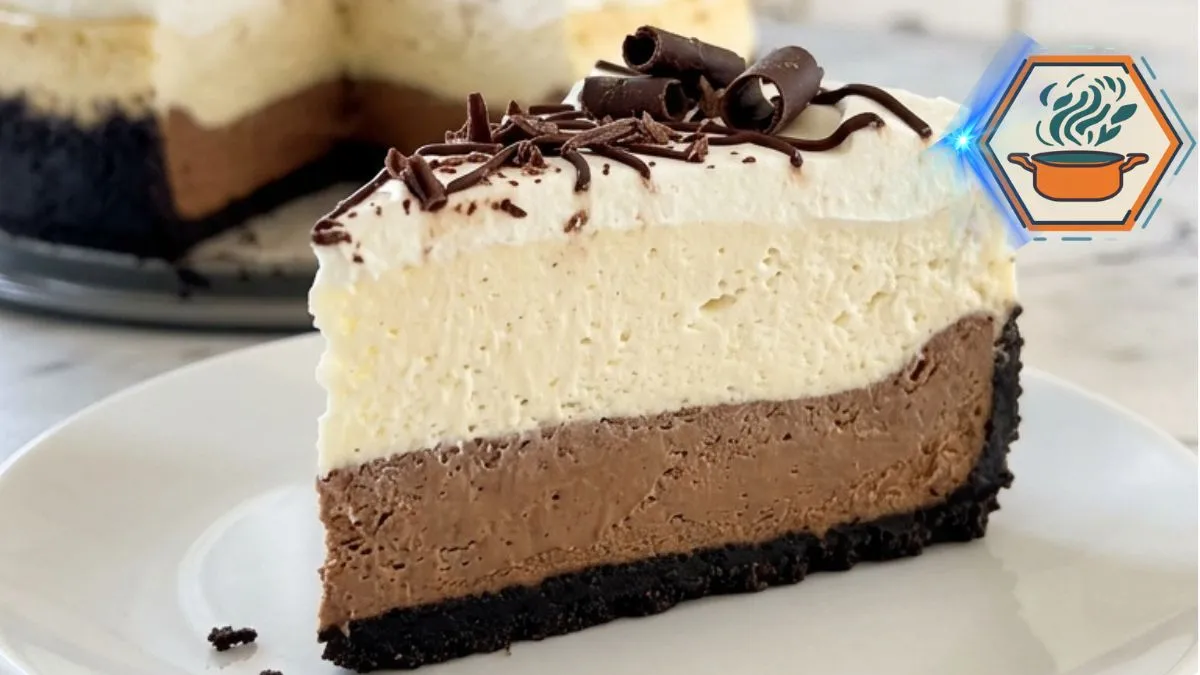
The first cut into this Triple Chocolate Vanilla Mousse Cheesecake is almost as satisfying as the first bite. The knife passes through soft whipped cream, a tall ivory mousse, creamy milk chocolate cheesecake, and finally a thin, dark chocolate cookie crust. Pull the slice away and four clean layers appear. Add the thin chocolate drizzle and irregular curls on top, and you have the kind of homemade dessert people stop to look at before reaching for a fork.
The impressive appearance comes from patience rather than complicated pastry work. Temperature matters at almost every stage. King Arthur Baking recommends bringing cheesecake ingredients to room temperature for a smooth batter and mixing at low or medium-low speed to limit excess air. Those two habits are particularly useful here because the baked chocolate cheesecake needs to form a smooth, stable foundation for the mousse.
There is another important lesson in layered cheesecakes: don’t judge everything by the timer. Food Network’s chocolate cheesecake guidance calls for a set edge while the center remains jiggly, followed by thorough chilling. That is exactly the visual cue we want. A cheesecake baked until completely rigid can become dry and dense.
This recipe takes those principles and turns them into a showpiece that is still realistic for a home kitchen.
jump to
Why This Triple Chocolate Vanilla Mousse Cheesecake Works
This isn’t simply chocolate cheesecake with cream on top.
Every layer has a separate job.
The bottom brings crunch and dark cocoa flavor. The milk chocolate cheesecake is rich and creamy. The white chocolate and vanilla mousse is much lighter. Finally, whipped cream and semisweet chocolate keep the top from feeling too dense.
From bottom to top, the finished slice should show:
- A thin, nearly black chocolate cookie crust
- A thick milk chocolate cheesecake layer
- A taller ivory vanilla white chocolate mousse
- Generous whipped cream swirls
- Thin semisweet chocolate drizzle
- Irregular chocolate curls and shavings
Keeping those proportions matters. If the crust becomes too thick, it dominates the bite. If the mousse is too thin, you lose the dramatic contrast.
A similar principle applies to caramel desserts, where texture can depend on a few small technique choices. Our guide to mastering caramelized sugar explains another useful pastry technique.
Recipe at a Glance
Yield: 12 slices
Pan: 8-inch springform pan
Preparation: About 40 minutes
Baking: About 48–55 minutes including the crust
Minimum chilling: 7 hours
Best chilling time: Overnight
Skill level: Intermediate
This is an excellent make-ahead dessert. Starting the day before serving is much easier than trying to finish every layer in one afternoon.
Ingredients
Dark Chocolate Cookie Crust
- 1½ cups finely ground chocolate cookie crumbs
- 4 to 5 tablespoons unsalted butter, melted
- 2 tablespoons unsweetened cocoa powder
- 2 tablespoons granulated sugar
- ⅛ teaspoon fine salt
Milk Chocolate Cheesecake
- 16 ounces full-fat block cream cheese, softened
- ½ cup granulated sugar
- 5 ounces milk chocolate, finely chopped
- ½ cup full-fat sour cream, room temperature
- 2 large eggs, room temperature
- 1 teaspoon pure vanilla extract
- ⅛ teaspoon fine salt
Vanilla White Chocolate Mousse
- 6 ounces real white chocolate, finely chopped
- 4 ounces full-fat cream cheese, softened
- 1 teaspoon pure vanilla extract
- 1½ cups cold heavy whipping cream
- 2 tablespoons powdered sugar
- Pinch of salt
Whipped Cream Topping
- 1 cup very cold heavy whipping cream
- 3 tablespoons powdered sugar
- 1 teaspoon vanilla extract
Chocolate Finish
- 3 ounces semisweet chocolate, finely chopped
- ¼ cup heavy cream
- 2 ounces chocolate for curls and irregular shavings
One Ingredient Detail That Can Save Your Crust
Not all chocolate cookies contain the same amount of fat.
That means blindly adding five tablespoons of melted butter can sometimes leave you with a greasy crust.
If you’re using cream-filled sandwich cookies, the filling already contains fat and sugar. Bon Appétit’s chocolate cheesecake, for example, uses the filling in its cookie crust and pairs it with a relatively modest amount of added butter.
For this recipe, grind your cookies first.
Mix the dry ingredients and begin with 4 tablespoons of melted butter.
Squeeze a spoonful in your hand.
It should behave like damp sand and remain together when compressed. If it immediately falls apart, add the remaining butter gradually.
That simple test is more reliable than assuming every brand of cookie needs exactly the same amount.
Equipment Worth Using for This Recipe
You do not need a kitchen full of gadgets. A bowl, spatula, springform pan, and electric mixer can make the cake.
But if you bake frequently, this recipe is also a good example of where better equipment can save effort.
A full-size stand mixer is particularly useful here. There are several separate mixing jobs: cream cheese filling, mousse, and whipped topping. A stand mixer also lets you work at controlled low speeds for cheesecake batter rather than aggressively whipping it.
For bakers who regularly make cheesecakes, bread, frostings, and layered desserts, a premium mixer is a more versatile purchase than another cake-specific gadget. You can compare KitchenAid stand mixers on Amazon before deciding whether the investment makes sense for your kitchen.
A powerful food processor is another useful option if you bake often. It turns chocolate cookies into uniformly fine crumbs in seconds. Fine crumbs matter here because large pieces create weak areas in a thin cheesecake crust. A good processor also works for savory recipes, doughs, sauces, nuts, and vegetables, so it isn’t limited to desserts. You can see current Breville food processors on Amazon if you want a higher-capacity option.
Affiliate disclosure: Some equipment links in this article may be affiliate links. If you purchase through them, RecipesMind may earn a commission at no additional cost to you.
How to Make the Dark Chocolate Crust
Preheat the oven to 325°F (165°C).
Line the bottom of an 8-inch springform pan with parchment. Lightly grease the inner sides.
Process the cookies into very fine crumbs.
Add cocoa, sugar, and salt. Stir thoroughly.
Mix in four tablespoons of melted butter. Test the crumbs by squeezing a small amount between your fingers.
Add more butter only when necessary.
Transfer the mixture to the pan.
Now comes an easily overlooked step: compression.
Use the flat bottom of a measuring cup or glass to press the crumbs firmly across the bottom.
Pay particular attention to the perimeter. Loose crumbs around the edge are often what cause a cheesecake crust to break when a slice is lifted.
Bake for 9 to 10 minutes.
Place the pan on a cooling rack while you prepare the cheesecake.
How to Make the Milk Chocolate Cheesecake Layer
Take the cream cheese, sour cream, and eggs out of the refrigerator early enough to lose their chill.
This isn’t just about convenience.
Cold cream cheese can remain lumpy even after extended mixing. King Arthur specifically recommends room-temperature cheesecake ingredients for smoother batter.
Melt five ounces of milk chocolate gently.
A microwave works well when used in short intervals. Stir after each interval rather than waiting for the chocolate to look completely melted.
Set it aside.
The chocolate should be fluid but no longer hot when it reaches the cream cheese.
Beat the softened cream cheese and sugar on low to medium-low speed until smooth.
Scrape the sides and bottom of the bowl.
Add the melted milk chocolate, sour cream, vanilla, and salt.
Mix just until uniform.
Add the eggs one at a time.
Once the eggs go in, resist the temptation to whip the mixture until fluffy. We want smooth cheesecake, not an aerated cake batter.
Mix each egg only until it disappears into the filling.
Pour the batter over the cooled crust.
Smooth the surface.
How to Know When the Cheesecake Is Actually Done
Bake at 325°F (165°C) for approximately 38 to 45 minutes.
Ovens vary, so start checking early.
The edges should look set.
The center should still move slightly when you gently nudge the pan.
Food Network uses this same basic doneness principle in its triple chocolate cheesecake: the edge sets while the center retains movement before chilling.
Do not wait for the center to become hard.
Turn off the oven. Open the door slightly and leave the cheesecake inside for about 15 minutes.
Then transfer it to a rack.
Let it cool completely before refrigerating it for at least 3 hours.
Overnight is even easier if you want to divide the recipe across two days.
A Useful Temperature Check
If cheesecake is something you make regularly, an accurate instant-read thermometer can be more useful than another decorative baking accessory. It can help with chocolate, custards, caramel, bread, meat, and dozens of everyday recipes.
A premium model such as a Thermapen is relatively expensive, but its usefulness extends far beyond this dessert. You can compare premium instant-read thermometers on Amazon.
For this cheesecake, however, the visual wobble remains important. Don’t repeatedly puncture the center just to chase a number.
Making Vanilla White Chocolate Mousse Without Gelatin
The pale mousse is what transforms the dessert.
It should be tall, creamy, and stable but not rubbery.
No gelatin is needed for this version. White chocolate, cream cheese, properly whipped cream, and sufficient chilling provide the structure.
Start by finely chopping six ounces of real white chocolate.
Check the ingredient label. White chocolate made with cocoa butter generally gives better melting behavior and flavor than products designed primarily as baking chips.
Melt it gently.
Then wait.
It needs to cool until barely warm. Mixing hot white chocolate directly with the other ingredients can create texture problems and weaken your whipped cream later.
Beat four ounces of softened cream cheese until smooth.
Gradually add the melted white chocolate.
Add vanilla and salt.
In another cold bowl, whip 1½ cups cold heavy cream with two tablespoons powdered sugar.
Stop at medium-firm peaks.
The cream should stand up when the whisk is lifted but still look smooth and creamy.
Take roughly one-third of the whipped cream and fold it into the white chocolate mixture.
This first addition lightens the base.
Fold in the remaining whipped cream in two additions using broad, gentle movements.
Do not whisk aggressively.
The final mousse should be thick enough to hold a soft mound.
The Most Important Rule for Clean Layers
Your baked cheesecake must be completely cold.
Not slightly warm.
Not “probably cool enough.”
Cold.
Adding mousse to warm cheesecake can soften the mousse from underneath. The border becomes less defined, and the upper layer may struggle to set.
Take the chilled cheesecake from the refrigerator.
Spread the mousse over it gently. An offset spatula makes this easier.
Keep this layer deliberately thick. It should be taller than the dark crust and visually substantial compared with the milk chocolate cheesecake.
Smooth the surface.
Refrigerate for another 4 hours minimum, preferably overnight.
Layered cheesecake recipes likewise rely on allowing layers adequate time to firm before adding subsequent components.
If you enjoy creamy desserts where temperature changes the final texture, our guide to crème brûlée and custard explains the differences between two other classic creamy desserts.
Making Whipped Cream That Holds Its Shape
Once the mousse is thoroughly chilled, prepare the topping.
Use:
- 1 cup cold heavy cream
- 3 tablespoons powdered sugar
- 1 teaspoon vanilla
A cold bowl helps, particularly in a warm kitchen.
Whip until firm but creamy peaks form.
Watch carefully near the end. There is a relatively short distance between beautifully whipped cream and a grainy, overwhipped texture.
Transfer the cream to a piping bag with a large star or open decorative tip.
Pipe large, slightly irregular swirls over the top.
Don’t make them look mechanically identical.
The visual goal is abundant, homemade whipped cream rather than a perfectly manufactured pattern.
Make a Thin Chocolate Drizzle, Not a Heavy Ganache Blanket
Finely chop three ounces of semisweet chocolate.
Heat ¼ cup heavy cream until steaming.
Pour the cream over the chocolate.
Leave it untouched for about two minutes.
Then stir slowly from the center outward until glossy.
The most important instruction comes next:
Wait before drizzling.
Hot ganache will melt your whipped cream.
The chocolate needs to remain fluid enough for thin lines but cool enough not to damage the topping.
Drizzle lightly over the whipped cream.
You should still see plenty of white underneath.
How to Make Natural Chocolate Curls
This cake looks better with imperfect chocolate decoration.
Use a vegetable peeler against the edge of a chocolate bar to make curls and shavings.
Some will break.
Keep them.
Mix larger curls with thin shards and tiny pieces. Scatter them primarily around the whipped cream.
Food Network also uses shaved chocolate as a simple finishing technique for chocolate cheesecake.
You don’t need to buy a chocolate-shaving gadget for a job a vegetable peeler already does well.
That’s also an important rule for a practical home kitchen: buy better equipment where it solves a recurring problem, not because every small task needs its own tool.
A Fourth Equipment Investment That Makes Sense Beyond Cheesecake
One appliance I would consider for someone who regularly cooks as well as bakes is a quality immersion blender with attachments, rather than another dessert-only accessory.
It won’t replace your mixer for whipping this mousse. That’s not why it’s here.
A powerful immersion blender can handle sauces, soups, fruit purées, emulsions, and many other preparations. Some sets also include chopping or whisking accessories.
That makes it far more useful across a kitchen than a specialty cheesecake tool that comes out twice a year.
If that versatility fits how you cook, you can compare premium Breville immersion blenders on Amazon. If you only bake occasionally, skip it. It isn’t required for this recipe.
How to Cut Picture-Perfect Slices
Your cake has chilled overnight.
The chocolate curls are in place.
Now don’t ruin those layers with a dirty knife.
Use a long, thin, sharp knife.
Fill a tall container with hot water.
Dip the blade into the water.
Wipe it completely dry.
Make one clean downward cut.
Clean and reheat the blade before the next cut.
Food Network similarly recommends warming and drying a knife before slicing chilled chocolate cheesecake.
Do not use a back-and-forth sawing motion.
It can pull dark crumbs upward into the milk chocolate layer and drag chocolate down through the ivory mousse.
A clean slice should reveal the dark crust, milk chocolate center, pale mousse, and white whipped cream as distinct bands.
Serving the Cheesecake
Serve the cheesecake cold, but you don’t need it to be ice-cold.
A few minutes outside the refrigerator can soften the textures slightly.
Each forkful should include some crust, cheesecake, and mousse.
That’s when the recipe makes the most sense.
First comes the airy cream and vanilla. Then white chocolate richness. The milk chocolate cheesecake feels denser. Finally, the dark cocoa crust gives the bite a crisp finish.
For another dessert where chocolate contrasts with a fruit center, try our strawberry-filled chocolate cake.
How to Store It
Keep the finished cheesecake covered in the refrigerator.
For the best texture and appearance, plan to eat it within about 3 to 4 days. A comparable chilled triple-chocolate cheesecake recipe also gives a refrigerated storage window of 3–4 days.
If you’re preparing ahead, a practical schedule is:
- Day 1 morning: Bake the crust and cheesecake.
- Day 1 afternoon/evening: Add the mousse once the cheesecake is completely cold.
- Day 2: Add whipped cream, ganache, and chocolate curls.
- Day 2: Slice and serve.
This schedule removes much of the stress from the recipe.
Troubleshooting Triple Chocolate Vanilla Mousse Cheesecake
The crust crumbles when sliced
Your crumbs may have been too coarse or too dry.
Process them finely. Add enough butter for the mixture to hold when squeezed, then compress it firmly into the pan.
The crust looks oily
There was probably too much fat.
Cream-filled cookies often require less added butter than dry chocolate wafers. Start with four tablespoons and add more only when needed.
My cheesecake filling is lumpy
The cream cheese was probably too cold.
Room-temperature ingredients combine more easily into smooth cheesecake batter.
The cheesecake cracked
Several things can contribute.
The oven may have been too hot. The batter may have contained too much incorporated air. The cheesecake may also have baked too long or cooled too quickly. King Arthur identifies temperature, mixing, and gradual cooling among the factors that affect cheesecake texture and cracking.
A crack is not a disaster here because the mousse covers the entire surface.
The mousse is too soft
Check three likely causes:
- The white chocolate was still hot.
- The heavy cream was underwhipped.
- The cheesecake underneath wasn’t completely cold.
Give the assembled mousse enough refrigeration time before judging its final consistency.
My mousse became grainy
The cream may have been overwhipped, or the white chocolate may have become too hot during melting.
Work gently and stop whipping once the correct peak stage is reached.
The chocolate drizzle melted my whipped cream
The ganache was too warm.
Let it cool until it still flows from a spoon but no longer feels hot.
The layers smear when I cut them
The cheesecake probably needs more chilling.
Use the warm, clean, dry knife method and clean the blade after every slice.
Frequently Asked Questions
Can I make Triple Chocolate Vanilla Mousse Cheesecake the day before?
Yes. You should, whenever possible.
The dessert needs at least seven hours of chilling across its different stages. Overnight chilling makes the mousse firmer and makes clean slicing easier.
Can I use chocolate chips?
Chocolate bars are the better choice for the cheesecake and mousse when available.
Chopped chocolate tends to melt smoothly, while some chips are formulated to retain their shape during baking. Bon Appétit likewise recommends bar chocolate rather than chips for its chocolate cheesecake.
Do I need gelatin for white chocolate mousse?
No.
This mousse gets its structure from white chocolate, cream cheese, whipped heavy cream, and chilling.
That gives it a creamy mouthfeel rather than the firmer texture gelatin can produce.
Can I use a 9-inch springform pan?
Yes, but the layers will be thinner.
An 8-inch pan creates the tall profile that gives this particular cheesecake its dramatic appearance.
You may also need to start checking for doneness earlier in a wider pan.
Do I need a water bath?
Not necessarily.
A water bath can promote gentler, more even cheesecake baking, and King Arthur lists it as one option for reducing cracks.
For this recipe, however, minor surface cracks will be hidden by mousse. If your oven runs evenly and you avoid overbaking, you can make it without a water bath.
Why is my cheesecake still wobbly after baking?
A small amount of movement in the center is expected.
Cheesecake continues to set as it cools and then chills. The important distinction is between a controlled center wobble and a center that still looks liquid.
Can I freeze this cheesecake?
For the best presentation, I prefer refrigerating the fully decorated cake.
If you need to freeze it, doing so before the final whipped cream and chocolate decoration is more practical. Thaw it gradually in the refrigerator before decorating.
How do I keep all the layers perfectly separate?
Temperature and patience.
The baked chocolate cheesecake must be completely cold before the mousse is added. The mousse then needs several hours to become stable before the final topping.
Never try to recover lost time by stacking warm or soft layers.
Print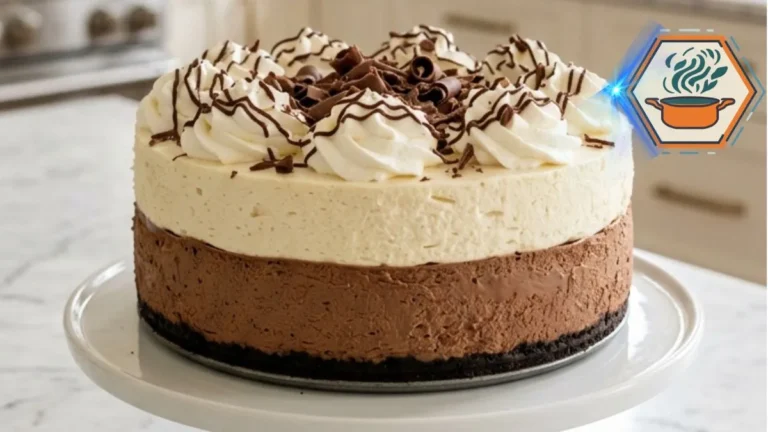
Triple Chocolate Vanilla Mousse Cheesecake
A showstopping layered cheesecake with a dark chocolate cookie crust, creamy milk chocolate cheesecake, thick vanilla white chocolate mousse, whipped cream, chocolate drizzle, and irregular chocolate curls. Each layer is chilled until stable for clean slices and distinct textures.
- Total Time: 8 hours 35 minutes
- Yield: 12 slices
Ingredients
Dark Chocolate Cookie Crust
1 1/2 cups finely ground chocolate cookie crumbs
4 to 5 tablespoons unsalted butter, melted
2 tablespoons unsweetened cocoa powder
2 tablespoons granulated sugar
1/8 teaspoon fine salt
Milk Chocolate Cheesecake
16 ounces full-fat block cream cheese, softened
1/2 cup granulated sugar
5 ounces milk chocolate, finely chopped, melted and cooled until barely warm
1/2 cup full-fat sour cream, room temperature
2 large eggs, room temperature
1 teaspoon pure vanilla extract
1/8 teaspoon fine salt
Vanilla White Chocolate Mousse
6 ounces real white chocolate, finely chopped
4 ounces full-fat block cream cheese, softened
1 teaspoon pure vanilla extract
1 1/2 cups cold heavy whipping cream
2 tablespoons powdered sugar
Pinch of fine salt
Whipped Cream Topping
1 cup cold heavy whipping cream
3 tablespoons powdered sugar
1 teaspoon pure vanilla extract
Chocolate Finish
3 ounces semisweet chocolate, finely chopped
1/4 cup heavy cream
2 ounces milk, dark, or semisweet chocolate for curls and shavingsInstructions
Preheat the oven to 325°F (165°C). Line the bottom of an 8-inch springform pan with parchment paper and lightly grease the inside edge.Combine the finely ground chocolate cookie crumbs, cocoa powder, sugar, and salt. Stir in 4 tablespoons melted butter. Squeeze a small amount in your hand. If it holds together like damp sand, it is ready. If it remains dry and crumbly, gradually mix in the remaining tablespoon of butter.Transfer the crumb mixture to the prepared pan. Press it firmly and evenly over the bottom using the flat base of a measuring cup. Pay special attention to the outer edge so no loose crumbs remain. Bake for 9 to 10 minutes. Transfer the pan to a rack and let the crust cool while preparing the filling.Gently melt the milk chocolate in a heatproof bowl over barely simmering water or microwave it in short intervals, stirring frequently. Let it cool until fluid but barely warm.Beat the softened cream cheese and granulated sugar on low to medium-low speed until smooth. Scrape the bowl. Mix in the cooled milk chocolate, sour cream, vanilla, and salt just until uniform.Add the eggs one at a time on low speed, mixing only until each egg disappears into the batter. Do not whip the batter after adding the eggs, as excess incorporated air can cause the cheesecake to rise and crack.Pour the filling over the cooled crust and smooth the surface. Bake at 325°F (165°C) for 38 to 45 minutes. The outer portion should look set while the center still has a gentle wobble when the pan is carefully moved.Turn off the oven, crack the door open, and leave the cheesecake inside for about 15 minutes. Remove it and cool completely on a rack. Cover and refrigerate for at least 3 hours. The cheesecake must be completely cold before adding the mousse.Gently melt the white chocolate and let it cool until barely warm. Beat the 4 ounces softened cream cheese until completely smooth. Gradually mix in the melted white chocolate, vanilla, and a pinch of salt.In a separate cold bowl, whip 1 1/2 cups cold heavy cream with 2 tablespoons powdered sugar until medium-firm peaks form. The cream should hold its shape while remaining smooth and creamy.Fold about one-third of the whipped cream into the white chocolate mixture to lighten it. Gently fold in the remaining whipped cream in two additions. Avoid vigorous stirring so the mousse stays airy.Make sure the cheesecake is completely cold. Spoon the mousse over the cheesecake and gently spread it into a thick, even layer. Refrigerate for at least 4 hours, preferably overnight.Whip 1 cup cold heavy cream with 3 tablespoons powdered sugar and 1 teaspoon vanilla until firm but creamy peaks form. Transfer to a piping bag fitted with a large star tip and pipe generous, slightly irregular swirls over the chilled mousse.Place 3 ounces finely chopped semisweet chocolate in a heatproof bowl. Heat 1/4 cup heavy cream until steaming, then pour it over the chocolate. Rest for 2 minutes and stir until smooth. Let the ganache cool until fluid but no longer warm enough to melt the whipped cream.Lightly drizzle the cooled chocolate ganache over the whipped cream. Use a vegetable peeler on the edge of a chocolate bar to make irregular curls and shavings. Scatter them naturally over the top.
Chill briefly after decorating. Dip a long thin knife into hot water, wipe it completely dry, and make one clean downward cutNotes
For the cleanest layers, never add the white chocolate mousse to a warm cheesecake. The baked cheesecake must be completely cold and firm.
Chocolate sandwich cookies with filling contain more fat than dry chocolate wafers. Begin the crust with 4 tablespoons of butter and add the fifth only if the crumbs do not hold together when squeezed.
Use full-fat block cream cheese rather than whipped or spreadable cream cheese.
For the smoothest cheesecake filling, bring the cream cheese, sour cream, and eggs to room temperature before mixing.
After adding the eggs, mix only until incorporated. Excess air can cause the cheesecake to puff during baking and crack as it cools.
Use real white chocolate made with cocoa butter when possible. Let melted white chocolate cool until barely warm before combining it with the mousse ingredients.
The mousse does not require gelatin. White chocolate, cream cheese, properly whipped heavy cream, and adequate chilling provide its structure.
The cheesecake is best prepared one day before serving. Chill the completed mousse layer overnight, then add the whipped cream, chocolate drizzle, and curls before serving.
For clean slices, use a warm, completely dry knife and clean it between every cut.
- Prep Time: 40 minutes
- Additional Time / Chill Time: 7 hours
- Cook Time: 55 minutes
- Category: Dessert
- Method: Baking and Chilling
- Cuisine: American-inspired
The Final Result
A successful Triple Chocolate Vanilla Mousse Cheesecake should look impressive without looking artificial.
At the bottom is that thin, dark chocolate crust. The milk chocolate cheesecake above it is smooth and substantial. The ivory mousse is thick and visibly lighter. Whipped cream sits generously across the top rather than forming a perfectly flat layer.
Then come just enough thin chocolate drizzle and irregular curls to tell you what you’re about to taste.
But the real success is inside.
The crust doesn’t crumble when the fork reaches it. The cheesecake is creamy rather than dry. The mousse holds its height without becoming rubbery. The whipped cream remains soft. And the chocolates taste distinct rather than blending into one overwhelmingly sweet layer.
That is why the waiting matters.
Give every layer the time it needs, and the final slice will tell the whole story.