
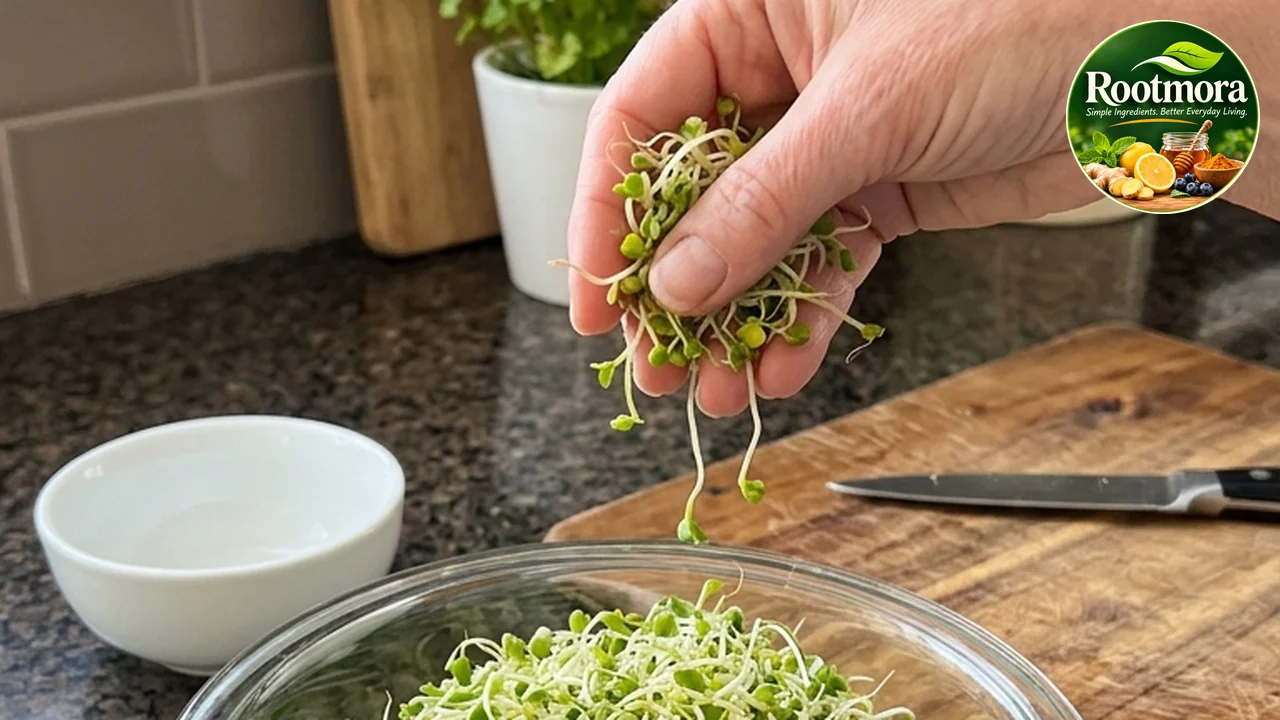
Fresh broccoli sprouts can produce sulforaphane when you chop or chew them. The sprouts store a precursor in their cells, and breaking those cells starts a natural reaction that researchers are studying for its role in cellular defense processes. The Rootmora post called it a fascinating little secret hiding in everyday food, and the kitchen method is simple: chop, rest, and eat.
This guide to broccoli sprouts sulforaphane explains what happens when you take a knife to a handful of sprouts, why a short rest on the counter matters, and how to turn them into a chopped topping for salads, toast, and bowls. You will also find a short home jar-sprouting method and FDA food-safety advice. This article is for general nutrition and cooking information only. It is not medical advice, and broccoli sprouts are not a treatment or cure for any disease.
If you like simple, fresh toppings, this mix is lovely over avocado toast. A spoonful can also go into a blender drink, in the same spirit as our carrot orange ginger juice.
Affiliate Disclosure: As an Amazon Associate I earn from qualifying purchases. Product links in this article may earn a commission at no additional cost to you.
What’s in This Post
- What Are Broccoli Sprouts and Sulforaphane?
- What Happens When You Chop or Chew Them
- The Chop-and-Rest Method
- How Heat Affects Sulforaphane
- A Note on Food Safety
- How to Make Chopped Broccoli Sprout Topping
- Helpful Tools
- How to Grow Broccoli Sprouts at Home
- Storage
- FAQ
What Are Broccoli Sprouts and Sulforaphane?
Broccoli sprouts are very young broccoli plants, often only a few days old, with slender white stems and tiny green leaves. They taste mildly peppery, closer to a radish than to a steamed floret, and a small handful goes a long way as a topping.
Sulforaphane is not sitting in the intact sprout, waiting to be eaten. The plant stores a stable precursor called glucoraphanin, a type of glucosinolate. An enzyme called myrosinase is stored separately in the tissue. When the cells are damaged, the two meet, and myrosinase can convert glucoraphanin into sulforaphane, an isothiocyanate. The Linus Pauling Institute at Oregon State University explains this pathway clearly and notes that three-day-old broccoli sprouts are a concentrated source of glucoraphanin, with 10 to 100 times more, by weight, than mature broccoli plants. That figure comes from a 1997 Johns Hopkins study led by Jed Fahey, Yuesheng Zhang, and Paul Talalay.
Researchers have been studying sulforaphane for decades, including how it may influence enzymes involved in the body’s processing of certain chemicals. Human evidence is still developing. The same Linus Pauling Institute review notes that although higher intakes of cruciferous vegetables have been associated with a lower risk for some cancers, there is insufficient evidence that isothiocyanates from those vegetables decrease cancer risk. Enjoy sprouts as a fresh, flavorful food, not as a remedy.
What Happens When You Chop or Chew Them
As long as the sprouts are whole, glucoraphanin and myrosinase stay apart. Chopping, crushing, blending, or thorough chewing breaks the cell walls so the enzyme and its substrate can mix. That is why the Rootmora reel focuses on a chef’s knife and a cutting board rather than on a long cooked recipe. The chopping is the method.
Chewing matters too. In a Johns Hopkins clinical study, volunteers who chewed fresh broccoli sprouts thoroughly excreted more sulforaphane metabolites than those who swallowed the same sprouts with little chewing. If you add whole sprouts to a sandwich and barely chew them, you still get a pleasant crunch, but you give the enzyme less of a chance to work. Chopping in advance does some of that work for you.
The Chop-and-Rest Method
Once the sprouts are chopped, the enzyme reaction can continue in the bowl. A practical approach is to chop them, spoon them into a small bowl, and let them rest at room temperature for 40 minutes before you eat them or add them to a warm dish. Nutrition educators often call a similar approach for mature broccoli “hack and hold” or “chop and rest.” The idea is to give myrosinase time to work while it is still active.
Two honest caveats belong here. First, 40 minutes is a commonly recommended window, not a magic number from a single stopwatch study of sprouts; conversion can vary, and some dietitians describe a broader range of about 10 to 40 minutes. This recipe uses 40 minutes because it is easy to remember and still sits inside the usual two-hour room-temperature window for perishable food. Second, if you plan to eat the sprouts raw, chopping or thorough chewing already starts the reaction, and the rest is a helpful extra step rather than a requirement. The rest becomes especially useful if the chopped sprouts will later meet heat, because heat can shut the enzyme down.
How Heat Affects Sulforaphane
Myrosinase is heat-sensitive. The Linus Pauling Institute notes that cooking cruciferous vegetables inactivates the enzyme and prevents the plant from forming isothiocyanates, although light steaming for less than about five minutes can preserve some activity. Boiling is generally a poorer choice if the goal is to keep this reaction going, because the enzyme is lost quickly and some of the water-soluble precursor can leach into the cooking water.
Research on mature broccoli, including work from Elizabeth Jeffery’s group at the University of Illinois, has also found that brief steaming (about 1 to 3 minutes in one study) can sometimes favor sulforaphane over a less useful related product, while longer or harsher cooking works against you. That is a nuance for florets you plan to cook, not a reason to cook these delicate sprouts as a default. Broccoli sprouts are usually eaten raw, which keeps the plant enzyme available. If you fold chopped sprouts into a warm grain bowl, chop and rest them first, then stir them in off the heat. A research-backed backup, also discussed by Jeffery, is to add a raw myrosinase source such as a pinch of mustard powder, or a little raw radish, arugula, or wasabi, to a dish whose own enzyme has been lost to cooking.
A Note on Food Safety
Raw sprouts need a little extra care. They are grown in warm, humid conditions that are also friendly to bacteria such as Salmonella, Listeria, and E. coli. The FDA’s guidance on selecting and serving produce safely explains that if only a few harmful bacteria are present in or on the seed, they can grow to high levels during sprouting, even when you grow sprouts at home under clean conditions.
Children, older adults, pregnant people, and anyone with a weakened immune system should avoid raw or lightly cooked sprouts of any kind, including broccoli sprouts. For those groups, the safer choice is to skip raw sprouts or to cook them thoroughly. The FDA also makes this point in its food-safety advice for pregnancy, and notes that restaurant sandwiches and salads sometimes include raw sprouts, so it is worth asking before you order.
For everyone else, practical habits still help. Choose sprouts that are kept refrigerated, check that they look fresh, and get them into your own refrigerator promptly. Rinse them thoroughly under cold running water before you chop them. Do not wash produce with soap, detergent, or a commercial produce wash. Refrigerate leftovers within 2 hours, and throw out sprouts that look slimy, smell off, or have turned brown or dark in spots.
How to Make Chopped Broccoli Sprout Topping
This is a five-minute prep recipe with a 40-minute rest, sized for two modest servings of topping. It stays faithful to the Rootmora reel: rinse, chop on a board with a chef’s knife, spoon into a small bowl, and rest before you eat. You will need 2 cups (about 4 oz / 112 g) of fresh broccoli sprouts. Optional, for serving, are a pinch of kosher salt, a squeeze of lemon, and 1 teaspoon of extra-virgin olive oil, in the same simple spirit as our carrots with olive oil. Spoon the finished topping over salads, grain bowls, or avocado toast (see also our notes on the best seasonings for avocado), or blend a small spoonful into a smoothie.
Step 1: Rinse and drain the sprouts
Place the sprouts in a colander or the basket of a salad spinner and rinse them thoroughly under cold running water. Drain well, or spin them dry so they are not waterlogged when you chop them. Wet sprouts smear on the board and dull the knife. Pick out any loose hulls or yellowed bits.
Step 2: Chop them finely
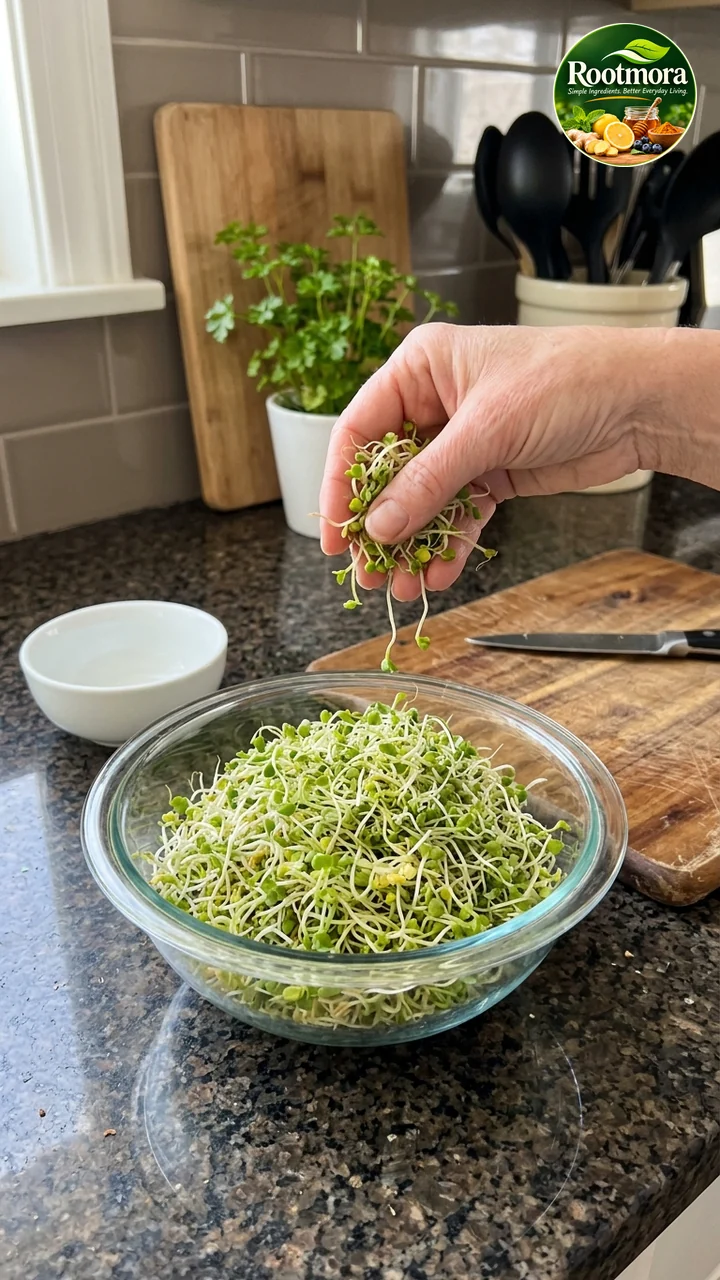
Pile the well-dried sprouts on a wooden cutting board and chop them with a sharp chef’s knife, using a gentle rocking motion. Keep going until the stems and leaves are in small pieces and the pile looks like a fine green relish. You do not need a paste, just a thorough chop so plenty of cells are broken. A dull knife crushes the stems instead of cutting them cleanly.
Step 3: Spoon into a small bowl
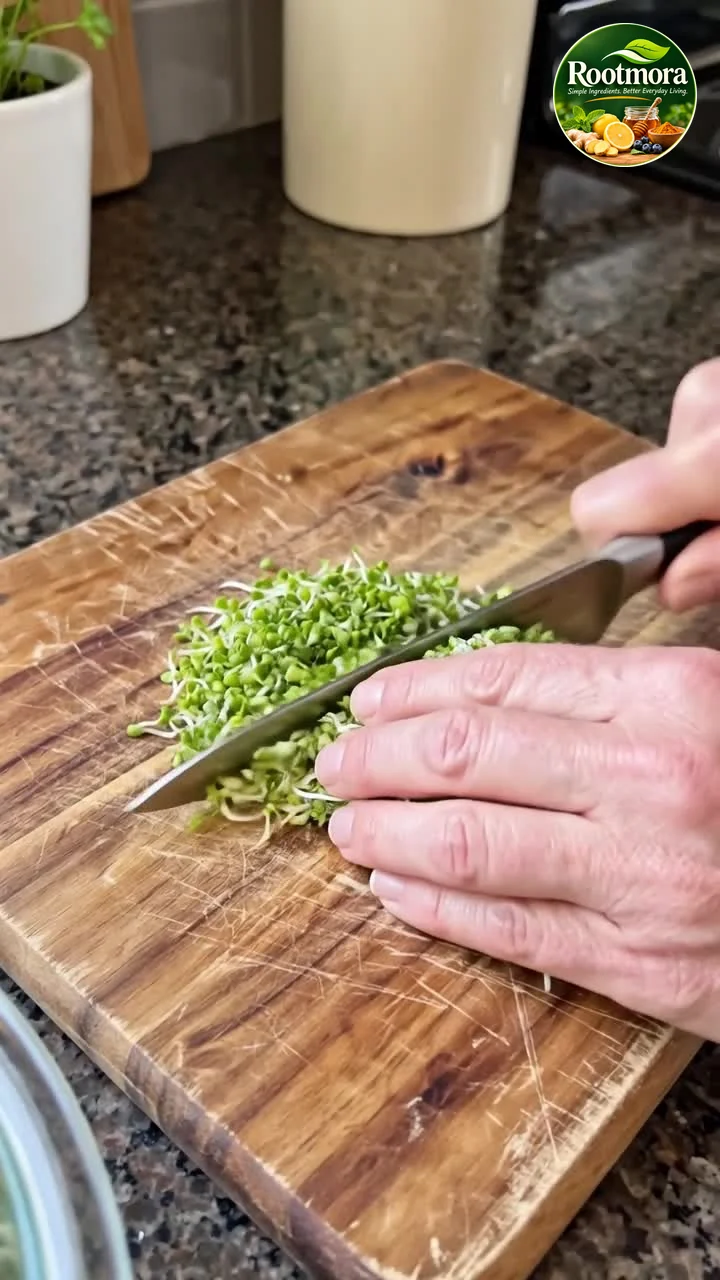
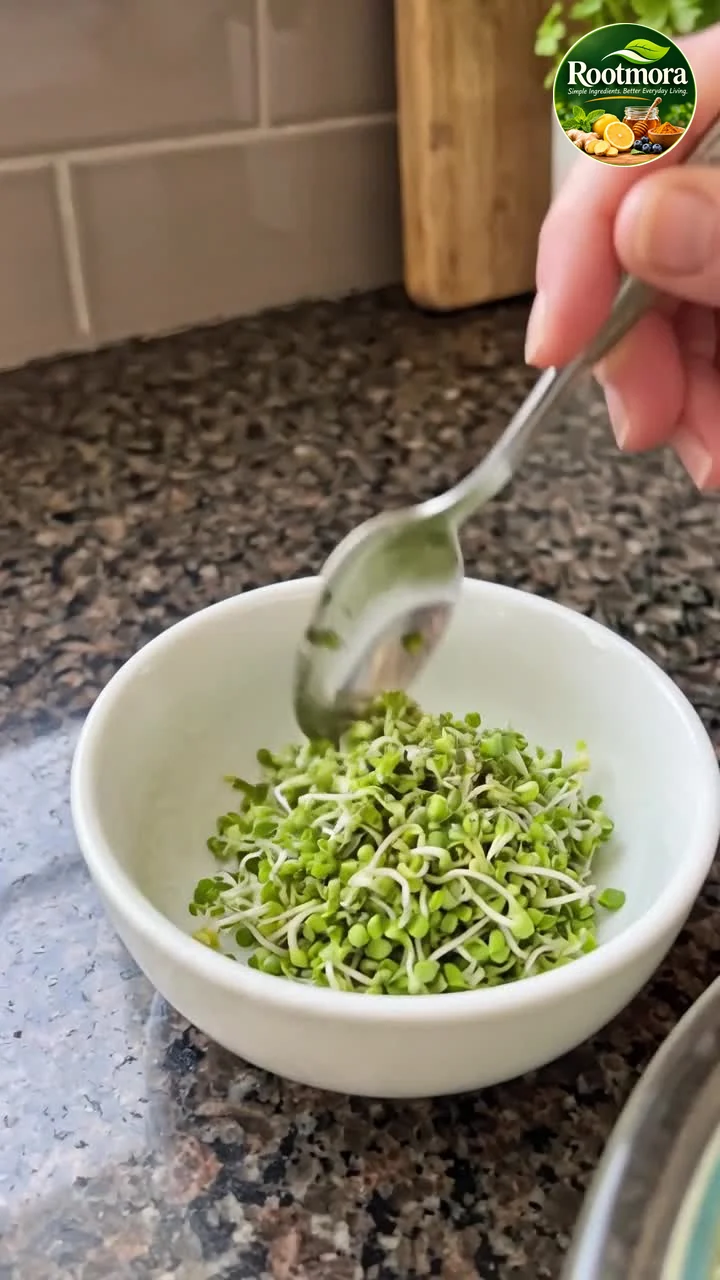
Use a spoon to transfer the chopped sprouts to a small shallow bowl. This is the same move shown in the reel, and it keeps the sprouts together for the rest instead of leaving them spread out on the board.
Step 4: Let them rest, then serve
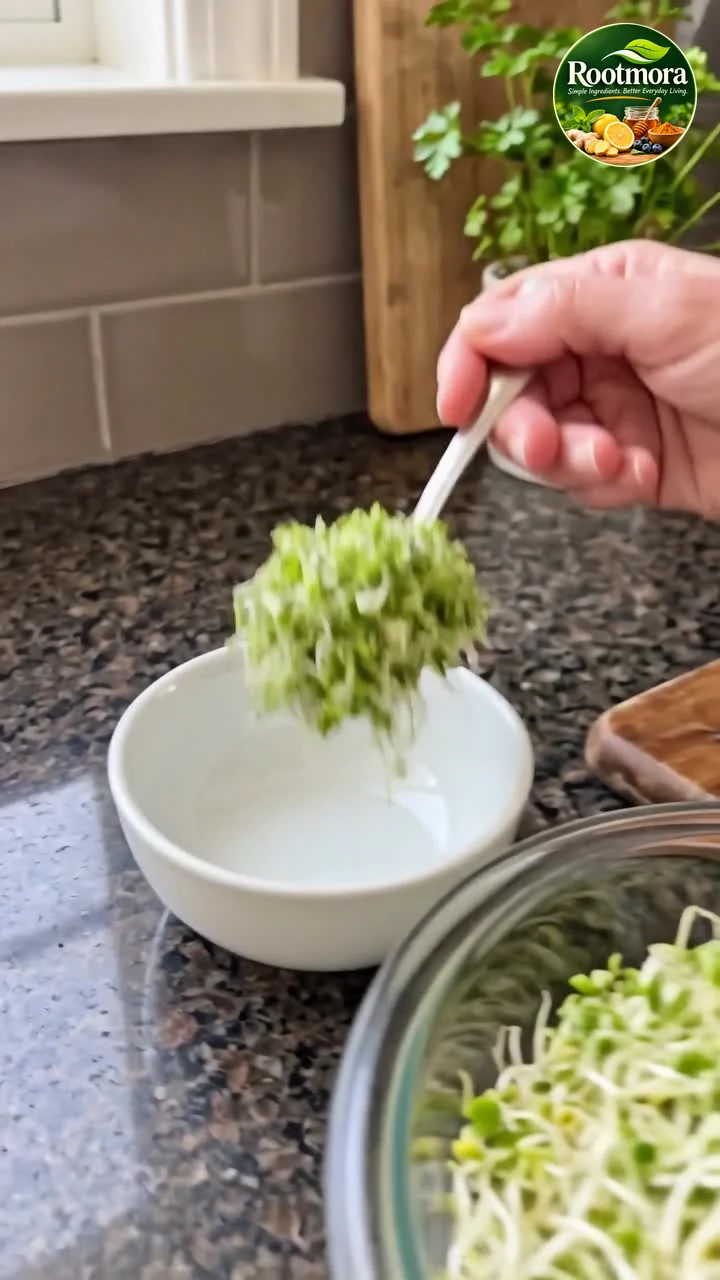
Leave the bowl at room temperature for 40 minutes. Then taste. Add a pinch of salt, a squeeze of lemon, and a teaspoon of olive oil if you like, and spoon the topping over salads, toast, or bowls. Refrigerate anything you are not eating within 2 hours.
Helpful Tools
You can make this topping with an ordinary knife, board, and bowl. A few sturdy tools just make the work cleaner, and they also cover the jar method later in the post.
- A sharp Victorinox Wood 8-Inch Chef’s Knife makes a fine chop without bruising the sprouts.
- A Freshware bamboo cutting board set gives you a dedicated board for fresh produce.
- A Pyrex glass mixing bowl set is useful for rinsing, resting, and storing, and it matches the clear bowl in the post.
- An OXO Good Grips salad spinner dries the sprouts quickly after rinsing so they chop cleanly.
- A Handy Pantry sprouting kit (a quart mason jar plus a wide-mouth strainer lid) is a simple way to start the jar method. The packet in this kit is a mixed sprouting blend, so use broccoli sprouting seeds when that is the crop you want.
- Handy Pantry organic broccoli sprouting seeds are sold specifically for sprouting, which is what you want, rather than garden seeds that may be treated for planting only.
How to Grow Broccoli Sprouts at Home
You do not have to grow your own sprouts to make the topping. Grocery-store sprouts work, as long as they have been kept refrigerated and look fresh. If you do want a jar on the counter, the mason-jar method is the usual home approach. The steps below follow university extension guidance from the University of Vermont and a broccoli-sprouting guide from Oregon State University’s Moore Family Center.
Use seeds sold for sprouting, not ordinary garden seeds. Wash a wide-mouth pint mason jar and a mesh sprouting lid (or cheesecloth and a rubber band) in hot, soapy water and rinse well. Oregon State also recommends sanitizing the seeds first: soak 1 tablespoon of seeds in a diluted unscented bleach solution (1/4 teaspoon of 8.25% bleach in a pint jar of water) for 20 to 30 minutes, or in undiluted white vinegar for 15 minutes, then rinse thoroughly until no bleach or vinegar smell remains. Never mix bleach and vinegar.
After the rinse, soak 1 tablespoon of seeds in a pint jar (or 2 tablespoons in a quart jar) with cool water for 8 to 12 hours at room temperature, out of direct sun. Drain well. Then rinse and drain twice a day, morning and night, for 3 to 6 days. After each rinse, invert the jar and prop it at an angle in a bowl so water can keep dripping out. The seeds should stay damp, never sitting in a puddle. Keep the jar at room temperature, out of direct sunlight; some guides tuck it in a cupboard.
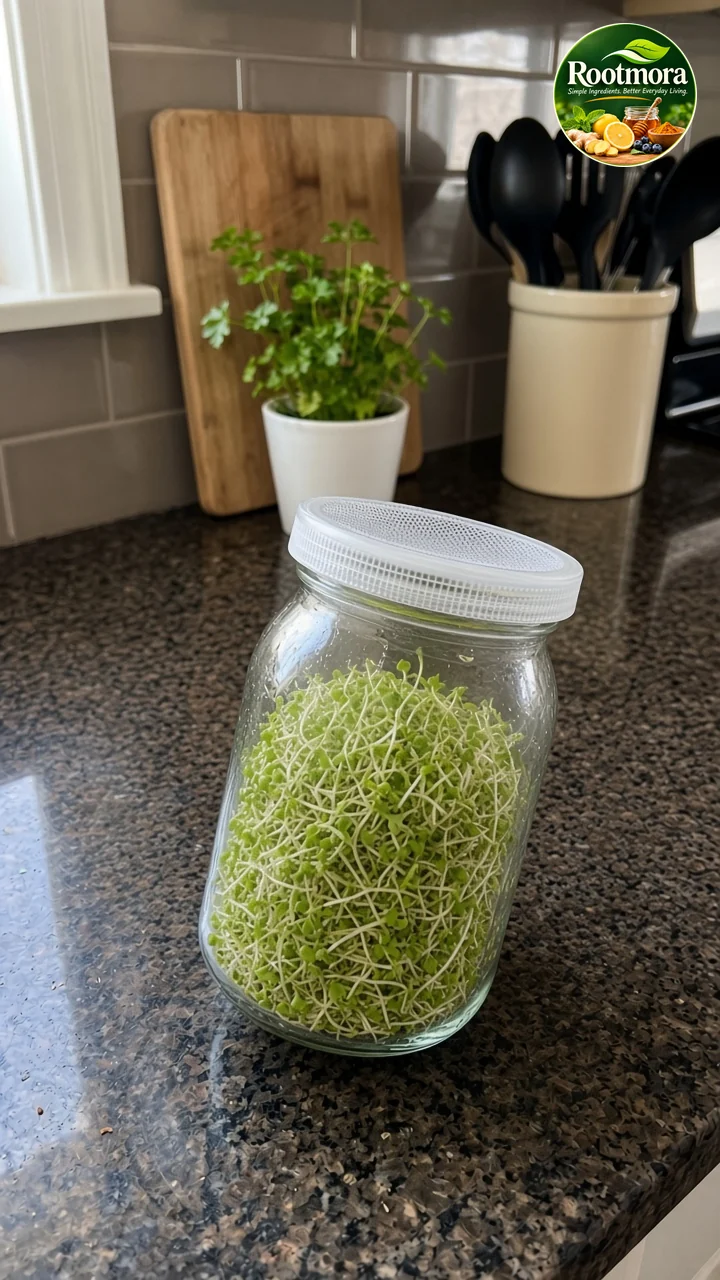
The sprouts are ready when they have small green leaves and the seed hulls start to loosen, usually in 3 to 6 days. Research on glucoraphanin often used 3-day-old sprouts, which are more concentrated by weight than older, leafier grocery sprouts; either can be used here. Soak the finished sprouts in a bowl of water, skim off loose hulls, drain, and dry them on a clean towel for 5 to 10 minutes. Refrigerate in a clean, covered container and use within 3 to 5 days. Discard the batch if it turns slimy, dark, or off-smelling. Home-grown sprouts are still raw sprouts, so the FDA warning still applies, and high-risk groups should not eat them raw.
Storage
Store unchopped sprouts in the refrigerator, ideally in their original ventilated container or a loosely covered bowl lined with a dry paper towel. Use them while they still smell fresh and the stems look plump, usually within a few days of bringing them home. After chopping, refrigerate leftovers within 2 hours and eat them within 1 to 2 days for the best texture. The topping does not freeze well; the sprouts turn limp and watery. Do not leave chopped sprouts out for more than 2 hours (or 1 hour if the room is hotter than 90°F).
FAQ
What is sulforaphane, in plain language?
It is a sulfur-containing compound that can form when glucoraphanin in broccoli and broccoli sprouts is broken down by the enzyme myrosinase. Researchers are studying it; it is not a medicine, and this article is not medical advice.
Should broccoli sprouts be eaten raw or cooked?
They are usually eaten raw, which keeps the plant enzyme active. If you add them to a hot dish, chop and rest them first, then stir them in off the heat. People at higher risk of foodborne illness should avoid raw or lightly cooked sprouts and cook sprouts thoroughly, or choose a different food.
Do I have to rest them for a full 40 minutes?
No, but it is a useful, widely recommended window, especially before any heat. If you are eating them raw right away, chopping or thorough chewing already starts the reaction. If you are short on time, even a shorter rest is more helpful than none.
Can I use store-bought sprouts instead of growing them?
Yes. The topping recipe starts with already-grown sprouts. Choose a refrigerated package, rinse well, and use them while they are fresh. Home growing is optional.
Does this method work with regular broccoli too?
The same chemistry applies to mature broccoli: chop or chew to bring glucoraphanin and myrosinase together, and rest before cooking if you want the enzyme to work first. Mature broccoli has much less glucoraphanin, by weight, than young sprouts, so the two foods are not a cup-for-cup swap. Brief steaming is a better cooking method than a long boil if you are preparing florets.
Print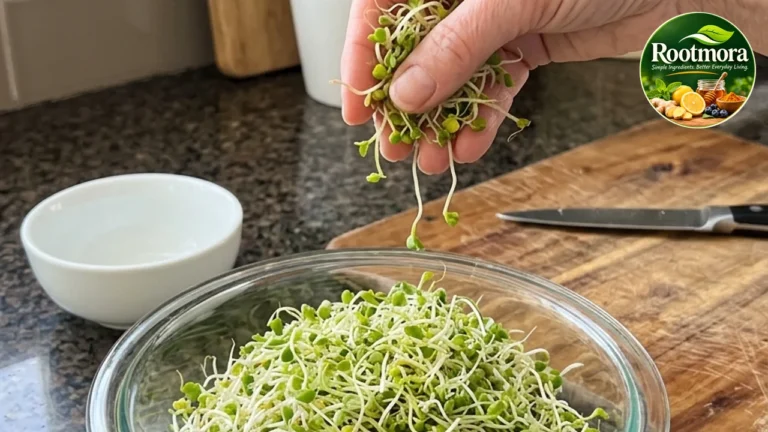
Chopped Broccoli Sprout Topping
A simple no-cook topping: finely chopped broccoli sprouts, rested so the natural enzyme reaction can take place, then spooned over salads, toast, and bowls.
- Total Time: 45 minutes
- Yield: 2 servings
Ingredients
2 cups (about 4 oz / 112 g) fresh broccoli sprouts
Optional, for serving:
Pinch of kosher salt
Squeeze of lemon
1 teaspoon extra-virgin olive oil
Instructions
Rinse the sprouts thoroughly under cold running water. Drain well, or spin them dry in a salad spinner, and pick out any loose hulls or yellowed bits.
Pile the sprouts on a cutting board and chop them finely with a chef’s knife until the stems and leaves are in small pieces.
Spoon the chopped sprouts into a small bowl.
Let them rest at room temperature for 40 minutes. Taste, then add salt, lemon, and olive oil if you like. Spoon over salads, avocado toast, grain bowls, or blend a small spoonful into a smoothie. Refrigerate leftovers within 2 hours.
Notes
The 40-minute rest gives the plant enzyme myrosinase time to convert glucoraphanin into sulforaphane. If you will add the sprouts to a warm dish, this rest is especially useful; stir them in off the heat.
If you already applied heat and want a backup source of the enzyme, a pinch of raw mustard powder (or a little raw radish, arugula, or wasabi) can help. This does not change the food-safety advice below.
Children, older adults, pregnant people, and anyone with a weakened immune system should avoid raw or lightly cooked sprouts. For those groups, cook sprouts thoroughly or choose a different food. This recipe is not medical advice, and broccoli sprouts do not prevent or treat disease.
Choose sprouts that have been kept refrigerated, rinse them under running water (do not use soap), and discard any that are slimy, off-smelling, or discolored.
Nutrition is an estimate for one serving of sprouts only (half of the recipe). Optional salt, lemon, and olive oil are not included.
- Prep Time: 5 minutes
- Additional Time: 40 minutes
- Cook Time: 0 minutes
- Category: Side Dish
- Method: No-Cook
- Cuisine: American
- Diet: Vegan