
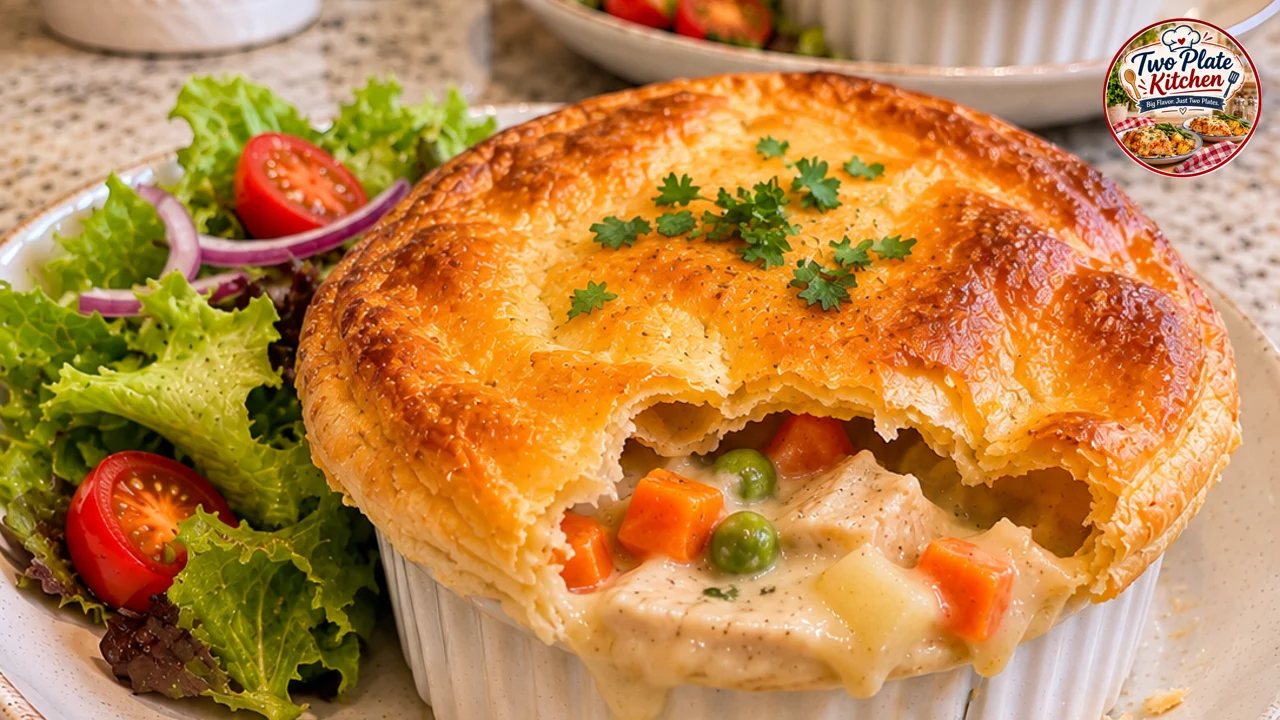
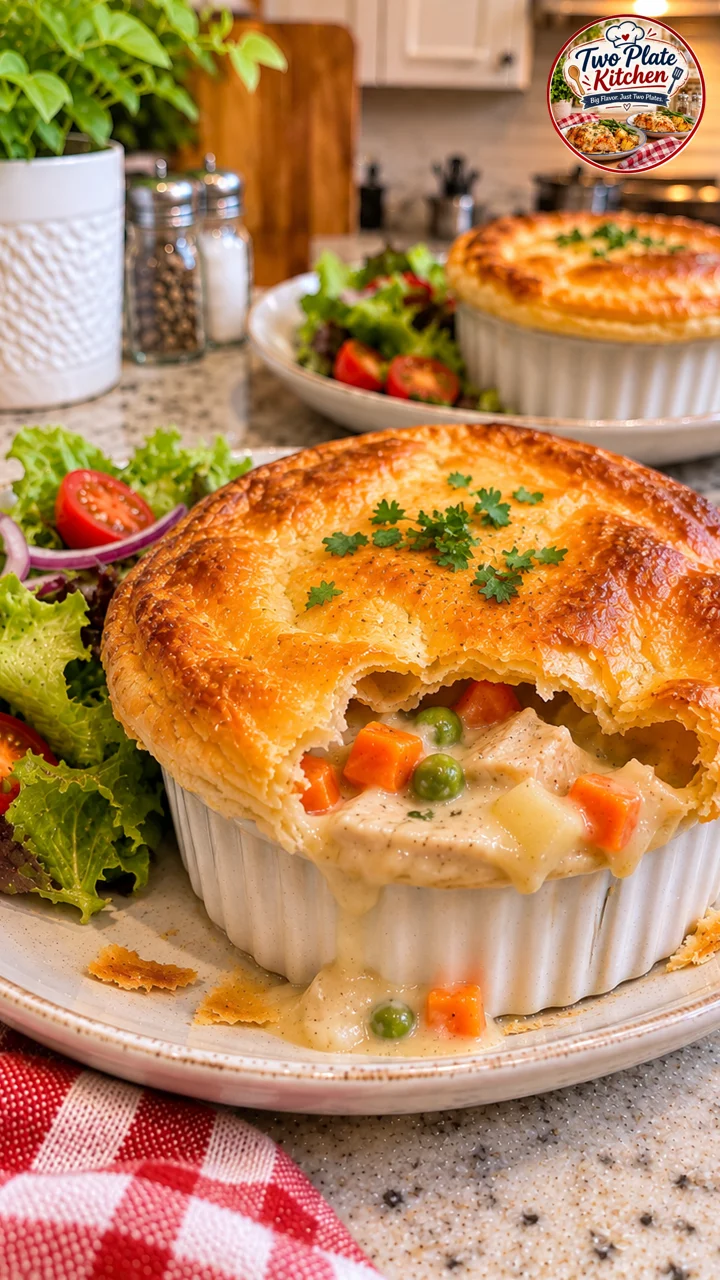
Mini chicken pot pies for two turn a little cooked chicken and a handful of vegetables into a cozy dinner with a golden, flaky top. Under each puff pastry lid is a creamy filling of chicken, carrots, potatoes, peas, and thyme. A simple green salad keeps the plate fresh without adding another cooked side.
This is the small-batch comfort food shown in the Two Plate Kitchen post: two individual white ramekins, two pastry lids, and just enough filling for a dinner together. There is no bottom crust to roll or blind-bake. Crack through the top at the table and spoon the pastry into the warm sauce.
The written guide builds on the supplied recipe with fuller timing, pastry handling, and temperature checks. The reference images show the intended presentation, not proof of a kitchen-tested batch. Ingredient brands, ramekin dimensions, and ovens vary, so use the practical doneness checks below.
Ingredients for Mini Chicken Pot Pies for Two
The printable recipe card gives the complete quantities, including the side salad. Most of the filling uses small amounts you can measure without opening several cans or preparing a large casserole.
- Cooked chicken breast: weigh out 8 ounces after cooking. Dice it into bite-size pieces. Leftover roast chicken or plain rotisserie-style chicken works if it has been stored safely; taste before adding salt.
- Carrots and potatoes: use 1/3 cup of each, cut into roughly 1/4-inch dice. Their short preliminary simmer matters because the pastry can brown before large raw vegetable chunks soften.
- Peas: 1/4 cup thawed frozen peas adds color and sweetness. They go into the filling near the end.
- Onion, butter, and flour: a small amount of onion builds flavor. One tablespoon each of butter and flour makes the base for a light cream sauce.
- Broth and milk: 1/2 cup low-sodium chicken broth and 1/4 cup whole milk make a modest amount of sauce. Start with these quantities; do not dilute it until it looks like soup.
- Thyme and seasoning: 1/4 teaspoon dried thyme is enough for this small batch. Season after considering how salty the cooked chicken and broth already are.
- Puff pastry and egg wash: keep the pastry thawed but cold. An egg beaten with a teaspoon of water gives the lid its gloss; you will not need to use every drop.
Choose the Dishes Before Cutting the Pastry
Use two 16-fluid-ounce oven-safe ramekins for comfortable headroom with this chicken-and-vegetable mixture. A nominal 10-ounce dish is smaller, and filling it to the brim leaves little room for bubbling. Capacity labels do not tell you the exact rim diameter or usable fill line.
Keep the filling about 1/2 inch below each rim. If your dishes hold less, reserve the excess filling rather than forcing it under the pastry. Ramekins must be rated for the oven temperature, and any storage lids stay out of the oven. Follow the dish manufacturer’s instructions about temperature changes.
Have one full puff pastry sheet available, usually about 8–9 ounces, and cut only what the two lids require. Do not assume half a sheet will fit every pair of ramekins. Measure the outside rims and make each pastry round about 1/2 inch wider than its dish. Save the remaining pastry according to its package directions.
Useful Equipment
Affiliate Disclosure: As an Amazon Associate I earn from qualifying purchases. Product links may earn a commission at no additional cost to you.
- 16-ounce oven-safe ramekins are a similar option for individual portions. Select the 16-ounce size and check the current oven rating and usable dimensions; the linked dishes are not claimed to be the exact ones photographed.
- A rimmed baking sheet supports both hot dishes and catches drips. You need only one sheet for this recipe; the linked option is a two-pack.
- A 2-quart saucepan is useful for briefly simmering the diced carrots and potatoes. Drain them before they go into the sauce.
- A small silicone pastry brush applies a thin, even egg wash without soaking the pastry edges.
- An instant-read food thermometer checks the center of the filling through the steam vent. This is more dependable than judging safety by crust color.
You will also need a small skillet, whisk or spoon, cutting board, sharp knife, measuring cups, a rolling pin if the pastry needs a light adjustment, and oven mitts. Use the tools you already have when they serve the same purpose.
How to Make Mini Chicken Pot Pies for Two
1. Start with Cooked Chicken and Cold, Thawed Pastry
This recipe starts with fully cooked chicken, not raw diced breast. Cooking raw chicken would be an additional step with additional time. If using leftovers, keep their original cooking date in mind before you start.
Thaw the pastry following the package. The manufacturer’s puff pastry handling guide explains that it should unfold easily while still cold; refrigerator thawing can take about 4 hours. Thawing is extra time when you begin with a frozen sheet. Keep the pastry chilled while preparing the filling.
Preheat the oven to 400°F (205°C). Place the two ramekins on a rimmed sheet so you can move them together. Check that the sheet sits level and both dishes fit comfortably without touching each other.
2. Simmer the Firm Vegetables
Put the finely diced carrots and potatoes in a small saucepan with enough lightly salted water to cover. Bring to a boil, then simmer for approximately 6–8 minutes. A knife should enter a piece with only slight resistance; the vegetables should not be hard in the center.
Drain thoroughly. Water clinging to the vegetables can loosen the small amount of sauce, so give them a moment to steam dry in the strainer. Larger pieces need longer than small dice, which is why consistent cutting helps.
3. Build the Creamy Filling
Meanwhile, melt the butter in a skillet over medium heat. Add the diced onion and cook for 2–3 minutes until softened. Sprinkle in the flour and stir for about 1 minute so it coats the onion and fat evenly.
Add the broth gradually, stirring or whisking as you go, then stir in the milk. Add the thyme and a little salt and pepper. Simmer gently for 2–3 minutes, stirring, until the sauce coats the spoon lightly. It should be creamy and spoonable rather than thick enough to stand in a mound.
Fold in the cooked chicken, well-drained potatoes and carrots, and thawed peas. Heat for another 1–2 minutes, then take the skillet off the burner. If the sauce has reduced too much, add broth a teaspoon at a time. Avoid adding a large splash that makes the filling watery.
4. Let the Steam Settle, Then Add the Lids
Let the filling stand for about 10 minutes, until warm rather than steaming vigorously. This short pause helps keep the pastry cold during assembly. Do not leave the chicken filling sitting out for an extended period, and keep the pastry in the refrigerator until you need it.
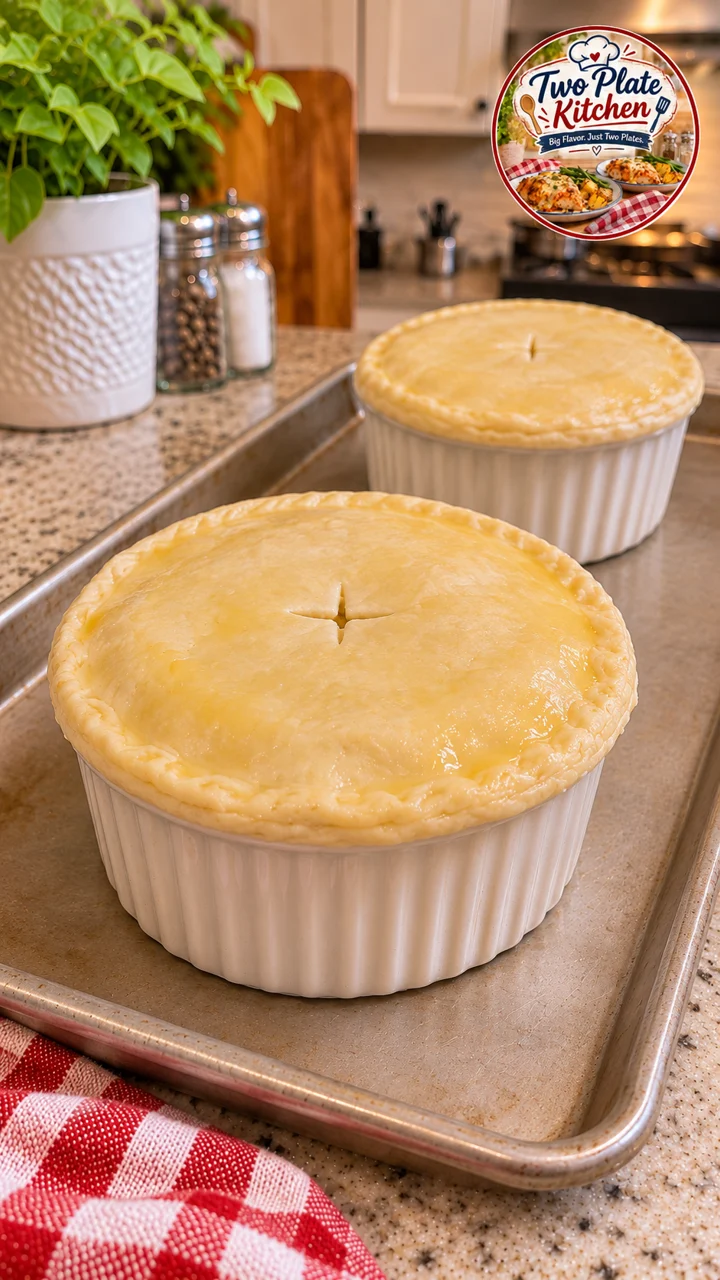
Divide the filling between the ramekins, leaving the headroom described above. On a lightly floured surface, unfold the pastry and gently roll only as much as needed for the two rounds. Avoid stretching it paper-thin or pressing hard along the cut edges, which can restrict the layers.
Brush a little egg wash on each ramekin rim, lay the pastry over it, and press gently to secure. Cut a small cross or slit in the middle of each lid. Brush the tops lightly with egg wash, keeping heavy drips off the exposed pastry edges. Discard unused egg wash after assembly.
5. Bake Until the Pastry and Filling Are Ready
Bake on the center rack for about 25–30 minutes, checking from 20 minutes. The lids should be well risen and deeply golden, with cooked layers beneath the surface. Pale, soft dough under a browned top needs more time.
Check the center of each filling with an instant-read thermometer inserted through the vent, without touching the dish. It needs to reach 165°F (74°C). If the pastry is ready first, cover it loosely with foil and continue baking. A longer bake may be needed if the filling started colder or your ramekins are unusually deep.
The FDA’s safe food handling guidance lists 165°F for leftovers and casseroles. A golden lid and bubbling edges are useful cooking cues, but they do not replace a center-temperature check.
6. Rest and Add the Salad
Let the pies rest for 5 minutes. Toss 2 cups mixed lettuce, 4 halved cherry tomatoes, and a few thin red onion slices with 1 teaspoon each olive oil and lemon juice. Dress the salad shortly before serving so it stays crisp.
Use oven mitts to set each ramekin on a heat-safe dinner plate. Add the salad alongside and, if you like, scatter a little chopped parsley over the pastry. The ramekins and filling stay hot well after the sheet leaves the oven, so warn anyone taking a first bite.
Realistic Timing and Common Fixes
Allow approximately 1 hour 15 minutes to 1 hour 20 minutes from prepared ingredients to serving: 20 minutes preparation, about 15 minutes stovetop work, 10 minutes for the filling’s steam to settle, 25–30 minutes baking, and 5 minutes resting. The recipe card uses the longer estimate. Vegetable cooking and sauce preparation can partly overlap, but that does not turn the full recipe into a 25-minute cook.
These times assume cooked chicken and already-thawed pastry. They are planning estimates rather than a timed kitchen test. Add time for either task if you have not done it, and follow temperature and pastry doneness rather than stopping at an exact minute.
| Problem | Better approach |
|---|---|
| Filling bubbles over heavily | Use adequately sized dishes and leave about 1/2 inch of headroom. |
| Carrots or potatoes stay firm | Cut small, even pieces and simmer nearly tender before assembling. |
| Pastry slumps or rises poorly | Keep it cold, handle gently, and avoid a strongly steaming filling during assembly. |
| Top browns before the center is hot | Tent loosely with foil and continue until each center reaches 165°F. |
| Sauce is thin | Drain vegetables well and simmer the flour-based sauce before adding chicken. |
Make-Ahead and Leftovers
You can make the filling a day ahead. Transfer it promptly to a shallow container, refrigerate at 40°F or below, and use it the next day within the original chicken’s safe storage window. When ready to assemble, gently reheat the filling while stirring until it reaches 165°F, then let vigorous steaming subside before adding the cold pastry. Allow extra time for reheating and that short pause.
Refrigerate leftover pies within 2 hours, or within 1 hour when the temperature is above 90°F. Keep the salad separate. Use the pies within 3–4 days of the original chicken cooking date, or sooner if the chicken was already older. USDA guidance on leftovers recommends shallow containers and a 3–4 day refrigerated window; baking leftover chicken again does not give it a new storage clock.
Reheat until the center reaches 165°F, protecting the pastry loosely with foil if needed. An oven generally preserves the lid better than a microwave, which softens it. For longer storage, freeze the filling alone for up to 2 months for best quality, thaw it in the refrigerator, and reheat before assembling fresh pastry lids. Do not put a chilled ceramic dish directly into a hot oven unless its manufacturer allows that temperature change.
Frequently Asked Questions
Can I use raw chicken?
Not directly in this filling. The written recipe calls for 8 ounces of fully cooked chicken. Cook raw chicken separately to 165°F, then dice and measure it. Its cooking and handling time is additional to the stated schedule.
Can I use frozen mixed vegetables?
You can substitute a similar amount of suitable vegetables, but their cooking needs vary. Thaw and drain them, and cook any firm pieces before adding them to the filling. Avoid pouring ice or excess thawing liquid into the sauce.
Is there pastry underneath the filling?
No. These pies have puff pastry lids only, which keeps the small-batch method simpler. Adding an unbaked bottom crust would change the method and could leave damp dough beneath the filling.
Can I use pie dough instead of puff pastry?
Pie dough gives a different, less layered crust. Follow its own thickness and baking instructions while still checking that the chicken filling reaches 165°F. The timing given here is for puff pastry, so do not assume the same bake applies.
What should I do with leftover pastry?
Keep unused pastry chilled and follow its package’s storage guidance. You can bake simple savory twists or small pastry pieces separately, using the package directions. Do not pile extra dough onto the pot pie lids; thicker layers can brown outside while staying doughy underneath.
More Dinners Sized for Two
For another comforting plate, try our garlic butter steak with mushroom gravy for two. For a vegetable-filled dinner with individual portions, see the turkey rice stuffed peppers for two. Both offer a different way to make dinner feel complete without cooking a family-size batch.
Printable Recipe
The card includes the full filling, pastry, and salad quantities, the complete timing, and storage notes. Nutrition has not been calculated. Check the pastry and broth labels for allergens; the recipe contains wheat, dairy, and egg.
Print
Mini Chicken Pot Pies for Two with Puff Pastry
Two individual chicken pot pies with creamy chicken, carrots, potatoes, peas, and flaky puff pastry lids, served with a simple green salad. Uses fully cooked chicken and two 16-ounce oven-safe ramekins.
- Total Time: 1 hour 20 minutes
- Yield: 2 individual pot pies
Ingredients
For the filling:
8 ounces (225 g) fully cooked chicken breast, cut into bite-size pieces
1/3 cup finely diced carrots (about 1/4-inch pieces)
1/3 cup finely diced peeled potatoes (about 1/4-inch pieces)
1/4 cup frozen green peas, thawed
1/4 small yellow onion, finely diced (about 2 tablespoons)
1 tablespoon unsalted butter
1 tablespoon all-purpose flour
1/2 cup (120 ml) low-sodium chicken broth
1/4 cup (60 ml) whole milk
1/4 teaspoon dried thyme
Salt and freshly ground black pepper, to taste
For the pastry:
1 sheet frozen puff pastry (about 8–9 ounces), thawed but cold; use enough for two lids and save the offcuts
All-purpose flour, for lightly dusting the work surface
1 small egg, beaten with 1 teaspoon water
For serving:
2 cups mixed lettuce, washed and dried
4 cherry tomatoes, halved
A few thin red onion slices
1 teaspoon olive oil
1 teaspoon lemon juice
1 teaspoon chopped fresh parsley, optional garnish
Instructions
1. Start with fully cooked chicken and thawed, cold puff pastry. Follow the pastry package for thawing; refrigerator thawing may take about 4 hours and is additional to the recipe time. Heat the oven to 400°F (205°C). Set two 16-fluid-ounce ramekins rated for this temperature on a rimmed baking sheet. Do not use storage lids in the oven.
2. Put the finely diced carrots and potatoes in a small saucepan and cover with lightly salted water. Bring to a boil, then simmer for 6–8 minutes, until nearly tender when pierced. Drain thoroughly.
3. Meanwhile, melt the butter in a small skillet over medium heat. Cook the onion for 2–3 minutes until softened. Stir in the flour and cook for 1 minute. Gradually whisk in the broth and milk until smooth. Add thyme and a little salt and pepper; simmer for 2–3 minutes until lightly thickened.
4. Stir in the cooked chicken, drained vegetables, and thawed peas. Heat for 1–2 minutes, stirring, then remove from the heat. Let stand for about 10 minutes, until warm rather than steaming vigorously. This cooling time is included in the total. Keep the pastry refrigerated while you wait.
5. Divide the filling between the ramekins, leaving about 1/2 inch below the rims; do not force in excess filling. On a lightly floured surface, unfold the pastry. If needed, roll gently just enough to cut two rounds about 1/2 inch wider than the outside ramekin rims, without rolling paper-thin. Use a full sheet as needed rather than assuming half will cover both dishes.
6. Lightly brush the ramekin rims with egg wash. Place a cold pastry round over each dish and press gently around the rim to secure. Cut a small cross or slit in the center of each lid. Brush the tops lightly with egg wash, avoiding heavy drips down the cut pastry edges. Discard unused egg wash.
7. Bake on the center rack for 25–30 minutes, checking from 20 minutes, until the pastry is well risen, deeply golden, and cooked through and the filling reaches 165°F (74°C) in the center of each pie. Insert an instant-read thermometer through the vent, avoiding the ramekin. If pastry browns early, tent loosely with foil and continue until the filling is hot enough. Timing varies with dish size, filling temperature, and oven.
8. Rest for 5 minutes. Toss lettuce, tomatoes, and red onion with the oil and lemon juice. Using oven mitts, set each hot ramekin on a heat-safe dinner plate with salad alongside. Garnish with parsley if desired and warn diners that the ramekins and filling remain hot.
Notes
Timing: 20 minutes preparation + approximately 15 minutes stovetop cooking + 10 minutes filling cooling + up to 30 minutes baking + 5 minutes resting = approximately 1 hour 20 minutes ready to serve. With a 25-minute bake, allow about 1 hour 15 minutes. Prep assumes thawed pastry and cooked chicken; pastry thawing and cooking raw chicken are additional. These are planning estimates, not a timed kitchen test.
Ramekins: two 16-fluid-ounce dishes give more headroom than two 10-ounce dishes for this chicken-and-vegetable filling. Actual capacity varies. Leave about 1/2 inch below each rim; refrigerate any excess filling promptly. Use only dishes rated for the oven temperature and follow their thermal-shock precautions.
Make ahead: refrigerate the cooked filling promptly in a shallow container at 40°F or below and use the next day, within the original cooked chicken’s safe storage window. Before assembling, gently reheat the filling, stirring, to 165°F; allow it to stop steaming vigorously, then add cold pastry and bake. Extra reheating/cooling time is not included in the same-day total.
Leftovers: refrigerate within 2 hours, or 1 hour above 90°F. Use within 3–4 days of the original chicken cooking date, or sooner if it was already older. Reheat the pie center to 165°F; cover pastry loosely if it darkens. Refrigerating or baking leftover chicken again does not restart its storage clock. Store salad separately. Freeze the filling alone for up to 2 months for best quality; thaw in the refrigerator and reheat before assembling.
Contains wheat, dairy, and egg; check puff pastry and broth labels for other allergens. Nutrition has not been calculated.
- Prep Time: 20 minutes
- Cook Time: 45 minutes
- Category: Dinner
- Method: Baking
- Cuisine: American