
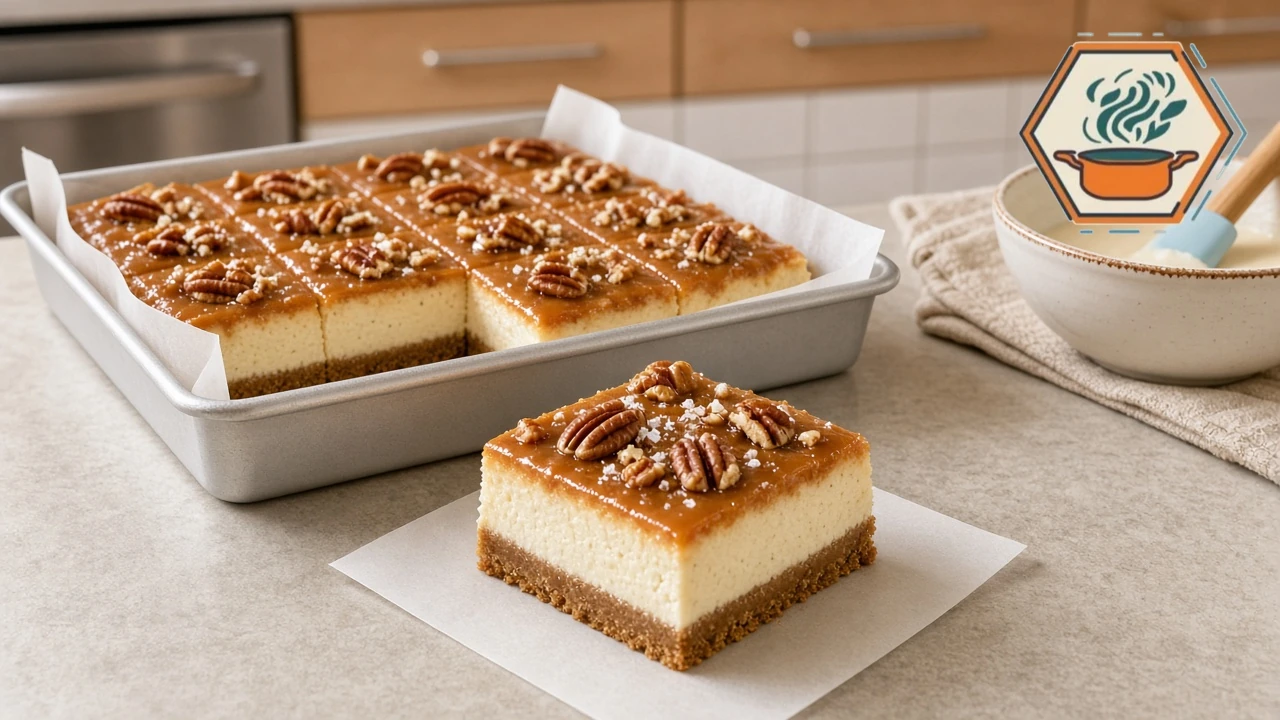
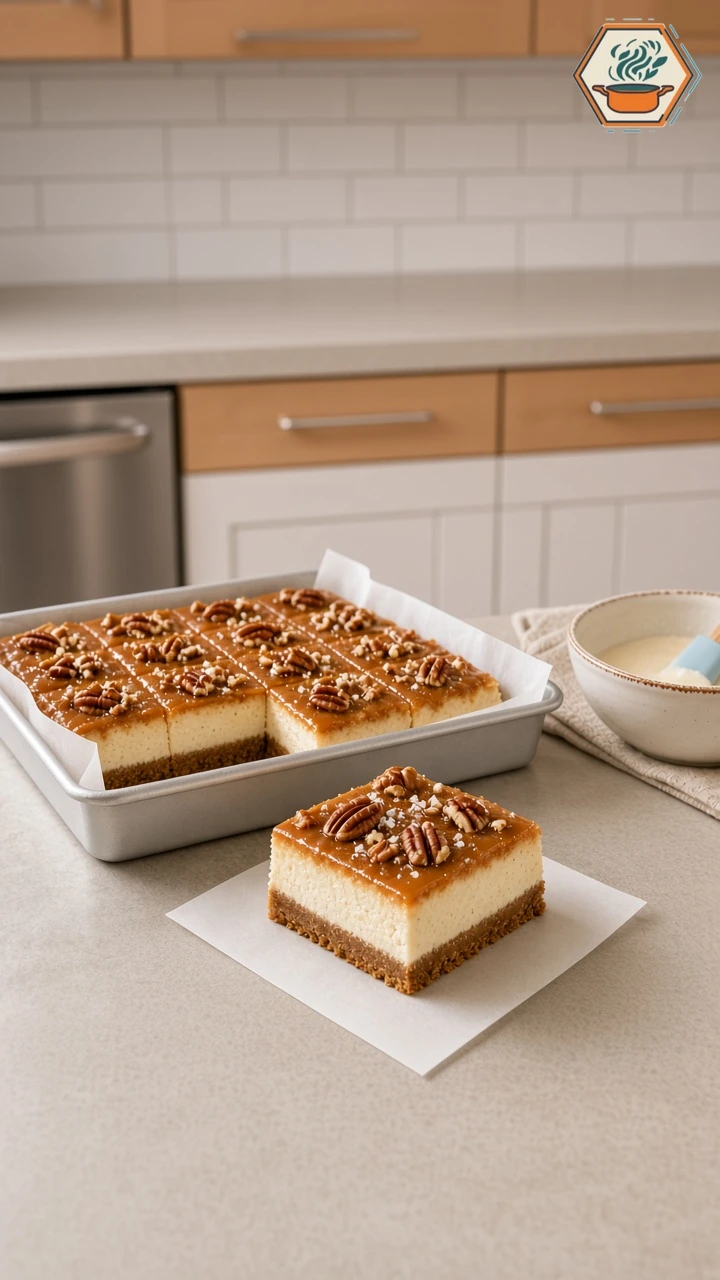
Caramel pecan cheesecake bars bring three lovely textures into one square: a buttery graham cracker base, a thick vanilla cheesecake center, and a glossy caramel topping with toasted pecans. The filling is creamy, the nuts add crunch, and a few salt flakes balance the sweetness. Corner piece or middle piece? With a little planning, you can have sixteen squares ready for either team.
This dessert is inspired by the post shared by RecipesMind.Com. No measured recipe accompanied the post, so the recipe below is an original formulation informed by established cheesecake-bar and caramel methods. It has not been kitchen-tested. Times, layer heights, and yield are estimates; use the written doneness checks rather than trying to copy a video frame.
The images are AI-generated illustrations, not photographs of a kitchen test. The video guides their visual style only.
In this article
Caramel Pecan Cheesecake: Three Layers, One Square Pan
These caramel pecan cheesecake bars are designed for a 9-inch square light-colored metal pan, at least 2 inches deep. That gives the filling room to bake gently without turning this into a tall springform cheesecake. A square pan also makes it simple to cut four rows in each direction for sixteen rich dessert portions.
The crust should be substantial enough to support a lifted square, but not so thick or compressed that it feels hard. The vanilla filling remains the main layer. Caramel and pecans supply a generous finish rather than an equally thick slab of candy. The illustrations suggest those proportions; your actual layers will vary with crumb texture and pan dimensions.
Ingredients for Caramel Pecan Cheesecake
Cream cheese: Full-fat brick-style cream cheese is the starting point for a smooth, sturdy filling. Whipped products and spreadable tubs can behave differently because of their moisture and stabilizers. Soften the cream cheese until it yields to gentle pressure, rather than trying to beat refrigerator-cold blocks into submission.
Eggs and sour cream: Eggs set the filling, while sour cream adds a little tang and softens its texture. Bring out only what you need shortly before mixing, keeping total room-temperature exposure within food-safety limits. There is no need to leave dairy or eggs on the counter all afternoon.
Graham crackers: Fine, evenly ground crumbs make a more cohesive base than a mixture of powder and large shards. Use the gram weight when possible because crumb volume changes with the brand and grind. Granulated sugar lightly sweetens the base; melted butter binds it. The card gives all quantities in one place.
Pecans and caramel: Choose fresh pecans without a stale or bitter smell. A mixture of halves and roughly chopped pieces gives each square crunch while keeping the topping easy to cut. The caramel uses real caramelized granulated sugar, butter, and heavy cream—not an egg-based pecan-pie filling.
Build a Sturdy Caramel Pecan Cheesecake Crust
For caramel pecan cheesecake, line the pan before pressing in the crumbs. A parchment sling that extends about an inch above two opposing sides lets you lift the chilled slab without turning it upside down. Keep the overhang away from oven walls and heating elements. Grease the exposed sides lightly.
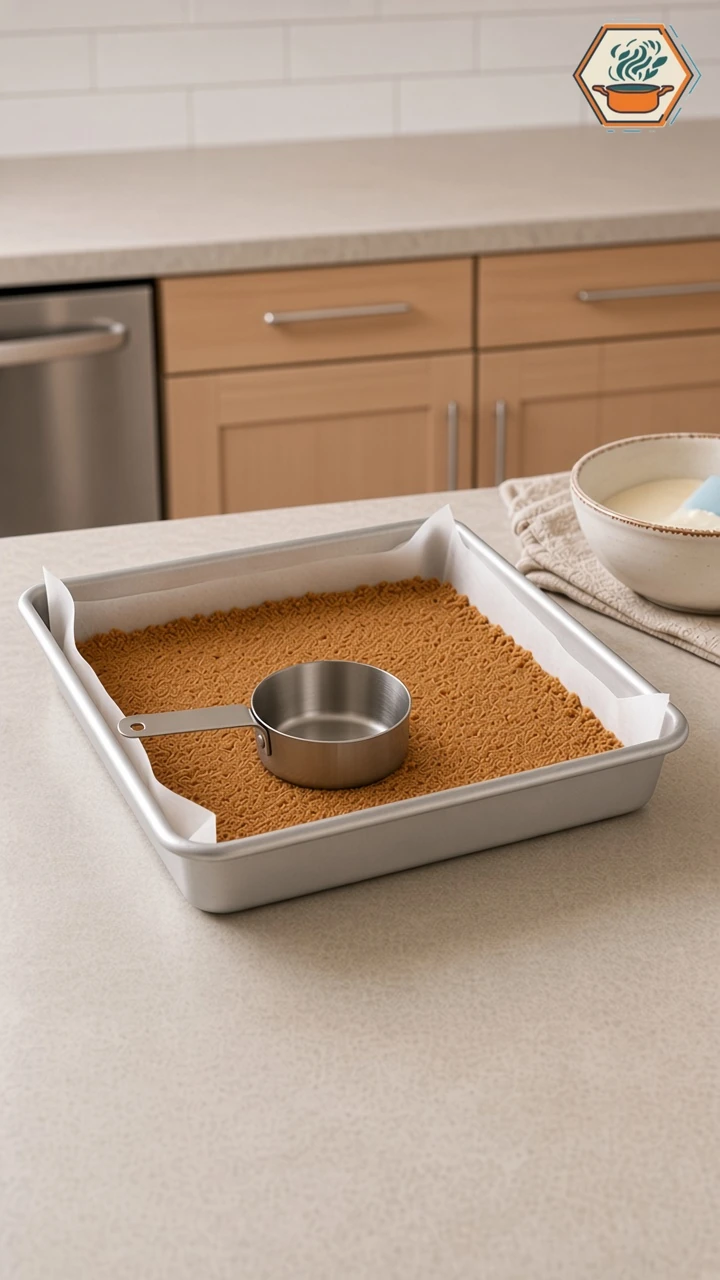
Press with the flat bottom of a metal measuring cup, using moderate pressure. Focus on an even layer all the way into the corners, rather than packing it into a rock-hard sheet. Prebaking helps set the buttered crumbs before the filling goes on. Let the crust cool briefly while you mix the filling and reduce the oven temperature.
Mix a Smooth Vanilla Filling
Start with the cream cheese and sugar, scraping the bottom and sides of the bowl as needed. Add sour cream and vanilla, then the eggs one at a time at low speed. Stop as soon as each egg disappears. The goal is a smooth mixture, not whipped volume. A silicone spatula is useful for a final gentle fold that catches any unmixed cream cheese.
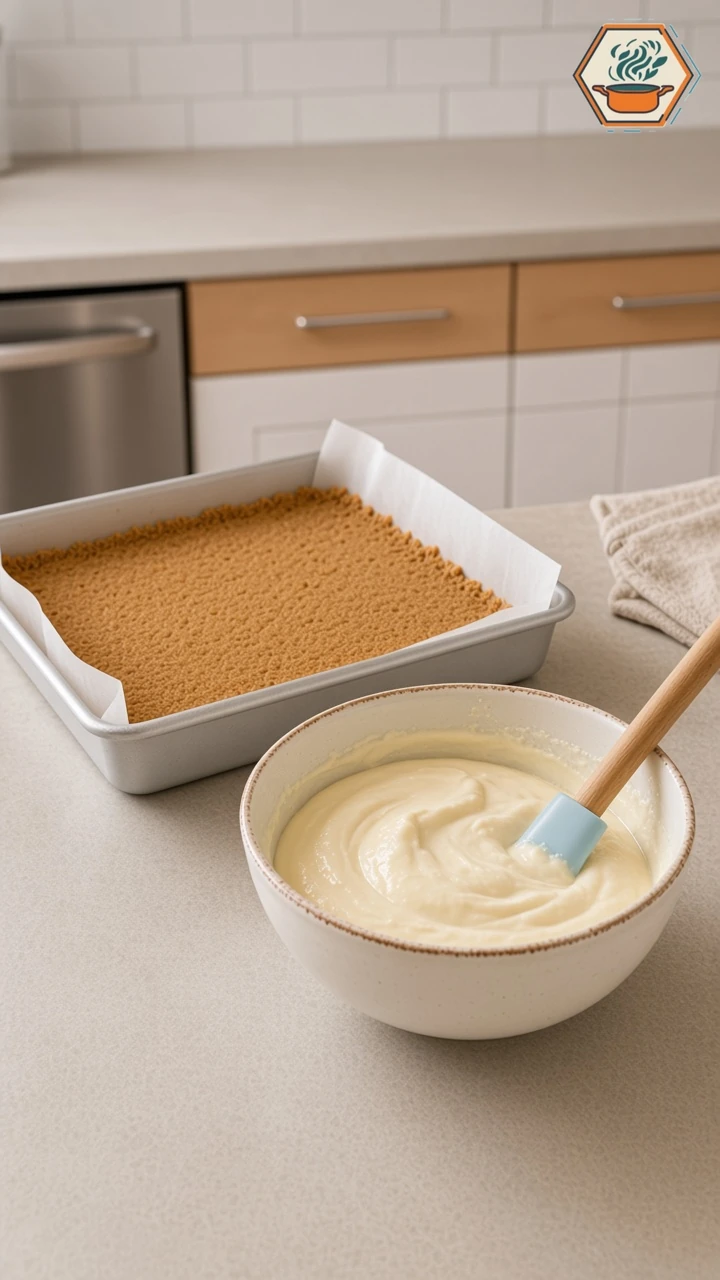
Overmixing can trap air that expands in the oven and contributes to cracks or a sunken center. Cold ingredients can leave lumps, but more high-speed beating is not the best rescue. For this caramel pecan cheesecake, patient softening and frequent bowl scraping are the better starting habits. Do not taste batter containing raw eggs.
Bake Gently, Then Give It Time to Chill
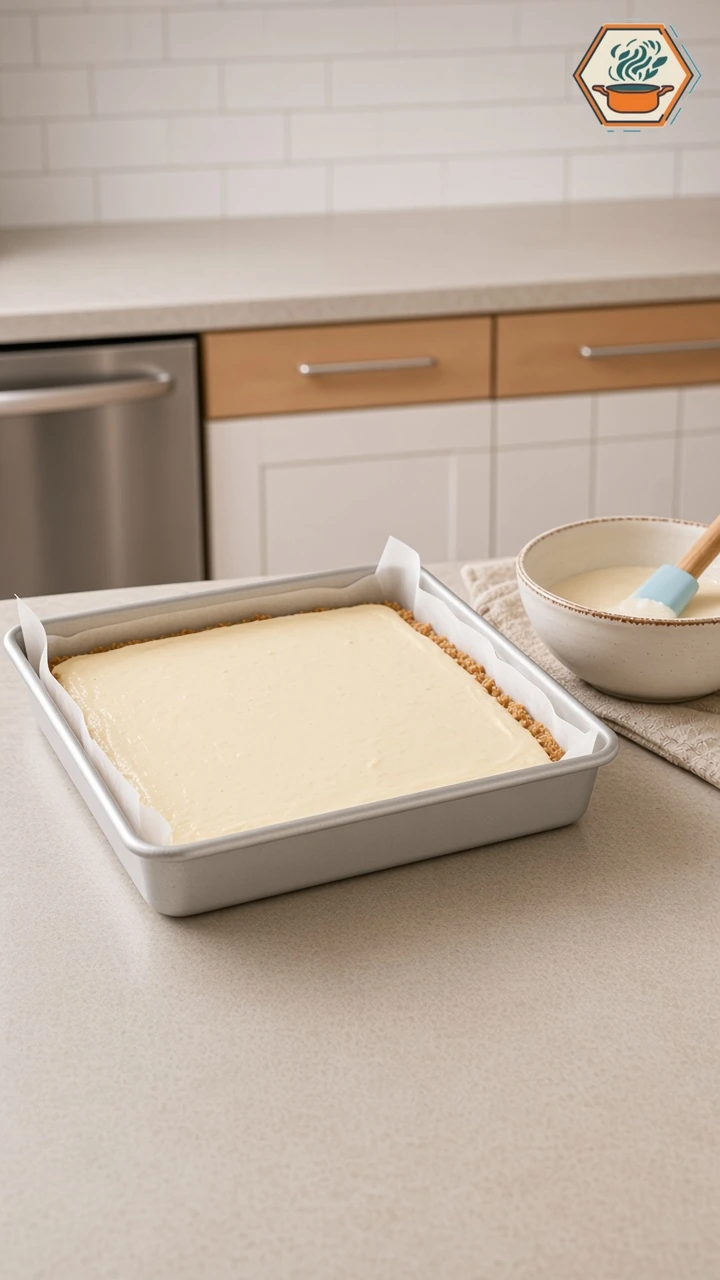
The caramel pecan cheesecake filling bakes at 325°F, after the crust gets its short bake at 350°F. A shallow square cheesecake does not require the water bath used for many tall round versions. This approach is consistent with King Arthur Baking’s cheesecake-bar method. Start checking near the early end of the suggested range.
Look for set edges and a center that trembles gently as one area, not liquid batter sloshing beneath the surface. Check that the center reaches at least 160°F, the USDA minimum for egg dishes, without touching the bottom crust with the probe. This is a safety check, not permission to ignore the texture. Continuing until the whole surface is rigid can make the filling dry.
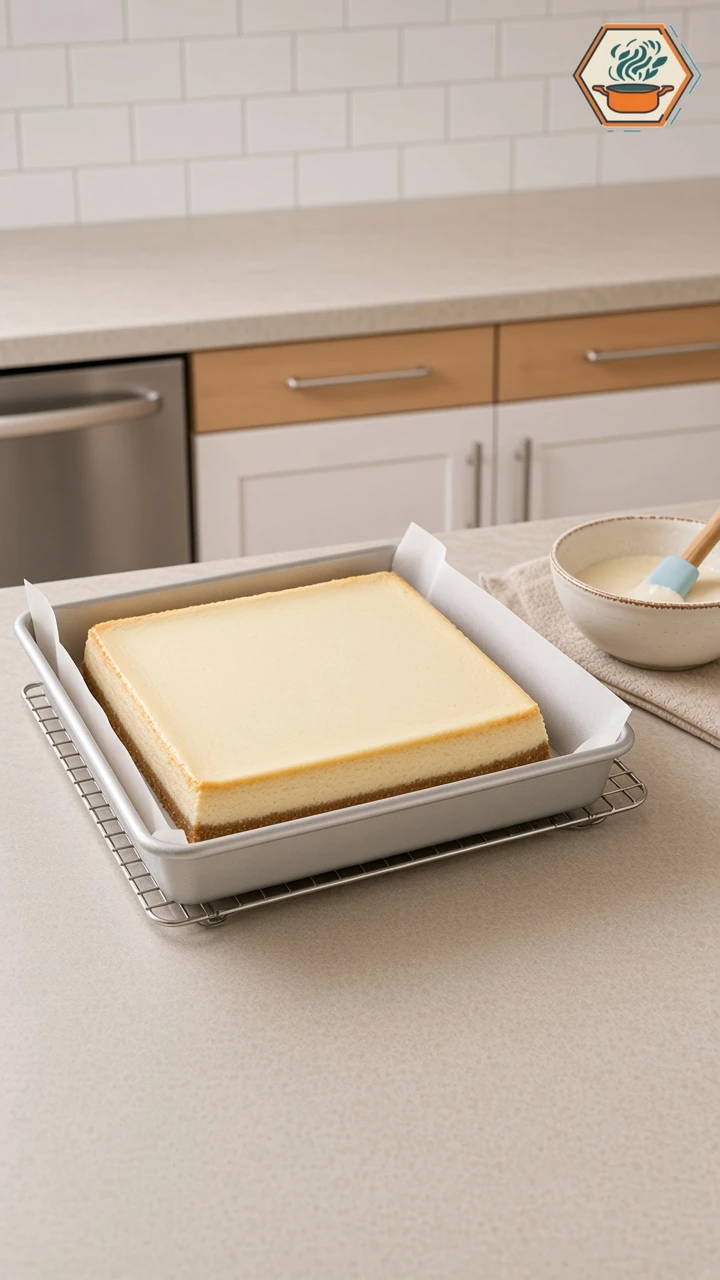
Plan on about 10 hours 25 minutes with the conservative, sequential schedule in the card. That includes 30 minutes of softening, all preparation, both bakes, 45 minutes of rack cooling, at least 6 hours in the refrigerator, pecan toasting, caramel cooking and cooling, finishing, and a final 30-minute chill. Most of that is waiting, but it still belongs in the total. Baking the base the day before is convenient.
Finish Caramel Pecan Cheesecake with Toasted Pecans
Toast the pecans just until fragrant and lightly deepened in color. Nuts can go from toasted to scorched quickly, so check early and stir once. Let them cool while you make the caramel. A heavy, light-colored saucepan helps you see the sugar change from clear melted patches to amber.
Use the dry-sugar method described in the card: stir the sugar as it melts, lower the heat for the butter, then add the cream very slowly. Butter and cream make hot caramel bubble and steam vigorously. Use a long heat-safe utensil, protect your hands, and keep children and pets clear. Never touch or taste hot caramel. Sally’s caramel guide explains this process and why the sauce thickens as it cools.
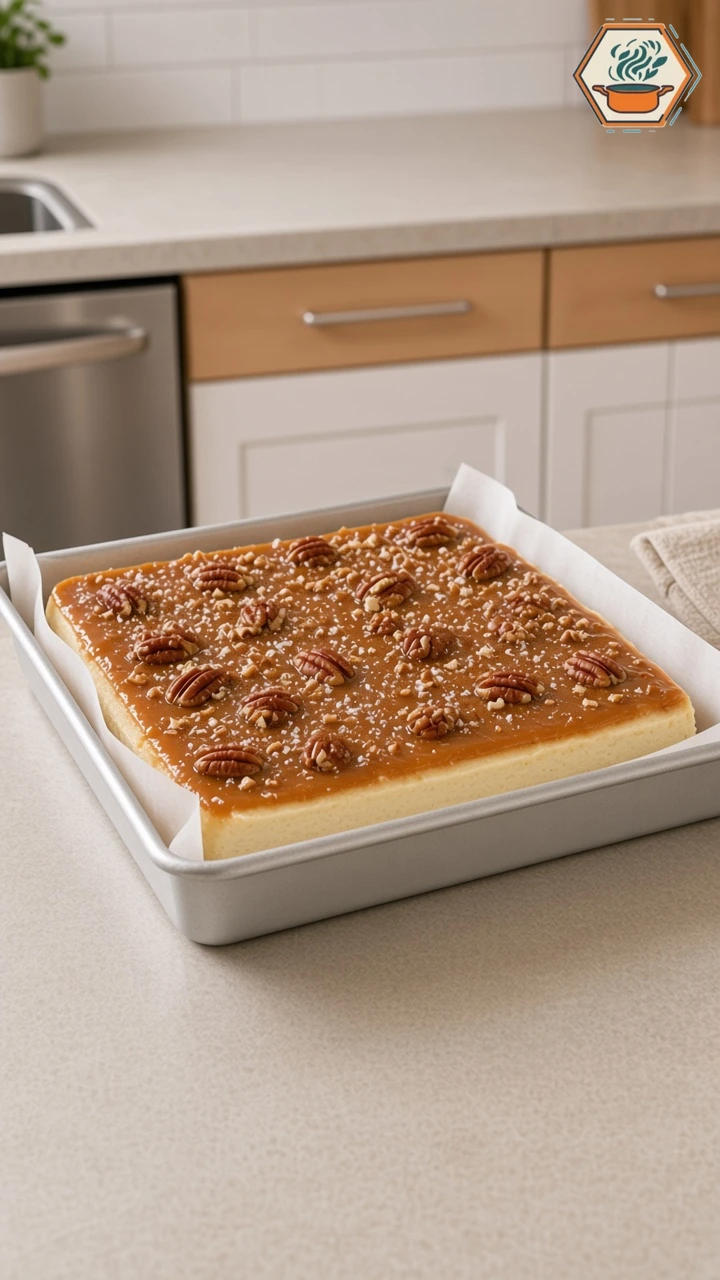
Let the topping cool until it is no longer hot but still spreadable before adding it to the fully chilled cheesecake. Hot sauce can soften the surface and undo those patient hours in the refrigerator. If the caramel becomes too firm, warm it gently in short bursts, stir, and let it cool again before spreading. Finish with a light pinch of flaky salt if you like.
Caramel Pecan Cheesecake Bars Recipe
Print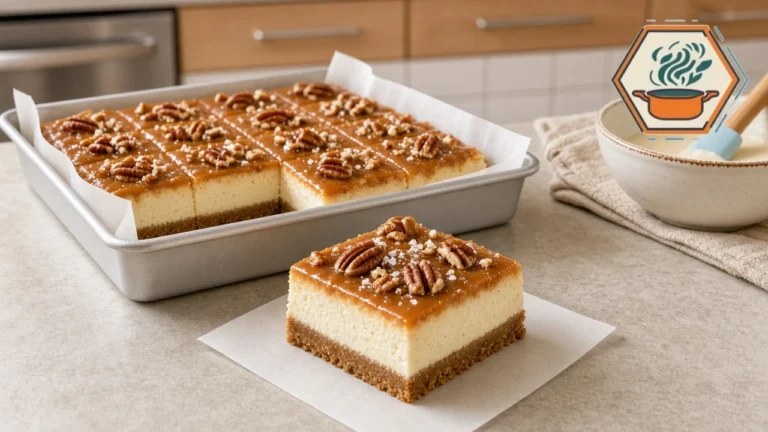
Caramel Pecan Cheesecake Bars
Sixteen rich vanilla cheesecake squares with a buttery graham cracker crust and homemade toasted pecan caramel topping. Original, untested formulation inspired by RecipesMind.Com. All times and yield are estimates. Allow about 10 hours 25 minutes including softening, cooling, and chilling; overnight preparation is convenient.
- Total Time: 10 hours 25 minutes
- Yield: 16 bars (estimated)
Ingredients
Graham crust
2 cups (200 g) finely ground graham cracker crumbs; use the weight for consistency
2 tablespoons (25 g) granulated sugar
1/8 teaspoon fine salt
6 tablespoons (85 g) unsalted butter, melted
Softened butter or nonstick spray, for the pan
Vanilla cheesecake
24 ounces (680 g; three 8-ounce bricks) full-fat brick cream cheese, softened
3/4 cup (150 g) granulated sugar
1/2 cup (120 g) full-fat sour cream
2 teaspoons pure vanilla extract
3 large eggs
Pecan caramel topping
1 1/2 cups (180 g) pecan halves, leaving about half whole and roughly chopping the rest after toasting
1 cup (200 g) granulated pure cane sugar
6 tablespoons (85 g) unsalted butter, cut into pieces and softened
1/2 cup (120 ml) heavy cream, about 36% fat
1/4 teaspoon fine salt
Optional: a small pinch flaky sea salt for finishing
Instructions
1. Soften safely (30 minutes planned): Cut cream cheese into small pieces and let soften about 30 minutes. Take sour cream and eggs out shortly before mixing. Softening may take longer in a cool room; include any extra time. Keep dairy/eggs out of refrigeration less than 2 hours total, or 1 hour above 90°F. Wash hands, equipment, and surfaces after handling raw eggs. Do not taste raw filling.
2. Prepare crust (15 minutes): Heat oven to 350°F (177°C), center rack. Lightly grease a light-colored 9-inch square metal pan, at least 2 inches deep. Line with a parchment sling extending about 1 inch above two opposite sides. Keep this lining in place throughout. Mix crumbs, crust sugar, salt, and melted butter until evenly damp. Press into an even bottom-only layer using moderate pressure with a flat-bottom measuring cup.
3. Prebake (10 minutes): Bake crust 10 minutes, until fragrant and set. Remove to a rack and reduce oven to 325°F (163°C). Let crust cool about 10 minutes while mixing the filling in the next step; this cooling overlaps that step and is not an extra wait.
4. Mix filling (15 minutes planned, including crust cooling): With a hand mixer or stand mixer paddle on low-to-medium speed, mix softened cream cheese and sugar until smooth, scraping bowl. Add sour cream and vanilla; mix just until combined. Add eggs one at a time on low, stopping as soon as each is incorporated. Gently fold with silicone spatula to check for unmixed pockets. Spread over briefly cooled crust, leaving at least 1/2 inch space below rim. No water bath required.
5. Bake filling (45 minutes planned): Bake at 325°F for about 40–50 minutes. Edges should look set and the center should tremble gently, not slosh. Verify center reaches at least 160°F with an instant-read thermometer, without touching crust/pan. If needed, continue checking every few minutes. Do not wait for the entire surface to become rigid or deeply brown. Baking time depends on oven and pan; 45 minutes is an estimate.
6. Cool and chill (45 minutes + at least 6 hours): Cool in the metal pan on a rack for about 45 minutes, then refrigerate promptly, even if still slightly warm. Do not leave it out to cool completely. Loosely tent until cold, then cover without touching the surface. Refrigerate at least 6 hours, or overnight, until fully cold and firm. Refrigerate sooner in a hot room; never exceed 2 hours after baking, or 1 hour above 90°F.
7. Prepare topping (10 minutes): After the cheesecake has chilled, measure topping ingredients and set out cream and butter briefly so they are not refrigerator-cold. Preheat oven to 300°F (149°C). Set aside a baking sheet and a heavy, light-colored stainless saucepan with ample room for foaming. Use a long heat-safe spoon/spatula and oven mitts; caramel can cause severe burns. Keep children/pets away.
8. Toast pecans (10 minutes): Spread nuts on baking sheet and toast 8–10 minutes, stirring once, until fragrant. Remove, let cool while making caramel, then roughly chop about half. Do not let nuts burn.
9. Make caramel (15 minutes planned): Put the 1 cup sugar in the dry saucepan over medium heat. Stir constantly with a heat-safe utensil as it clumps, melts, and turns amber, about 6–10 minutes. Once fully melted and amber, lower heat. Carefully stir in softened butter; it will foam. Slowly add cream while stirring, standing back from steam and splashes. Return to medium heat and boil about 1 minute, then remove. Stir in fine salt and toasted pecans. Do not taste while hot. If sugar smells burnt or turns black, do not use that batch.
10. Cool topping (30 minutes planned): Transfer to a suitable heat-safe bowl if desired. Let cool about 30 minutes, stirring occasionally, until no longer hot but still spreadable. Allow extra cooling if needed; never pour hot caramel onto cheesecake. If too thick to spread, warm gently, stir, and cool again. Keep cream-containing topping refrigerated promptly if not using.
11. Top (5 minutes), chill (30 minutes), slice (5 minutes): Spread cooled pecan caramel over cold cheesecake. Add optional flaky salt sparingly. Refrigerate about 30 minutes to firm topping. Lift chilled slab using parchment onto a board; use three cuts in each direction for a 4-by-4 grid, 16 bars. Warm a sharp knife in hot water, wipe dry, and clean between cuts. Serve chilled and return leftovers promptly to refrigerator.
Notes
Original formulation NOT kitchen-tested. Yield, timings, layer heights and consistency are estimates. Pan visual does not prove dimensions or quantities.
Use 9-inch square metal pan, not a round springform. An 8-inch pan needs a separately adjusted formulation/time. Baking the base without a water bath follows established square-bar methods; not a rule for every cheesecake.
TRUE estimated sequential total 10 hours 25 minutes: softening30 + crustprep15 + crustbake10 + fillingprep15 (includes10 crustcool) + fillingbake45 + rackcool45 + fridge360 + toppingprep10 + toast10 + caramel15 + caramelcool30 + topping5 + finalchill30 + slice5 = 625 minutes.
Active preparation 50 minutes (crust15 + filling15 + toppingprep10 + finishing5 + slicing5). Cook 80 minutes (crust10 + filling45 + nuts10 + caramel15). Additional inactive 8 hours 15 minutes (soften30 + rackcool45 + firstchill360 + caramelcool30 + finalchill30). Sum 625min. Oven preheat overlaps preparation; slow preheating adds time. If overnight chilling, total is longer. No topping-time overlap assumed in stated total.
Storage: cover and refrigerate at <=40°F for 3–4 days from baking, including make-ahead day. Limit serving/handling outside fridge to 2h total, or1h above90°F. Freeze well-chilled UNTOPPED cheesecake tightly wrapped about1–2months for quality. Thaw in refrigerator; top with freshly cooled caramel/pecans. No counter thawing. Not a shelf-stable dessert.
Contains milk, eggs, wheat and pecans (tree nuts). Check ingredient labels for other allergens. No dietary/health claim.
Caramel will be gooey and firmer cold, not a hard candy slab. Thickness varies with cooking and ingredient brands. White or unbleached baking parchment both work; wax paper does not.
- Prep Time: 50 minutes
- Softening, Cooling & Chilling: 8 hours 15 minutes
- Cook Time: 1 hour 20 minutes
- Category: Dessert
- Method: Baking and Stovetop
- Cuisine: American
Cut Sixteen Squares and Serve Chilled
For neat caramel pecan cheesecake squares, chill the topped slab briefly, lift it with the parchment, and place it on a cutting board. Make three evenly spaced cuts in each direction. Use a sharp knife warmed in hot water and wiped dry, cleaning it between cuts. Cut straight down through nuts rather than sawing the cheesecake back and forth.
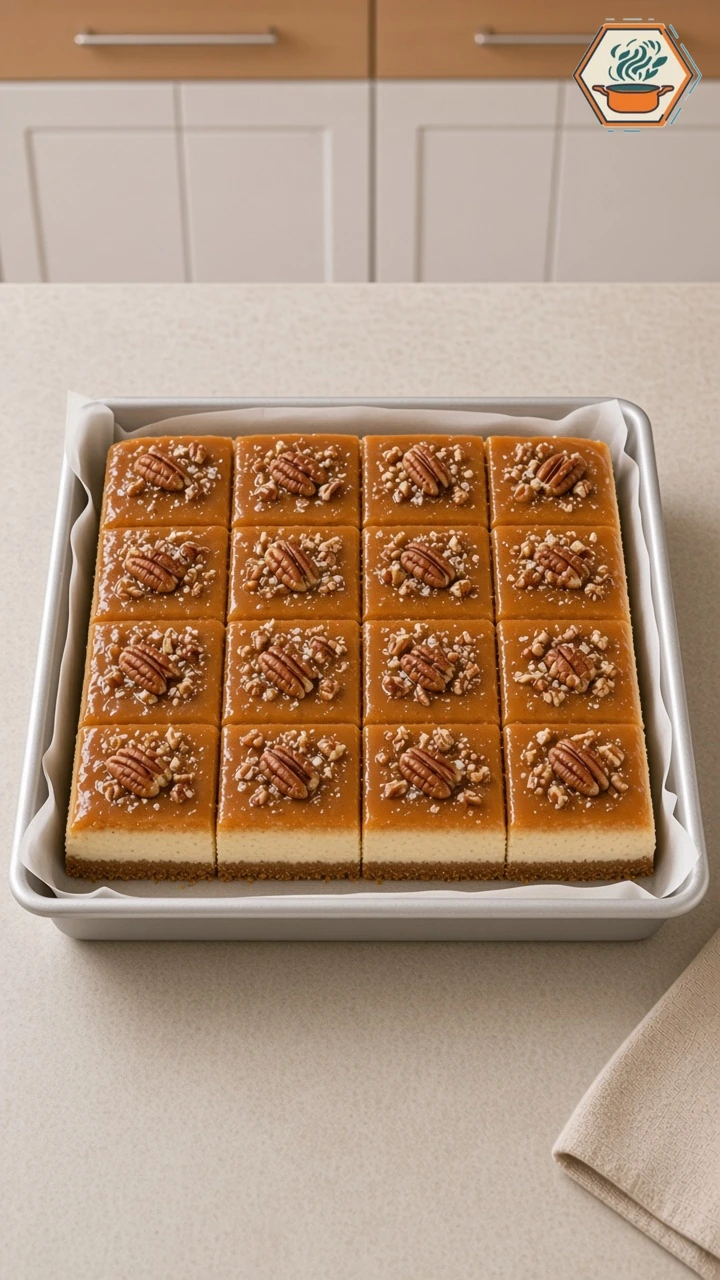
Serve on little parchment squares or small plates. These bars already have caramel and nuts, so they do not need an extra sweet garnish. Coffee or unsweetened tea makes a simple companion. If you are choosing another dessert for the table, our New York cheesecake offers a classic alternative, while caramel apple blondies bring a different kind of chewy bar.
Useful Equipment and Materials
This post contains affiliate links. As an Amazon Associate I earn from qualifying purchases.
Essential equipment: The Nordic Ware Naturals 9-inch square aluminum pan has the right dimensions for this recipe. Use a comparable pan you already own if you prefer. A KitchenAid 5-speed hand mixer helps smooth the softened cream cheese; a stand mixer with a paddle is an alternative, not another purchase you need. A TempPro TempSwift TP19H instant-read thermometer checks the filling’s center. Remove it after reading; do not leave this handheld tool in the oven.
Optional equipment: A Wilton 9-inch angled spatula makes spreading filling and cooled caramel easier. A regular silicone spatula or spoon can do the same job. You also need a saucepan, a baking sheet for nuts, and a rack for the pan; there is no need for a springform pan or a specialty cheesecake kit.
Useful materials: Reynolds Kitchens parchment paper forms the lifting sling. White or unbleached baking parchment works; do not substitute wax paper. Follow the package temperature limit and keep loose edges away from heat. The brand of parchment does not affect the caramel pecan cheesecake flavor.
Caramel Pecan Cheesecake Storage and Make-Ahead Tips
Keep caramel pecan cheesecake covered in the refrigerator at 40°F or below and use within 3–4 days. Refrigerate the baked slab after its brief cooling period; do not wait for it to reach room temperature completely. At serving time, keep the total time out of refrigeration under 2 hours, or under 1 hour if the temperature is above 90°F. USDA egg-safety guidance covers safe cooking and handling of egg-containing foods.
For longer storage, freeze the well-chilled cheesecake without the topping, wrapped well, for about 1–2 months for quality. Thaw covered in the refrigerator, then add freshly cooled topping. This avoids some of the sticky texture changes that nuts and caramel can develop after freezing. Do not thaw dairy desserts on the counter. The same storage clock includes any day spent making the dessert ahead.
Frequently Asked Questions
Can I use an 8-inch square pan?
Not as a direct swap. The same batter would be deeper, with different baking and cooling needs. Use the specified 9-inch pan for this untested formulation rather than guessing a new bake time.
Can I skip homemade caramel?
Yes. A thick store-bought caramel sauce can be a shortcut, but its firmness varies. Start with about 1 cup and add the toasted pecans. Cool any warmed sauce before applying; follow its label for storage. Timing will differ from the homemade version.
Why did my caramel pecan cheesecake crack?
Too much mixing after the eggs, excess baking, or a sudden temperature change can contribute. Small cosmetic cracks can sit beneath the topping, but caramel cannot fix an undercooked or improperly stored filling.
Are these pecan pie cheesecake bars?
They have similar flavors, but this topping is caramel sauce and toasted pecans, not a baked egg-and-syrup pecan-pie layer. The filling is plain vanilla so the caramel remains the main sweet accent.
Can the bars sit out at a party?
Treat them as a refrigerated dairy-and-egg dessert, not a shelf-stable cookie. Serve small batches and replenish from the refrigerator while following the time limits above.