
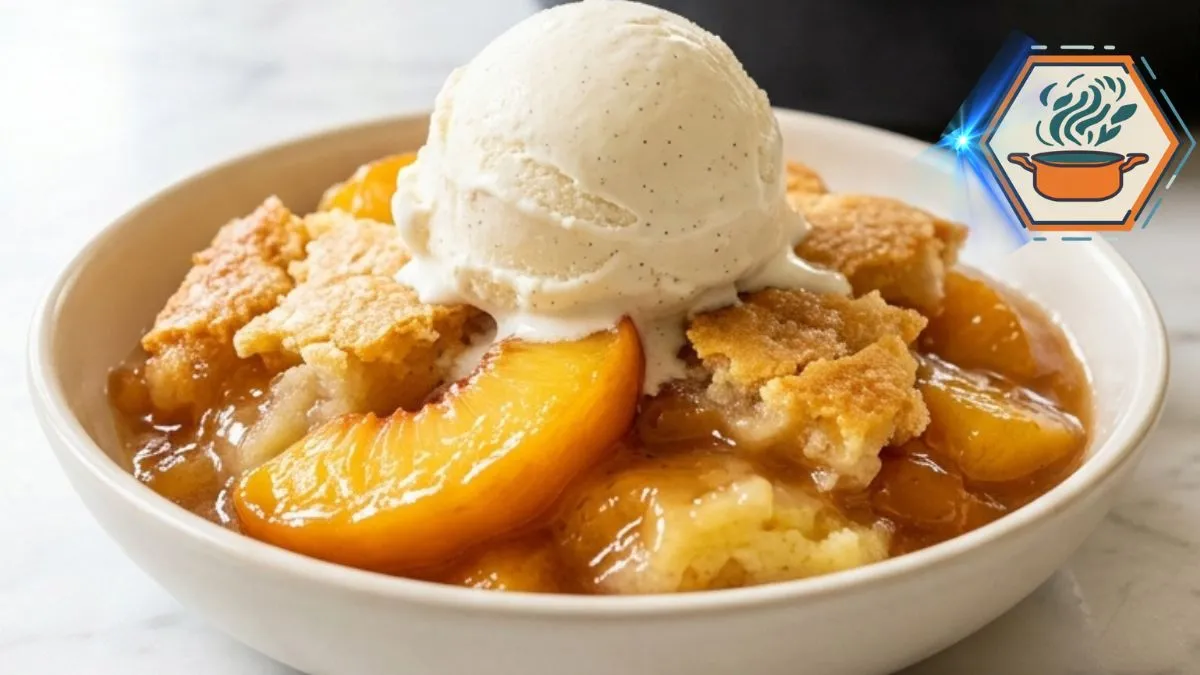
There is something special about the moment a peach cobbler comes out of the oven. The fruit is bubbling around the edges. The kitchen smells like peaches, vanilla, butter, and warm cinnamon. Then there is the best part: the golden topping, covered with tiny crystals of caramelized sugar.
This Sugar Crusted Peach Cobbler is made for that moment. Under its crisp, golden top sits a juicy peach filling and a soft, buttery cobbler layer. Add cold vanilla ice cream while the cobbler is still warm, and the ice cream slowly melts into every crack.
Peach cobbler has many legitimate styles. Some recipes use biscuits, while others use pastry or a soft cake-like batter. King Arthur Baking, for example, publishes both biscuit-style and cake-style versions. Its classic version also bakes for roughly 45 to 50 minutes, which is a useful reference point for this dessert. You can read their Classic Peach Cobbler guide for another established approach to this American favorite.
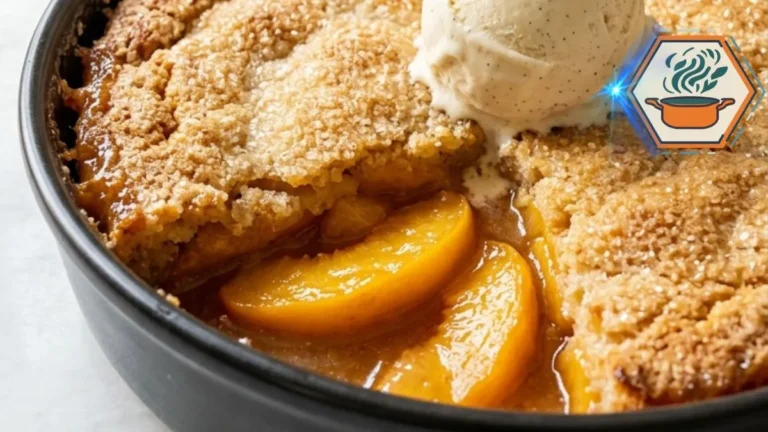
The feature that makes our recipe different is its sugary finish. A combination of fine granulated sugar and coarse turbinado sugar gives the surface more texture. That idea has good baking precedent. King Arthur uses coarse sparkling or cinnamon sugar on one of its peach cobblers, while another well-known cobbler technique coats batter with sugar before baking. For more peach and seasonal cooking inspiration, the Food Network classic peach cobbler recipe is another useful reference.
JUMP TO
Sugar Crusted Peach Cobbler
This Sugar Crusted Peach Cobbler combines juicy cinnamon-scented peaches with a tender buttery topping and a crisp golden layer of granulated and turbinado sugar. Serve it warm with vanilla ice cream for a classic homemade peach dessert.
- Total Time: 1 hour 10 minutes
- Yield: 10–12 servings
Ingredients
Peach Filling
6 cups fresh peaches, sliced about 1/2 inch thick
3/4 cup granulated sugar
2 tablespoons packed light brown sugar
2 tablespoons cornstarch
1 tablespoon fresh lemon juice
1 teaspoon vanilla extract
1/2 teaspoon ground cinnamon
1/4 teaspoon ground nutmeg
Pinch of fine salt
Cobbler Topping
1 1/2 cups all-purpose flour, spooned and leveled
1/2 cup granulated sugar
2 teaspoons baking powder
1/2 teaspoon fine salt
1/2 cup unsalted butter, melted and slightly cooled
3/4 cup whole milk, preferably at room temperature
1 teaspoon vanilla extract
Sugar Crust
1/3 cup granulated sugar
2 tablespoons coarse turbinado sugar
2 tablespoons unsalted butter, melted
For Serving, Optional
Vanilla ice cream
Fresh peach slices
Ground cinnamon
Caramel sauce
Instructions
1. Place an oven rack in the center position. Preheat the oven to 375°F (190°C). Lightly butter the bottom and sides of a 9 x 13-inch baking dish.
2. Slice the peaches into pieces about 1/2 inch thick. Place them in a large mixing bowl.
3. Add the granulated sugar, brown sugar, cornstarch, lemon juice, vanilla extract, cinnamon, nutmeg, and salt. Gently toss until the peaches are evenly coated and no visible patches of cornstarch remain.
4. Let the peach mixture stand for 10 minutes. This gives the sugar time to draw out some peach juice and helps distribute the cornstarch.
5. Pour the peaches and all accumulated juices into the prepared baking dish. Spread them into an even layer.
6. In a separate large bowl, whisk together the flour, granulated sugar, baking powder, and salt.
7. Add the slightly cooled melted butter, milk, and vanilla. Stir gently just until a thick, spoonable batter forms. Stop mixing once the dry flour disappears. Do not beat the batter.
8. Drop spoonfuls of batter evenly over the peaches. Gently spread the batter so most of the fruit is covered, leaving a few small openings where the peach juices can bubble through.
9. In a small bowl, combine the granulated sugar and turbinado sugar for the crust. Sprinkle the mixture evenly over the entire cobbler topping, including near the edges.
10. Slowly drizzle the 2 tablespoons of melted butter over the sugar in small streaks and droplets. Avoid pouring all the butter into one area.
11. Bake on the center rack for 45 to 50 minutes. The cobbler is ready when the surface is deeply golden, the sugar crust looks set, and the peach filling is visibly bubbling around the edges.
12. If the top becomes dark before the filling is bubbling, loosely cover the darkest areas with aluminum foil and continue baking.
13. Remove the cobbler from the oven and let it rest for 10 to 15 minutes. The filling will settle slightly as it stands.
14. Serve warm. Add vanilla ice cream, fresh peach slices, cinnamon, or a small caramel drizzle if desired.
Notes
Peaches: Choose ripe but still firm peaches. Very hard peaches may remain firm after baking, while overripe peaches can release too much liquid.
Peeling: Peeling the peaches is optional. Leave the skins on for a rustic cobbler or remove them for a smoother filling.
Measuring flour: Spoon the flour into the measuring cup and level it rather than packing it down. Too much flour can produce a heavy topping.
Batter consistency: The batter should be thick but easy to spoon. If it is unusually stiff, add whole milk 1 tablespoon at a time until spoonable.
Do not overmix: Stir only until the flour disappears. Excess mixing can make the topping less tender.
Sugar crust: Use both granulated and turbinado sugar. Granulated sugar coats the surface evenly, while turbinado creates larger crisp sugar crystals.
Butter application: Drizzle the final melted butter across the surface rather than pouring it into one spot. This gives the crust more even color and texture.
Doneness: Do not rely only on the timer. Look for a deeply golden top and peach juices visibly bubbling around the edges.
Frozen peaches: Thaw and drain them well before measuring. Excess liquid can make the filling too loose.
Canned peaches: Use well-drained peaches. Do not add the packing syrup to this recipe.
Resting: Allow the baked cobbler to stand for 10 to 15 minutes before serving. It will still be warm, but the filling will have time to settle.
Storage: Cool leftovers, cover, and refrigerate. Reheating in the oven gives the topping a better texture than microwaving.
Nutrition information does not include ice cream, caramel sauce, or optional garnishes.
- Prep Time: 20 minutes
- Rest Time: 10–15 minutes after baking
- Cook Time: 45–50 minutes
- Category: Dessert
- Method: Baking
- Cuisine: American / Southern-inspired
- Diet: Vegetarian
Why You’ll Love This Sugar Crusted Peach Cobbler
A great cobbler needs contrast.
The peaches should be tender and juicy without turning the bottom into soup. The topping should remain soft where it meets the fruit but become golden on top. Finally, the sugar layer needs enough heat to form its characteristic crisp finish.
This recipe builds those textures in separate stages.
You get:
- Juicy peach slices rather than peach purée
- Lemon juice to balance the sweetness
- Cornstarch to control excess peach juice
- Cinnamon and nutmeg in modest amounts
- A buttery homemade batter
- Granulated sugar for even coverage
- Turbinado sugar for larger, crunchy crystals
- Melted butter to help the surface brown
The result falls somewhere between a tender cake-style cobbler and a crunchy-topped fruit dessert.
And despite its impressive appearance, it uses familiar pantry ingredients.
Ingredients for Sugar Crusted Peach Cobbler
For the Peach Filling
- 6 cups sliced fresh peaches
- 3/4 cup granulated sugar
- 2 tablespoons brown sugar
- 2 tablespoons cornstarch
- 1 tablespoon fresh lemon juice
- 1 teaspoon vanilla extract
- 1/2 teaspoon ground cinnamon
- 1/4 teaspoon ground nutmeg
- 1 pinch fine salt
For the Cobbler Topping
- 1 1/2 cups all-purpose flour
- 1/2 cup granulated sugar
- 2 teaspoons baking powder
- 1/2 teaspoon fine salt
- 1/2 cup unsalted butter, melted and slightly cooled
- 3/4 cup whole milk, at room temperature
- 1 teaspoon vanilla extract
For the Golden Sugar Crust
- 1/3 cup granulated sugar
- 2 tablespoons coarse turbinado sugar
- 2 tablespoons unsalted butter, melted
For Serving
- Vanilla ice cream
- Fresh peach slices, optional
- Light dusting of cinnamon, optional
- Caramel sauce, optional
Prep time: 20 minutes
Rest before baking: 10 minutes
Bake time: 45–50 minutes
Cooling time: 10–15 minutes
Total time: About 1 hour 20 minutes
Servings: 10–12
Oven: 375°F (190°C)
Pan: 9 × 13-inch baking dish
The Details That Make This Recipe More Reliable
A short recipe can tell you what ingredients to combine. It does not always explain what those ingredients should look or feel like.
Those details matter in cobbler.
Start With Ripe but Firm Peaches
Do not choose rock-hard peaches. They may stay too firm after baking.
Very soft peaches create a different problem. They can release lots of liquid and lose their shape.
Look for peaches that smell fragrant and yield slightly when gently pressed.
Fresh peaches are especially appealing during peach season, and established cobbler recipes also emphasize ripe fruit as a major part of the finished dessert.
Cut the peaches into fairly even slices, roughly 1/2 inch thick. Similar pieces cook at a similar rate.
You can peel them if you prefer a smoother filling. Leaving the skins on is also possible.
Why Cornstarch Matters
Six cups of peaches can release a surprising amount of juice.
That juice is delicious, but uncontrolled liquid can leave you with a watery cobbler.
Cornstarch helps those juices thicken as they heat. King Arthur’s Southern-style peach cobbler likewise pairs peaches with cornstarch, showing why a starch can be useful in a juicy fruit filling.
There is one detail you should not skip.
Mix the cornstarch thoroughly with the peaches and other filling ingredients. You should not see white patches of dry starch before the fruit goes into the baking dish.
Then give the mixture about 10 minutes to sit.
How to Make Sugar Crusted Peach Cobbler
1. Prepare the Oven and Pan
Place a rack near the center of the oven.
Preheat to 375°F (190°C).
Give the oven enough time to reach temperature before baking. Starting in a properly heated oven helps the topping begin setting while the fruit heats underneath.
Lightly butter a 9 × 13-inch baking dish, including the corners.
A light-colored ceramic or metal dish is a good choice. If you use glass, follow the manufacturer’s temperature and handling instructions.
2. Make the Peach Filling
Place the sliced peaches in a large bowl.
Add the granulated sugar, brown sugar, cornstarch, lemon juice, vanilla, cinnamon, nutmeg, and salt.
Fold gently until every peach slice is coated.
Do not mash the fruit.
Leave the mixture for 10 minutes. You should begin to see some peach juice collecting in the bowl.
Pour everything into the prepared baking dish, including the juices.
Spread the peaches into an even layer.
3. Mix the Dry Topping Ingredients
In another large bowl, whisk together:
- Flour
- Granulated sugar
- Baking powder
- Salt
Break apart any visible lumps.
Baking powder is especially important here. Without it, this batter would be much heavier.
4. Add the Wet Ingredients
Let your melted butter cool slightly first. It should still be liquid, but it should not be extremely hot.
Add the melted butter, room-temperature milk, and vanilla to the flour mixture.
Stir until you no longer see large pockets of dry flour.
Then stop.
Do not aggressively beat the batter.
Overmixing can make a flour-based topping less tender.
The finished batter should be thick enough to spoon over the peaches. If your exact flour or measuring method makes it unusually stiff, add milk 1 tablespoon at a time, only until it becomes spoonable.
That small detail makes the recipe much easier to reproduce.
How to Cover the Peaches Correctly
Drop spoonfuls of batter across the fruit rather than pouring all the batter into one spot.
Gently spread those spoonfuls.
You do not need to create a perfectly smooth surface.
In fact, a few small gaps are useful. Peach juices can bubble through them, creating the rustic appearance associated with cobbler.
Try to keep the topping at a fairly even thickness. One huge mound in the center may remain underdone while thinner edges brown.
How to Make the Golden Sugar Crust
Now we reach the signature step.
Mix the 1/3 cup granulated sugar with 2 tablespoons turbinado sugar.
Sprinkle the mixture evenly across the batter.
Do not dump it into the center.
You want sugar all the way toward the edges so each serving gets some of that crisp top.
Then drizzle 2 tablespoons melted butter lightly across the sugar.
The butter should be distributed in small streaks and droplets rather than poured onto one spot.
This combination gives the topping three useful components:
- Fine sugar for broad coverage
- Coarse sugar for noticeable crystalline crunch
- Butter for richness and browning
Coarse sugar on cobbler isn’t an unusual idea. King Arthur’s cake-style Southern cobbler specifically suggests coarse sparkling sugar as a topping option.
Bake Until the Fruit Is Bubbling
Place the dish on the center rack.
Bake for 45 to 50 minutes.
Do not judge the dessert by the clock alone.
Look for visual signs.
The top should be a rich golden brown. The sugar should look set rather than wet. Most importantly, the peach filling should be visibly bubbling around the edges and preferably through a few openings in the topping.
Fruit bubbling matters because the filling needs to become hot enough for its starch-thickened juices to develop their final consistency.
If the topping is becoming dark too quickly but the filling is not bubbling yet, loosely shield the darkest areas with foil and continue baking.
King Arthur’s classic peach cobbler uses the same general 45-to-50-minute baking window, though exact timing always varies with the recipe, pan, fruit, and oven.
The 10-Minute Rule You Shouldn’t Skip
It is tempting to grab a spoon immediately.
Wait 10 to 15 minutes.
Freshly baked cobbler is extremely hot, and the fruit filling continues to settle as it stands. King Arthur also recommends a 10-to-15-minute cooling period for its Southern-style version.
After that short rest, the cobbler is still wonderfully warm.
That is when I like to serve it.
Spoon a generous portion into a shallow bowl. Add vanilla ice cream and watch it soften over the golden crust.
That combination of cold ice cream, hot peaches, crisp sugar, and soft topping is the whole reason to make this dessert.
Fresh vs. Frozen vs. Canned Peaches
Fresh peaches are my first choice when they are ripe and flavorful.
But peach season does not last forever.
Frozen Peaches
Frozen peaches can work. King Arthur explicitly lists frozen fruit as an option for its classic cobbler.
For this recipe, thaw them first and drain excess liquid before measuring six cups. Pat away excessive surface moisture without squeezing the fruit.
This helps keep the filling closer to the intended consistency.
Canned Peaches
Canned peaches can also be used in cobblers, but syrup changes both moisture and sweetness. If adapting this exact recipe, choose well-drained peaches rather than pouring syrup into the filling.
Because canned fruit is already soft, expect a softer final peach texture.
Common Peach Cobbler Mistakes
The Cobbler Is Too Runny
Possible causes include very juicy peaches, inaccurate cornstarch measurement, or removing the dessert before the filling has bubbled properly.
Also remember that a warm cobbler should be juicy. It will settle further as it cools.
The Topping Is Tough
You may have mixed the batter too much.
Stir only until the ingredients come together.
The Top Isn’t Crisp
Check three things.
Use the full sugar-crust mixture. Spread it evenly. Bake until the surface is genuinely golden.
Removing the cobbler while it is still pale will give you a softer topping.
The Bottom Seems Too Wet
Peach cobbler is not supposed to have the dry interior of a cake. The underside of the topping sits directly against juicy fruit, so it naturally stays moist.
The contrast is intentional: crisp above, tender beneath.
The Top Browns Before the Center Is Ready
Ovens can have hot spots.
Rotate the dish carefully if one side is browning much faster. If necessary, loosely cover the dark area with foil.
Can You Make Peach Cobbler Ahead?
You can prepare parts of it ahead, but I prefer assembling it close to baking time.
The reason is texture.
Once batter sits against juicy fruit for a long period, moisture starts working its way into the topping before it even reaches the oven.
Instead, slice your peaches and measure the dry ingredients in advance. Assemble and add the sugar crust shortly before baking.
For the best crackly top, serve the finished cobbler warm.
How to Store Leftover Peach Cobbler
Once the cobbler has cooled, cover leftovers and refrigerate them.
For reference, King Arthur’s storage instructions for its Southern-style cobbler also call for covering and refrigerating leftovers. It recommends reheating that version in a 300°F oven for 10 to 20 minutes.
For this recipe, an oven is preferable to a microwave when preserving the top texture matters.
The microwave will warm the peaches quickly, but it tends to soften a crisp crust.
What to Serve With Peach Cobbler
Vanilla ice cream is the classic choice for a reason.
Keep the serving simple:
- Vanilla bean ice cream
- Lightly whipped cream
- Fresh peach slices
- Small pinch of cinnamon
- Modest caramel drizzle
Do not bury the cobbler under too many toppings. The peaches should remain the main flavor.
If you enjoy working with fruit in desserts, you may also like this RecipesMind guide to using pineapple in baking. And for another fruit-focused baking project, see our 3-ingredient banana bread guide.
A Few Useful Variations
Once you know the original recipe, small changes are easy.
For a stronger cinnamon flavor, add a small extra pinch to the sugar topping.
For more fruit complexity, replace a small portion of the peaches with blueberries or raspberries.
For extra vanilla aroma, serve it with vanilla bean ice cream rather than adding much more extract to the filling.
You can also leave out the caramel drizzle. The cobbler already has plenty of sweetness.
I would not reduce the topping sugar dramatically if your main goal is the characteristic sugar crust. That layer is part of the dessert’s texture, not merely decoration.
Why This Recipe Works for a Crowd
A 9 × 13-inch cobbler is wonderfully practical for gatherings.
There is no pastry to roll. You do not need to create individual portions. The rustic surface actually becomes more attractive as peach juice bubbles through it.
One pan gives about 10 to 12 servings, depending on portion size.
Bring the baking dish to the table while it is still warm. Put vanilla ice cream nearby. Let everyone spoon out their own serving.
Sometimes the least formal desserts disappear first.
Sugar Crusted Peach Cobbler FAQs
What makes a peach cobbler crust crispy?
A dry, golden surface and a sugar topping are key to this version. We use both granulated and coarse turbinado sugar, followed by a light drizzle of melted butter. The cobbler then needs enough oven time for the top to become deeply golden.
Should I peel peaches for peach cobbler?
You don’t have to. Peach skins soften during baking. Peel them if you prefer a smoother filling, or leave them on for a more rustic dessert.
Can I use frozen peaches?
Yes. Frozen peaches are used successfully in established cobbler recipes. For this version, thaw and drain them before measuring so excess liquid does not dilute the filling.
Why is my peach cobbler soggy?
Extra fruit liquid, too little thickener, or insufficient baking can contribute to a very wet cobbler. Remember, though, that the layer touching the peaches should remain moist. Only the exposed top is meant to become crisp.
How do I know when peach cobbler is done?
Look beyond the timer. The topping should be deeply golden and the peach juices should be bubbling. For this recipe, that normally takes around 45 to 50 minutes at 375°F (190°C).
Should peach cobbler be served hot or cold?
Either works, but this recipe is best warm rather than piping hot. Rest it for 10 to 15 minutes after baking. Then add vanilla ice cream.
Can I make Sugar Crusted Peach Cobbler the day before?
Yes, but the crust is crispest on the day it is baked. If making it ahead, refrigerate the cooled cobbler and warm portions in the oven before serving.
What’s the difference between peach cobbler and peach crisp?
The topping is the main distinction. Cobbler commonly uses biscuit, pastry, or batter-style toppings. Crisps usually feature a crumbly topping and often include oats or nuts. Current recipe collections likewise treat peach crisp and biscuit peach cobbler as distinct fruit desserts.
The Final Spoonful
The first spoonful gives you everything this dessert is supposed to be.
The top cracks gently. Underneath, the cobbler becomes softer and buttery. Then you reach the warm peaches and their cinnamon-scented juices. Vanilla ice cream melts down the sides and pools around the fruit.
That is the charm of this Sugar Crusted Peach Cobbler.
It does not need complicated pastry work or unusual equipment. What matters is paying attention to the small steps: use good peaches, control their liquid, don’t overmix the batter, distribute the topping evenly, give the sugar room to brown, and wait for the filling to bubble before taking the pan from the oven.
Those details turn a simple peach dessert into one worth making again.
For more approachable homemade recipes and baking guides, visit RecipesMind.