
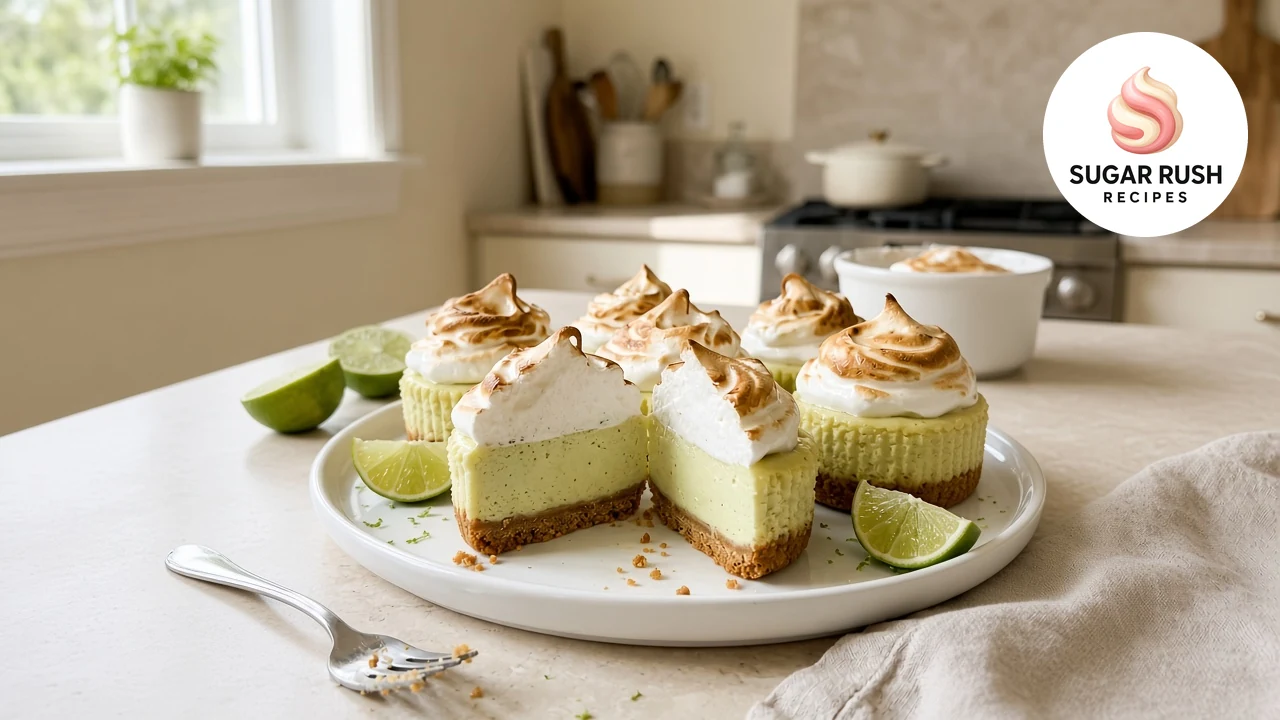
Mini key lime meringue cheesecakes pack everything people love about key lime pie into a dessert you can hold in one hand: a buttery graham cracker crust, a creamy, tangy lime cheesecake filling, and a tall swirl of toasted meringue that tastes like a campfire marshmallow. Twelve fit on one pan, and they look far fancier than the effort involved.
This recipe was developed for RecipesMind from the dessert idea shared by Sugar Rush Recipes. The post had no written recipe, so the quantities and steps below were built from established cheesecake and meringue techniques, with food-safety checks added. This original write-up has not been kitchen-tested by RecipesMind, so use the visual cues and a thermometer alongside the clock.
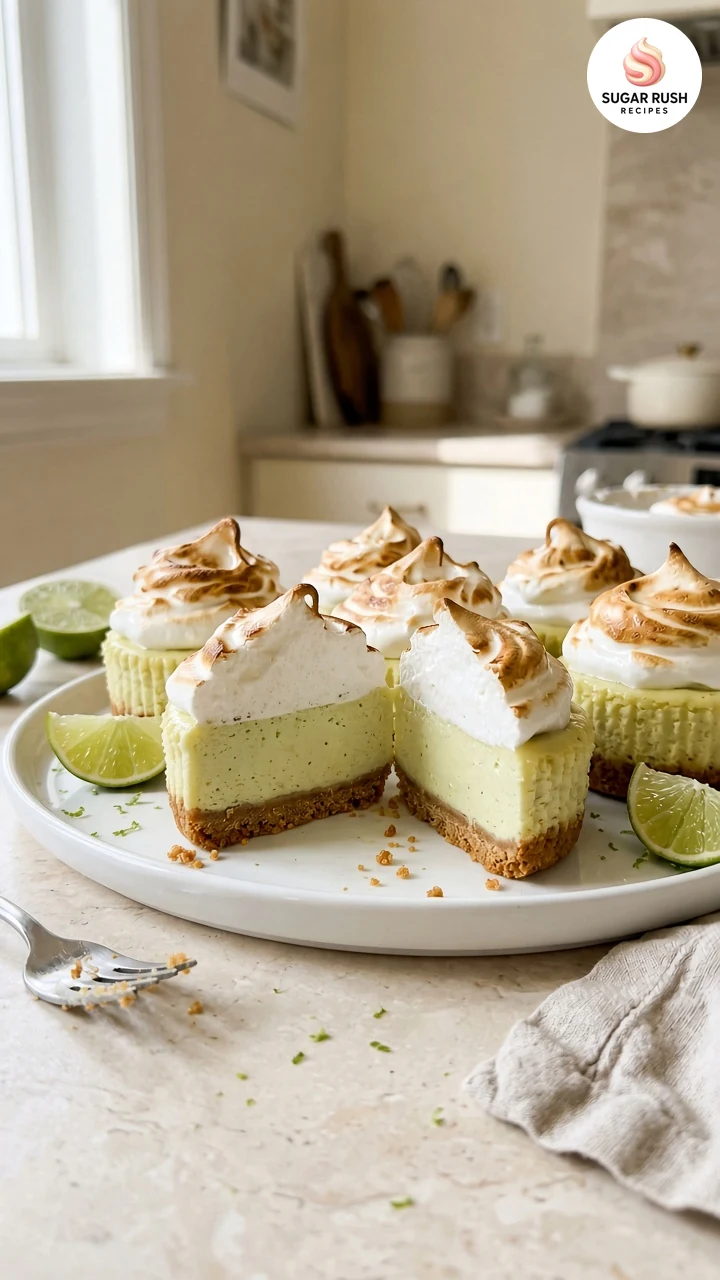
Images are AI-generated recipe illustrations based on the Sugar Rush Recipes post, not photographs of a kitchen test. Follow the recipe card for measurements and food-safety checks.
In this article
Why These Mini Cheesecakes Work
Minis bake in about 20 minutes instead of an hour, with no cracked center or messy slicing, and everyone gets all three layers.
A mini cheesecake pan with removable bottoms gives them their bakery look: straight sides and loose discs that push each cheesecake out cleanly. Its 12 cavities are about 2 inches wide and 1 inch deep, so each one is about three generous bites.
The topping is a Swiss meringue: egg whites and sugar are warmed over simmering water to 160°F, then whipped. Because the meringue is only torched, not baked, that heating step is what makes it food-safe, and it gives a glossy meringue that pipes beautifully.
Ingredients for Mini Key Lime Meringue Cheesecakes
Graham cracker crumbs, sugar, and butter: About 3½ full sheets make ½ cup of crumbs; pre-ground crumbs work too. Pre-baking keeps the crust crisp.
Full-fat brick cream cheese: Use the block kind, not the softer tub, and let it come to room temperature so it blends smoothly.
Key lime juice and lime zest: Key limes are smaller, seedier, and more aromatic than the regular Persian limes most stores carry, according to the University of Florida IFAS key lime profile. Fresh key limes, bottled 100% key lime juice, or regular lime juice all work; Persian limes are easier to zest.
Sour cream, cornstarch, and one egg: Sour cream adds tang, cornstarch helps the acidic filling set evenly, and one egg binds 8 ounces of cream cheese.
Egg whites, sugar, and cream of tartar: Three large whites make 12 tall swirls, and cream of tartar stabilizes the foam. Leftover raw yolks keep 2 to 4 days in the refrigerator.
Helpful Tools for Mini Cheesecakes
As an Amazon Associate, RecipesMind earns from qualifying purchases. The links below are affiliate links; buying through them costs you nothing extra. Your own equipment works fine if it does the same job.
The one tool that really shapes this recipe is a Tosnail 12-cavity mini cheesecake pan with removable bottoms. Its cups are 2 inches wide and 1 inch deep, and the recipe is portioned to fit them. A Cuisinart Power Advantage 5-speed hand mixer handles both the filling on low speed and the meringue on high.
A Microplane Classic zester removes only the fragrant green zest and leaves the bitter white pith behind, and a Chef’n FreshForce citrus juicer makes quick work of small key limes. An instant-read thermometer like the TempPro TP19H is the easiest way to confirm that both the cheesecakes and the meringue reach 160°F.
For the topping, a large Wilton 1M open star piping tip works with large bags such as Wilton 16-inch disposable decorating bags. To brown the peaks, a culinary torch such as the Iwatani PRO2 culinary butane torch gives steady, adjustable heat. It screws onto a butane canister, which is sold separately.
Step 1: Press the Graham Cracker Crust
Set one rack in the center of the oven and another below it. Put an empty 9×13-inch metal pan on the lower rack, preheat to 300°F (150°C), and boil a kettle of water.
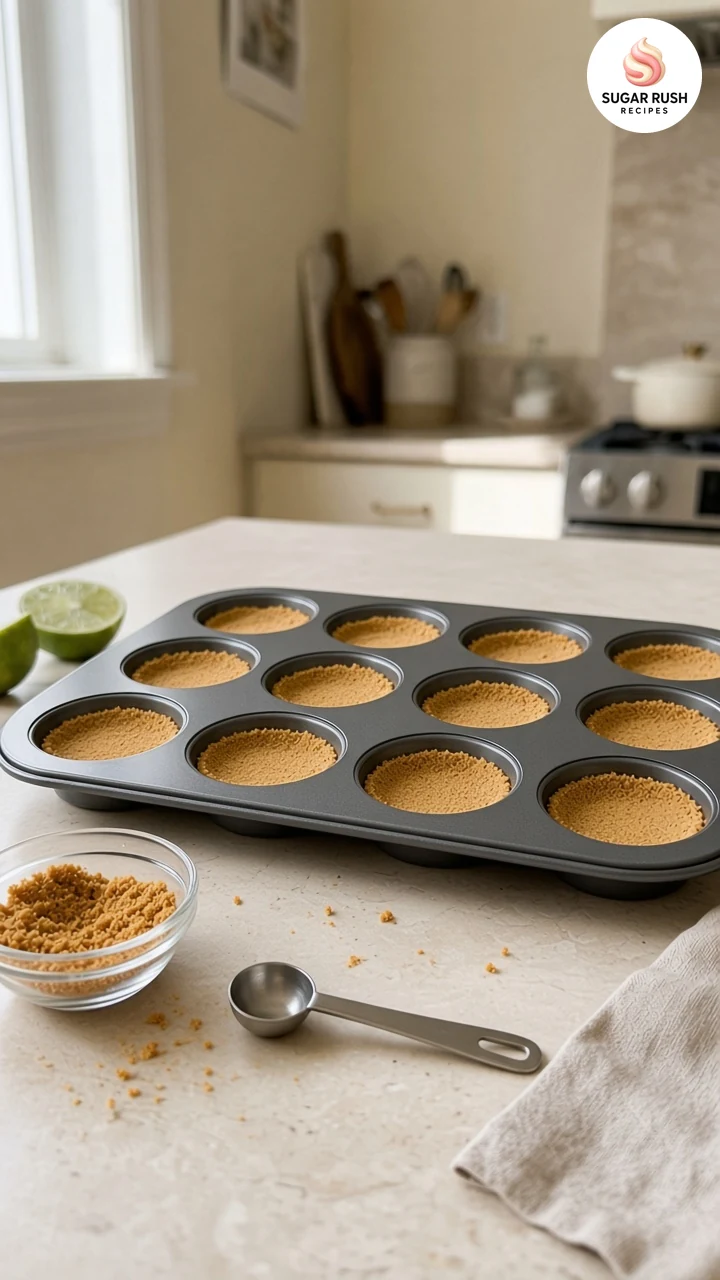
Stir the crumbs, sugar, and a pinch of salt with the melted butter until it looks like wet sand. Spoon about 2 teaspoons into each cavity and press it down hard with the back of a small measuring spoon; a compact layer will not crumble. Bake for 8 minutes, then set aside.
Step 2: Mix and Bake the Key Lime Filling
Cheesecake filling should be mixed, not whipped: air bubbles make the tops puff and crack. Keep the mixer on low speed and scrape the bowl often.
- Beat the softened cream cheese for about 1 minute until completely smooth.
- Add the sugar, cornstarch, and a pinch of salt and beat for 1 minute more.
- Mix in the sour cream, vanilla, and lime zest.
- Add the beaten egg and mix just until no streaks remain.
- Stir in the key lime juice by hand with a spatula.
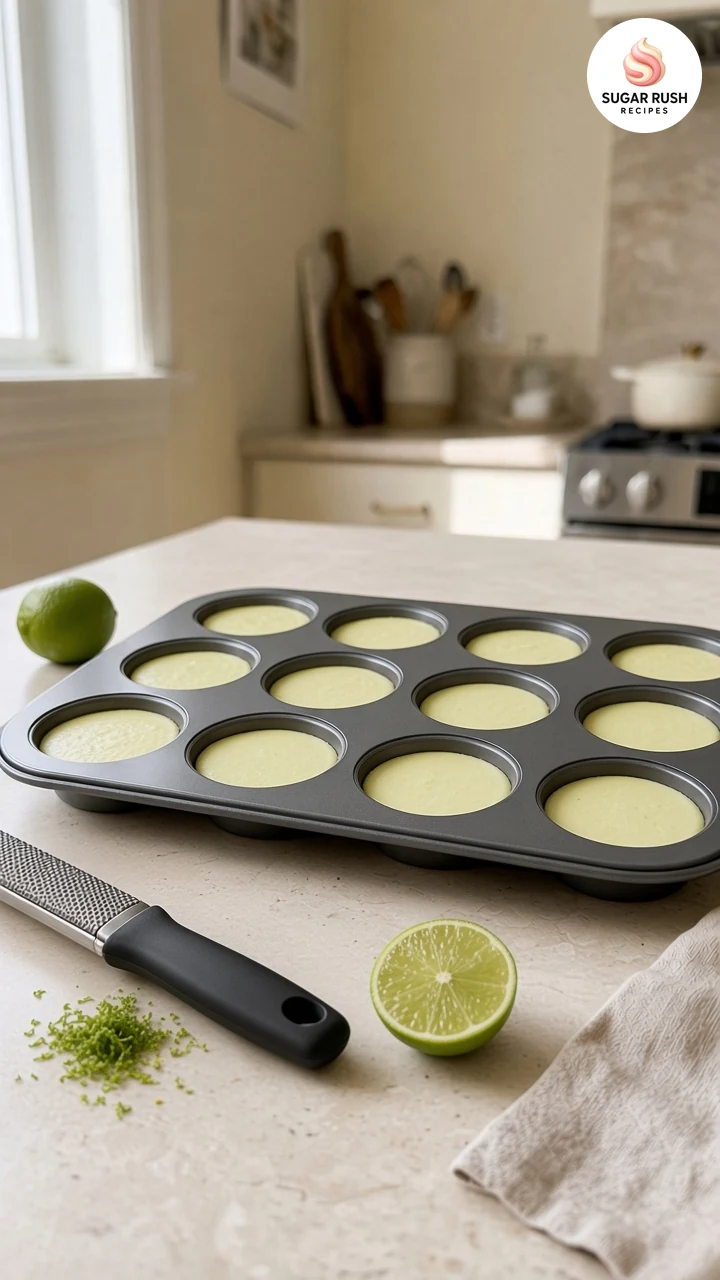
Carefully pour about 1 inch of boiling water into the lower pan. Divide the filling among the cavities, about 2½ tablespoons each, to ⅛ inch below the rim, and tap the pan to pop bubbles. The water under the cheesecakes adds gentle steam; never set a removable-bottom pan directly in a water bath, because water seeps in through the discs.
Bake on the center rack for 18 to 22 minutes. The cheesecakes are ready when the edges look set and slightly puffed, the centers wobble only a little when you nudge the pan, and an instant-read thermometer in the center of one reads 160°F. That is the temperature recommended for baked egg dishes in the USDA guide Shell Eggs from Farm to Table.
Step 3: Cool, Chill, and Unmold
Turn off the oven, prop the door open a few inches, and leave the cheesecakes inside for 15 minutes to prevent cracks. Move the pan to a rack, run a thin knife around each cheesecake, and cool for about 45 minutes.
Refrigerate uncovered for 1 hour, then cover loosely and chill at least 4 hours in total, or overnight. To unmold, set the pan over a small can, press each disc up, and slide a thin spatula between disc and crust. Keep them on a parchment-lined baking sheet in the refrigerator while you make the meringue.
Step 4: Whip and Pipe the Swiss Meringue
Fat keeps egg whites from whipping, so use a spotless bowl and no trace of yolk. Combine the whites, sugar, cream of tartar, and salt in a heatproof bowl set over barely simmering water, without letting it touch the water.
Whisk constantly for 4 to 6 minutes, until the sugar has fully dissolved (rub a drop between your fingers: it should feel smooth, not gritty) and the mixture reaches 160°F on your thermometer. The Egg Safety Center recommends heating egg mixtures with sugar or liquid to 160°F to destroy harmful bacteria.
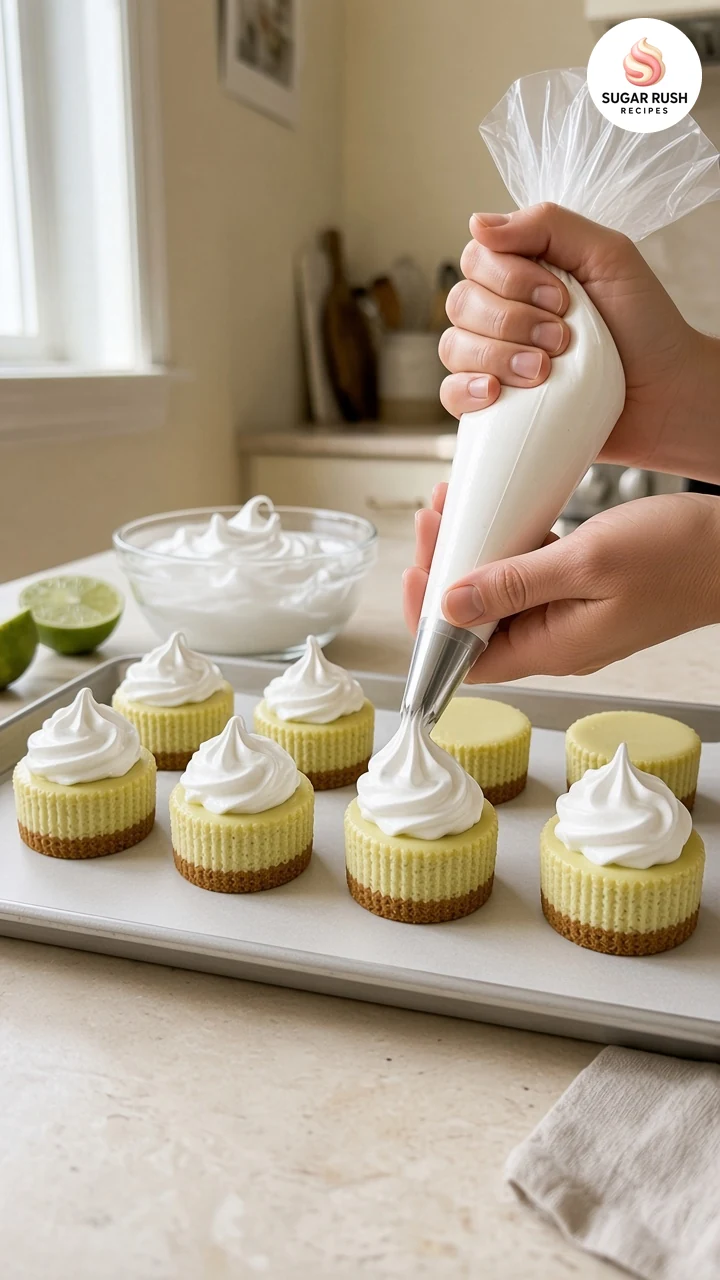
Off the heat, beat on medium-high for 5 to 7 minutes, until thick, glossy, stiff peaks form and the bowl no longer feels warm. Beat in the vanilla and fill a piping bag fitted with the star tip. Holding the bag straight up, pipe two tight circles rising toward the center, then release and lift for a tall peak.
Step 5: Torch the Meringue
Work on the metal baking sheet, away from towels and paper. Hold the flame tip 2 to 3 inches from the meringue and keep it moving in small circles until the ridges turn golden with a few darker tips. Let the torch cool before storing it.
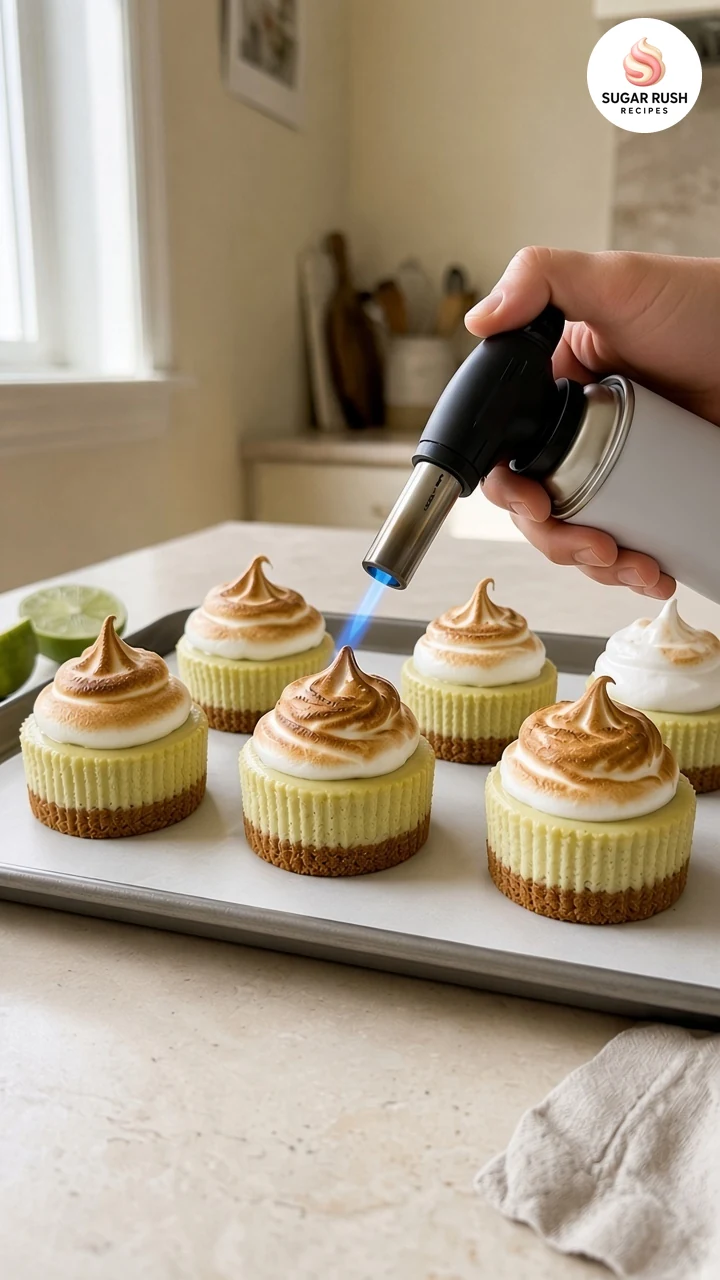
No torch? Make sure the cheesecakes are very cold, then slide the sheet under a preheated broiler for 30 to 90 seconds, watching the whole time, since meringue goes from golden to burnt in seconds.
How Long Mini Key Lime Meringue Cheesecakes Really Take
Chilling takes most of the time. Here is a realistic plan (plus about an hour beforehand to soften the dairy and egg):
- Active prep: about 45 minutes in total (crust and filling about 20 minutes, meringue, piping, and torching about 25 minutes).
- Baking: about 30 minutes (8 minutes for the crust, 18 to 22 minutes for the filling).
- Cooling: about 1 hour (15 minutes in the oven with the door ajar, then about 45 minutes on a rack).
- Chilling: at least 4 hours, or overnight.
- Ready to serve: about 6 hours 15 minutes from start to finish.
It is an ideal dessert to start the day before and finish with meringue on serving day.
Mini Key Lime Meringue Cheesecakes Recipe
Print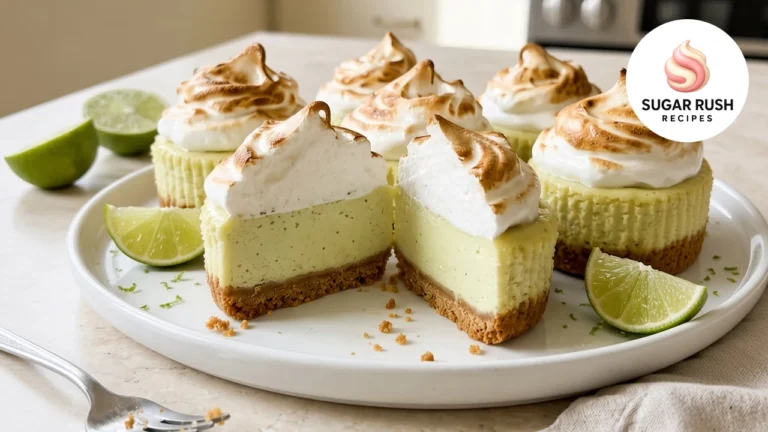
Mini Key Lime Meringue Cheesecakes
Twelve mini cheesecakes with a buttery graham cracker crust, a creamy key lime filling baked gently over a pan of steam, and a tall swirl of food-safe Swiss meringue toasted with a kitchen torch. Made in a 12-cavity mini cheesecake pan with removable bottoms; inspired by Sugar Rush Recipes. About 45 minutes hands-on, ready to serve in about 6 hours 15 minutes including cooling and chilling. Not kitchen-tested by RecipesMind; times are estimates.
- Total Time: 6 hours 15 minutes
- Yield: 12 minis
Ingredients
For the graham cracker crust
- 1/2 cup (50 g) graham cracker crumbs (about 3 1/2 full sheets)
- 1 tbsp granulated sugar
- 2 tbsp (28 g) unsalted butter, melted
- Pinch of salt
For the key lime filling
- 8 oz (226 g) full-fat brick cream cheese, at room temperature
- 1/3 cup (67 g) granulated sugar
- 2 tsp cornstarch
- Pinch of salt
- 2 tbsp (30 g) full-fat sour cream, at room temperature
- 1/2 tsp vanilla extract
- 2 tsp finely grated lime zest (about 2 Persian limes or 4–5 key limes)
- 1 large egg, at room temperature, lightly beaten
- 2 tbsp key lime juice (fresh, or bottled 100% key lime juice; regular lime juice also works)
For the Swiss meringue
- 3 large egg whites (about 100 g)
- 3/4 cup (150 g) granulated sugar
- 1/4 tsp cream of tartar
- Pinch of salt
- 1/2 tsp vanilla extract
To garnish (optional)
- Lime wedges, extra lime zest, and a few graham crumbs
Instructions
- Prepare the oven (about 15 minutes before baking): Set out the cream cheese, sour cream, and egg about 1 hour ahead to soften. Place one rack in the center of the oven and one rack below it. Set an empty 9×13-inch metal pan on the lower rack and preheat the oven to 300°F (150°C). Bring a kettle of water to a boil.
- Make the crust: Stir the graham crumbs, 1 tbsp sugar, pinch of salt, and melted butter until the mixture looks like wet sand. Divide among the 12 cavities of a mini cheesecake pan with removable bottoms (about 2 teaspoons each) and press very firmly with the back of a small measuring spoon. Bake on the center rack for 8 minutes. Set aside.
- Mix the filling (low speed only): With a hand mixer on low, beat the cream cheese about 1 minute until completely smooth. Add the 1/3 cup sugar, cornstarch, and pinch of salt; beat 1 minute, scraping the bowl. Mix in the sour cream, vanilla, and lime zest. Add the egg and mix just until no streaks remain. Stir in the key lime juice by hand with a spatula.
- Fill: Carefully pour about 1 inch of boiling water into the pan on the lower rack. Divide the filling among the cavities (about 2 1/2 tablespoons each), filling to about 1/8 inch below the rim. Tap the pan gently on the counter to release air bubbles. Do not place the removable-bottom pan in a water bath.
- Bake: Bake on the center rack for 18–22 minutes, until the edges are set and slightly puffed, the centers wobble only slightly, and an instant-read thermometer in the center of one cheesecake reads 160°F.
- Cool: Turn off the oven, prop the door open a few inches, and leave the cheesecakes inside for 15 minutes. Transfer the pan to a wire rack, run a thin knife around each cheesecake, and cool about 45 minutes.
- Chill: Refrigerate uncovered for 1 hour, then cover loosely and chill for at least 4 hours total, or up to 3 days.
- Unmold: Set the pan over a small can and push each bottom disc up. Slide a thin offset spatula between the disc and the crust. Arrange the cheesecakes on a parchment-lined baking sheet and keep refrigerated.
- Heat the meringue: In a spotlessly clean, heatproof mixing bowl, combine the egg whites, 3/4 cup sugar, cream of tartar, and pinch of salt. Set over a saucepan of barely simmering water (the bowl should not touch the water). Whisk constantly for 4–6 minutes, until the sugar is fully dissolved and the mixture reaches 160°F on an instant-read thermometer.
- Whip: Remove from the heat and beat on medium-high for 5–7 minutes, until thick, glossy, and holding stiff peaks and the bowl no longer feels warm. Beat in the vanilla.
- Pipe: Transfer the meringue to a piping bag fitted with a large open star tip (such as Wilton 1M). Holding the bag upright, pipe two tight rising circles on each cold cheesecake and lift to form a tall peak.
- Torch: On the metal baking sheet, away from towels and paper, hold the flame tip of a culinary torch 2–3 inches from the meringue and keep it moving until the ridges are golden brown with a few darker tips. (No torch: broil very cold cheesecakes on the top rack for 30–90 seconds, watching constantly.)
- Serve: Garnish with lime wedges, zest, and graham crumbs. Serve cold, ideally within a few hours of topping.
Notes
- Times: Active prep about 45 minutes (crust + filling about 20 minutes; meringue, piping, and torching about 25 minutes). Baking about 30 minutes (crust 8 + filling 18–22). Additional inactive time: about 1 hour cooling (15 minutes in the turned-off oven + about 45 minutes on a rack) and at least 4 hours chilling. Real ready-to-serve time: about 6 hours 15 minutes. Softening the dairy and egg (about 1 hour on the counter) can happen beforehand and is not counted.
- Pan: Portioned for a 12-cavity mini cheesecake pan with removable bottoms, cavities about 2 inches wide and 1 inch deep. Deeper cavities may need 2–4 extra minutes. Muffin tin option: use paper or foil liners and check from 16 minutes; sides will be ruffled.
- Why a pan of water underneath: It adds steam for gentle, even baking without water seeping through the removable bottoms (never set this type of pan in a water bath). It also catches any butter drips.
- Food safety: The filling is baked to 160°F (USDA guidance for baked egg dishes). The meringue is a Swiss meringue: egg whites and sugar are heated to 160°F before whipping, because torching only browns the surface. For extra caution, pasteurized egg whites may be used (they whip more slowly). Do not leave the cheesecakes at room temperature for more than 2 hours.
- Storage: Refrigerate, covered, up to 3–4 days; the meringue is best within about 24 hours (it softens and can weep). Make-ahead: bake and chill the plain cheesecakes up to 3 days ahead and top on serving day. Freeze plain, un-topped cheesecakes individually wrapped up to 1 month; thaw overnight in the refrigerator. Do not freeze with meringue.
- Torch safety: Use a culinary torch with butane made for it, follow the manufacturer’s instructions, work on a metal sheet away from flammable items, and let the torch cool before storing.
- Leftover yolks: 3 raw yolks keep 2–4 days refrigerated, covered.
- Allergens: Contains milk, eggs, and wheat (graham crackers). No dietary claim is made.
- Not kitchen-tested by RecipesMind. Nutrition values are estimates.
- Prep Time: 45 minutes
- Cook Time: 30 minutes
- Category: Dessert
- Method: Baked
- Cuisine: American
Serving Ideas and Variations
To match the Sugar Rush Recipes plate, arrange six cheesecakes on a round white plate, halve one to show the center, and add lime wedges, fresh zest, and a few graham crumbs. They suit brunches, cookouts, and showers.
For a change, use lemon instead of lime or vanilla wafers instead of graham crackers. For a classic slice instead of minis, try the New York cheesecake, or keep the citrus theme going with the two-ingredient lime cheesecake bars and three-ingredient lemon bars. Little desserts for a crowd? The mini strawberry cheesecakes in cups need no oven at all.
Storage and Make-Ahead Tips
Keep these egg-and-dairy desserts refrigerated and do not leave them out for more than 2 hours, in line with USDA egg-handling guidance. Covered, they keep 3 to 4 days (the USDA window for custard pies), but the meringue is best within about 24 hours, after which it softens and may bead with syrup.
Bake the plain cheesecakes up to 3 days ahead and add the meringue on serving day. Un-topped cheesecakes can be frozen, individually wrapped, for up to 1 month; thaw overnight in the refrigerator. Do not freeze them with meringue.
Frequently Asked Questions
Can I make mini key lime meringue cheesecakes in a muffin tin?
Yes. Use paper or foil liners in a standard muffin tin and start checking at 16 minutes. The sides will be ruffled instead of straight.
Can I use regular limes instead of key limes?
Yes. Persian lime juice is slightly less aromatic but still bright and tangy.
Why did my mini cheesecakes crack or sink?
Usually from overmixing or overbaking. Mix on low, pull them at 160°F while the centers still wobble slightly, and cool them gradually.
Is the meringue safe to eat if it is only torched?
Yes, because the whites and sugar are heated to 160°F before whipping. A torch alone only browns the surface. Pasteurized carton whites are another option, though they whip more slowly.
Why is my meringue weeping?
Undissolved sugar and humidity are the usual causes, so dissolve the sugar fully and top them on serving day.
Is this the exact recipe from the Sugar Rush Recipes post?
The post shared the idea but no written recipe. The quantities, method, and food-safety guidance were developed by RecipesMind from established techniques and have not been kitchen-tested.
Tangy, creamy, and crowned with toasty meringue, these little cheesecakes are worth the wait in the refrigerator. Enjoy every bite.