
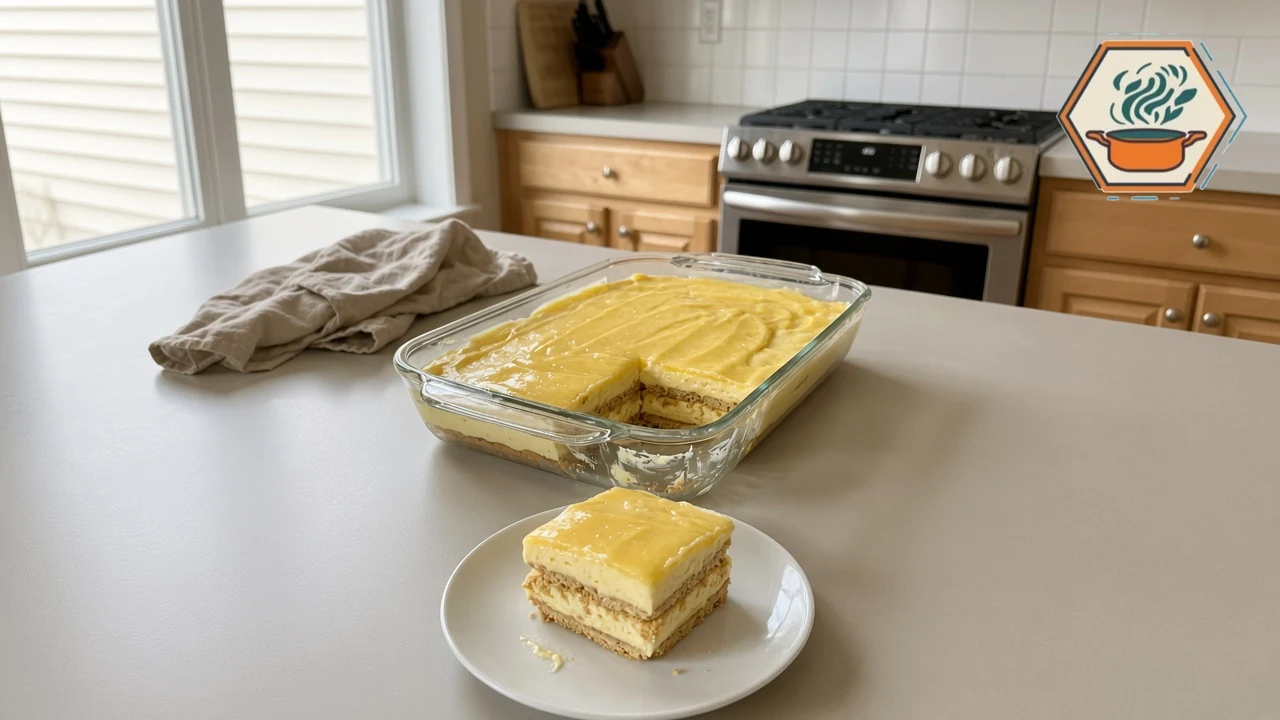
Lemon icebox cake is the kind of dessert that does its best work while you sleep. Crisp graham crackers, a thick and fluffy lemon cream, and a glossy layer of real lemon curd go into one 9×13 dish, and after a night in the refrigerator the crackers soften into tender, cake-like layers. No oven, and it is done a day before you need it: perfect for cookouts, potlucks, and busy weekends.
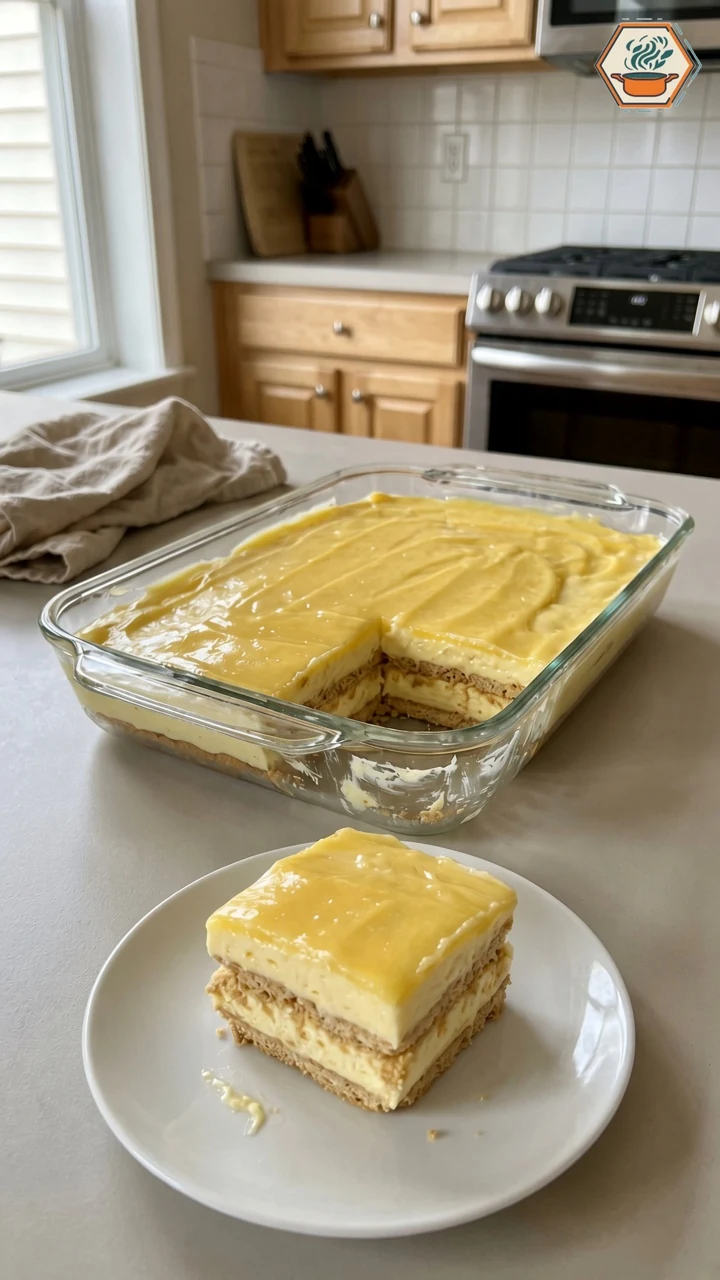
The RecipesMind.Com Facebook post showed this dessert without a written recipe, so the quantities and method below were developed from established techniques, with food-safety checks added. This write-up has not been kitchen-tested by RecipesMind, so use the visual cues and a thermometer along with the clock. Images are AI-generated recipe illustrations based on the post, not photographs of a kitchen test.
In this article
Why This Lemon Icebox Cake Works
In an icebox cake, crackers absorb moisture from the cream as they chill and turn soft enough to slice like cake. The cream has to be thick enough to hold its shape, or the squares turn soupy.
That is why the lemon cream here starts with cream cheese and sweetened condensed milk. When fresh lemon juice meets condensed milk, the acid thickens it noticeably, the same reaction behind classic lemon icebox pie. Cream cheese adds body and tang, and whipped heavy cream folded in at the end makes it light. The result is a stable, sliceable cream with no gelatin, no instant pudding, and no raw eggs.
The glossy top is a real stovetop lemon curd, cooked to 170°F so it is thick, shiny, and food-safe. It sets softly in the fridge and gives every square that bright yellow finish.
Ingredients for Lemon Icebox Cake
Graham crackers: About 20 to 22 full sheets for two layers, most of a standard 14.4-ounce box.
Full-fat brick cream cheese: Use the block kind, softened for about an hour so it beats smooth. Tub-style spreads are too soft.
Sweetened condensed milk: One 14-ounce can sweetens the cream and, with the lemon juice, thickens it. Do not swap in evaporated milk, which is unsweetened and will not set the same way.
Heavy whipping cream: It must be cold to whip to stiff peaks.
Fresh lemons: Plan on 5 to 6 large lemons for 1 cup of juice plus the zest. Zest them before juicing. Fresh juice tastes brighter than bottled.
Eggs, sugar, and butter for the curd: Two whole eggs plus three yolks give the curd a deep yellow color and a silky set. Keep the three leftover whites covered in the refrigerator for 2 to 4 days, the window listed in the USDA Shell Eggs from Farm to Table storage chart.
Easy swaps: Vanilla wafers or Biscoff cookies can replace graham crackers, and gluten-free grahams work if you need them. For an egg-free top, use the cornstarch lemon glaze described in the FAQ. Store-bought lemon curd also works; you will need about 1½ cups.
Helpful Tools for a 9×13 Icebox Cake
As an Amazon Associate, RecipesMind earns from qualifying purchases. The links below are affiliate links; buying through them costs you nothing extra. Your own equipment works fine if it does the same job.
Glass shows off the layers and will not react with lemon. This recipe fills a standard 2-inch-deep, 3-quart 9×13 dish almost to the rim, so a Pyrex Deep 9×13 glass baking dish with lid is a comfortable choice; its lid makes chilling and transport simple.
A Cuisinart Power Advantage 5-speed hand mixer whips the cream and beats the cream cheese base in minutes. For spreading the cream and curd edge to edge, a long Wilton 13-inch angled offset spatula covers a 9×13 surface far faster than a spoon.
A Microplane Classic zester takes only the fragrant yellow zest and leaves the bitter white pith behind, and a Chef’n FreshForce citrus juicer makes squeezing a cup of lemon juice much less tiring. For the curd, an instant-read thermometer like the TempPro TP19H confirms 170°F, and a OXO Good Grips 6-inch fine mesh strainer catches zest and any bits of cooked egg for a perfectly smooth, glossy top.
Step 1: Cook the Lemon Curd
Make the curd first so it has time to cool while you mix the cream. In a medium heavy-bottomed saucepan, off the heat, whisk the eggs, yolks, sugar, lemon zest, and a pinch of salt until smooth, then whisk in the lemon juice.
Set the pan over medium-low heat and stir constantly with a silicone spatula, scraping the bottom and corners, for 8 to 10 minutes. The curd is ready when it is thick enough to coat the spatula and hold a clear line when you swipe a finger through it, and it reads 170°F on an instant-read thermometer. Do not let it boil, or the eggs can curdle.
That temperature also covers food safety. The Egg Safety Center recommends cooking egg mixtures diluted with sugar or liquid to 160°F, and this curd uses about ¼ cup of sugar and juice per egg, as that guidance describes.
Strain the curd into a heatproof bowl, then whisk in the butter, a few cubes at a time, until glossy. Set the bowl in a larger bowl of ice water and stir every few minutes for 15 to 20 minutes, until it is no longer warm to the touch. Press plastic wrap onto the surface if it has to wait.
Step 2: Mix the Fluffy Lemon Cream
Whip the cream first so you can reuse the beaters without washing them. Beat the cold heavy cream, powdered sugar, and vanilla on medium-high for 3 to 4 minutes, until stiff peaks hold their shape. Refrigerate it while you make the base.
- Beat the softened cream cheese on medium for about 1 minute, until completely smooth.
- Gradually beat in the sweetened condensed milk, scraping the bowl, until silky.
- Beat in the lemon zest.
- On low speed, add the lemon juice in two additions and mix for about 30 seconds; the base will thicken as the acid meets the condensed milk.
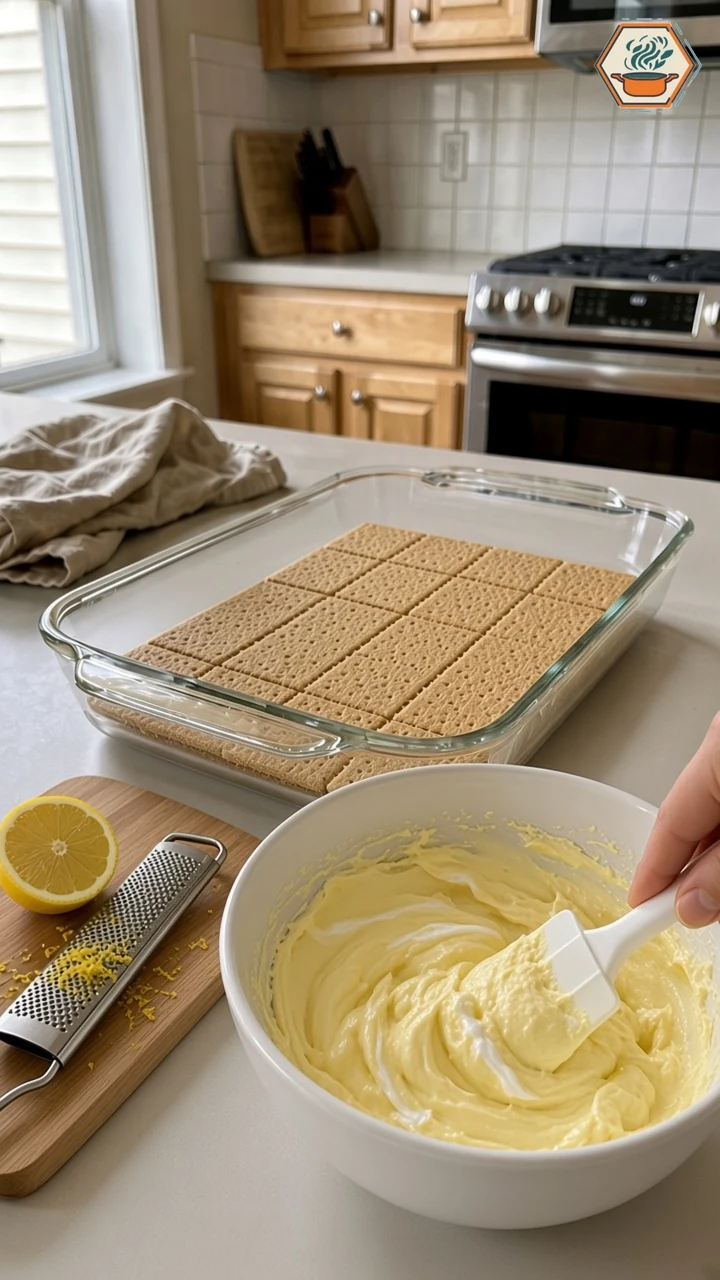
Stir about 1 cup of the whipped cream into the base to lighten it, then fold in the rest in two additions with a large spatula, cutting down through the middle and sweeping up the sides. Stop as soon as the white streaks disappear. You will have about 7 cups of thick, fluffy lemon cream.
Step 3: Build the Layers
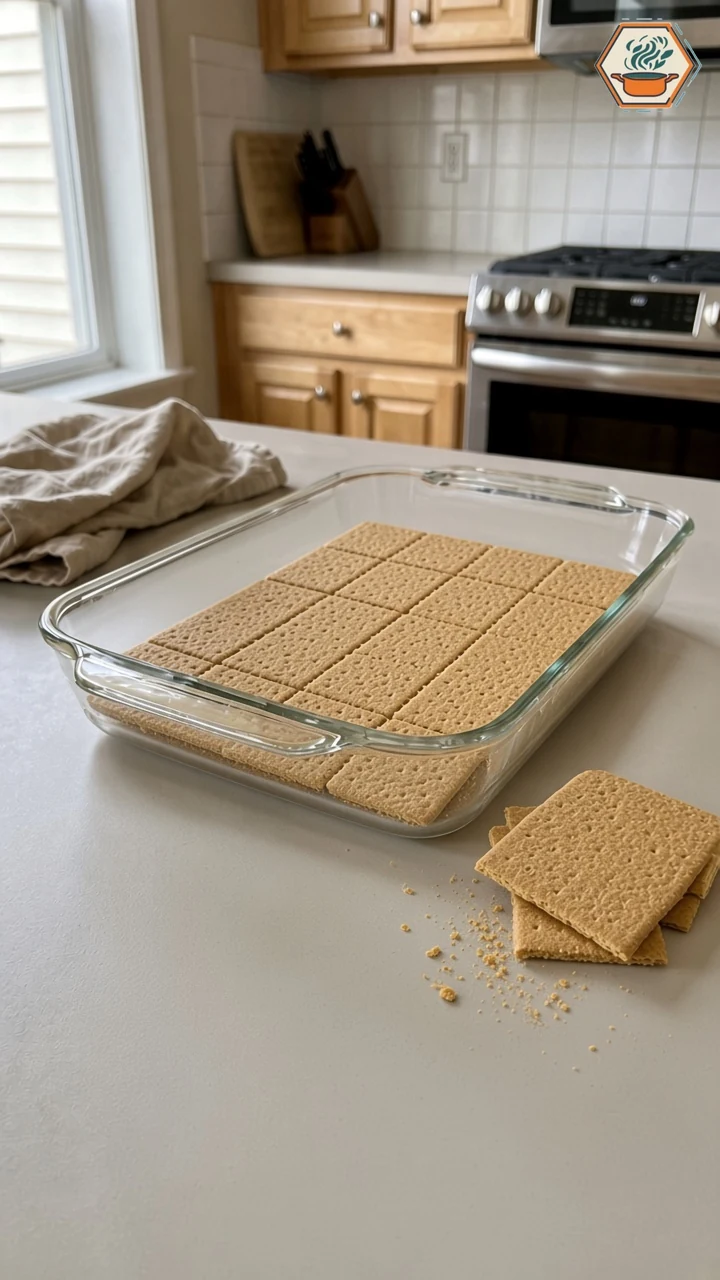
Cover the bottom of the 9×13 dish with a single layer of graham crackers, about 10 to 11 full sheets, breaking pieces along the perforations to fill the gaps.
Spread half the lemon cream, about 3½ cups, evenly over the crackers, pushing it right to the edges so every square gets its share. Add a second layer of graham crackers and press them down gently so they settle into the cream.
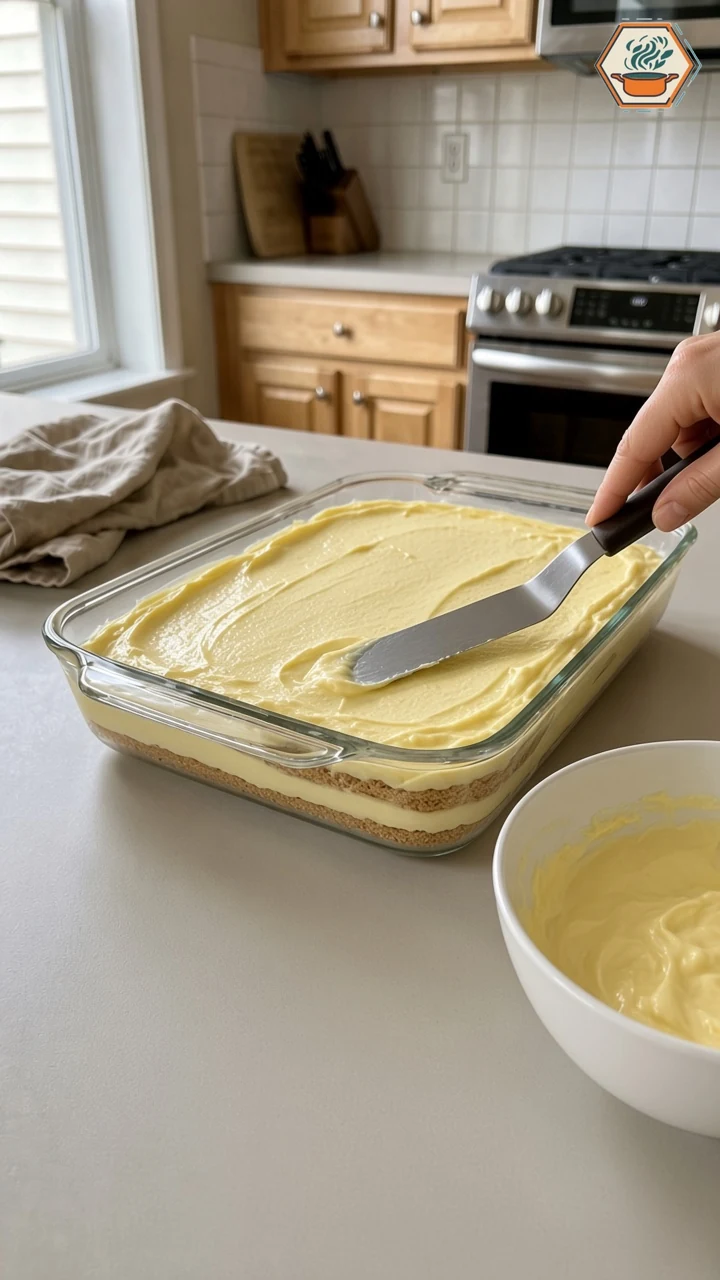
Spread the remaining cream over the top and smooth it level so the curd layer is even.
Step 4: Add the Glossy Lemon Top
Check that the curd is cool; warm curd will melt the whipped cream. Spoon or pour it over the cream in several spots, then spread it gently to the edges with the offset spatula, leaving a few soft swirls for that glossy look.
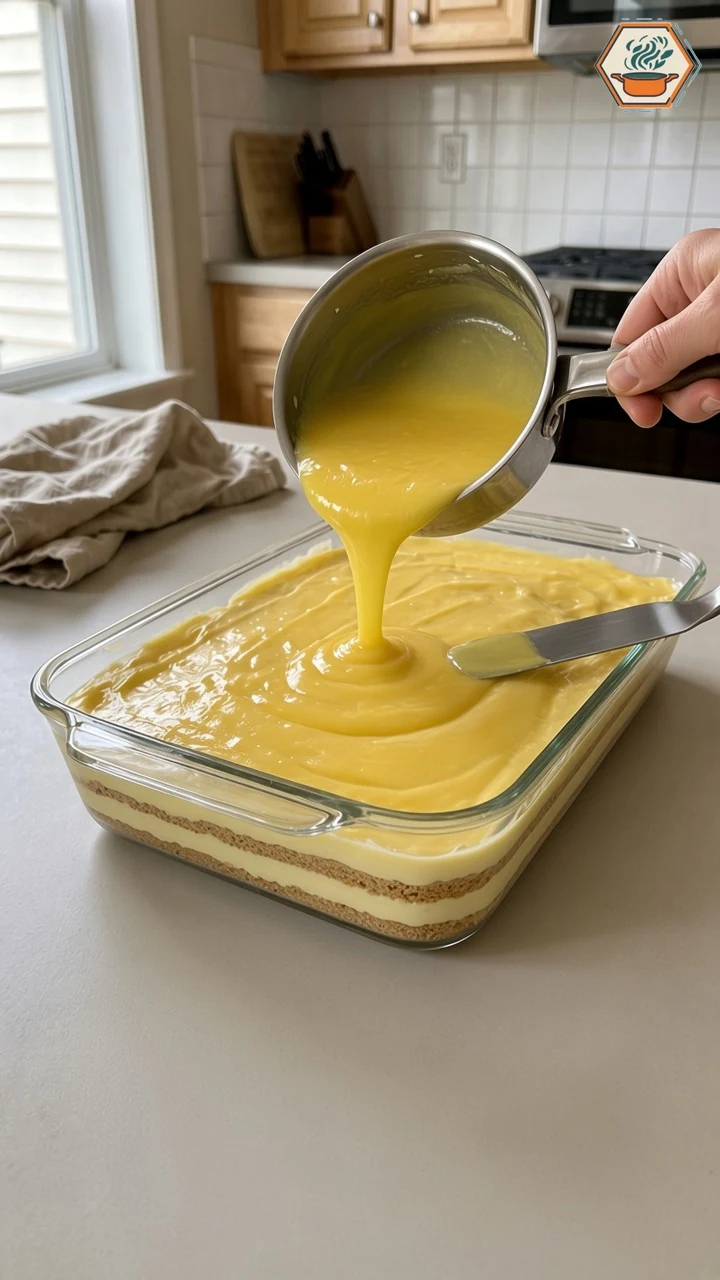
Step 5: Chill Overnight and Slice
Cover the dish and refrigerate for at least 8 hours, preferably overnight. If the lid would touch the curd, tent plastic wrap over a few toothpicks instead.
To serve, cut 3 rows by 5 rows for 15 squares with a long, sharp knife dipped in hot water and wiped dry between cuts. Lift the first piece out with a thin spatula. Serve cold and return leftovers to the refrigerator right away.
How Long Lemon Icebox Cake Really Takes
Here is a realistic plan (soften the cream cheese for about an hour beforehand):
- Active prep: about 40 minutes (zesting and juicing, starting the curd, whipping the cream, mixing, layering, and spreading). The curd cools in its ice bath while you work.
- Stovetop cooking: about 10 minutes for the curd.
- Chilling: at least 8 hours, or overnight.
- Ready to serve: about 8 hours 50 minutes, so start the evening before or early in the morning.
Lemon Icebox Cake Recipe
Print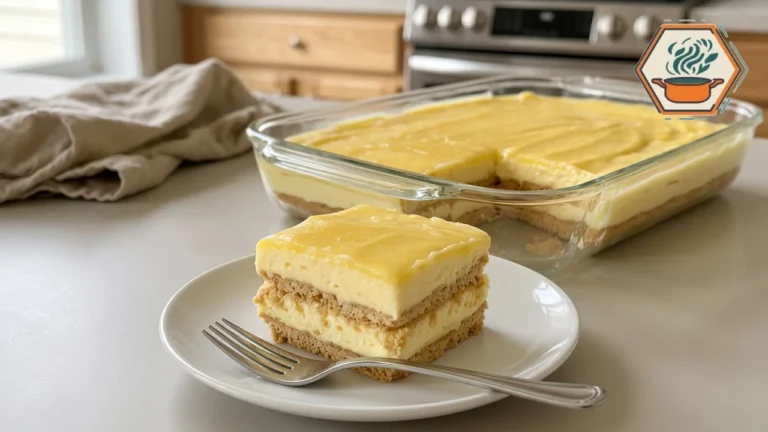
No-Bake Lemon Icebox Cake
Two layers of graham crackers and a fluffy no-bake lemon cream (cream cheese, sweetened condensed milk, fresh lemon and whipped cream), finished with a glossy homemade lemon curd cooked to 170°F. Chilled overnight in one 9×13 glass dish until the crackers turn soft and cake-like. About 40 minutes hands-on; ready in about 8 hours 50 minutes including chilling. Not kitchen-tested by RecipesMind; times are estimates.
- Total Time: 8 hours 50 minutes
- Yield: 15 squares (one 9×13 dish)
Ingredients
For the lemon curd topping2 large eggs3 large egg yolks3/4 cup (150 g) granulated sugar2 tsp finely grated lemon zest1/2 cup (120 ml) fresh lemon juicePinch of salt4 tbsp (57 g) unsalted butter, cut into cubesFor the lemon cream2 cups (480 ml) cold heavy whipping cream1/4 cup (30 g) powdered sugar1 tsp vanilla extract8 oz (226 g) full-fat brick cream cheese, softened1 can (14 oz / 396 g) sweetened condensed milk1 tbsp finely grated lemon zest1/2 cup (120 ml) fresh lemon juiceFor the layers20 to 22 full graham cracker sheets (most of one 14.4-oz box)Total lemons: about 5–6 large lemons for 1 cup juice + 5 tsp zest.
Instructions
Prep: Soften the cream cheese on the counter for about 1 hour. Zest the lemons first, then juice them and strain out the seeds.
Cook the curd: In a medium heavy-bottomed saucepan, off the heat, whisk the eggs, yolks, sugar, 2 tsp zest, and salt until smooth; whisk in 1/2 cup lemon juice. Cook over medium-low heat, stirring constantly with a silicone spatula and scraping the bottom and corners, 8–10 minutes, until thick enough to coat the spatula and it reaches 170°F on an instant-read thermometer. Do not boil.
Strain and cool the curd: Strain into a heatproof bowl and whisk in the butter a few cubes at a time until glossy. Set the bowl in a larger bowl of ice water and stir every few minutes for 15–20 minutes, until no longer warm to the touch. Press plastic wrap onto the surface if it has to wait.
Whip the cream: Beat the cold heavy cream, powdered sugar, and vanilla on medium-high for 3–4 minutes, until stiff peaks form. Refrigerate.
Make the lemon base: With the same beaters, beat the cream cheese on medium about 1 minute until smooth. Gradually beat in the sweetened condensed milk until silky, scraping the bowl. Beat in 1 tbsp zest. On low, add 1/2 cup lemon juice in two additions and mix about 30 seconds, until thickened.
Fold: Stir about 1 cup whipped cream into the base to lighten it, then gently fold in the rest in two additions just until no white streaks remain (about 7 cups).
Layer: Cover the bottom of a 9×13-inch glass dish (3-quart or deep) with a single layer of graham crackers (10–11 sheets), breaking pieces to fill gaps. Spread half the lemon cream (about 3 1/2 cups) to the edges. Add a second layer of graham crackers and press gently. Spread the remaining cream and smooth the top.
Top: Make sure the curd is cool. Spoon it over the cream and spread gently to the edges with an offset spatula, leaving soft swirls.
Chill: Cover (tent plastic wrap over toothpicks if a lid would touch the curd) and refrigerate at least 8 hours, preferably overnight, until the crackers are soft and cake-like.
Slice and serve: Cut into 15 squares (3 × 5) with a long sharp knife dipped in hot water and wiped between cuts. Serve cold; refrigerate leftovers promptly.
Notes
Times: Active prep about 40 minutes (the curd cools in its ice bath while you make the cream and layer). Stovetop cooking about 10 minutes. Additional inactive time: at least 8 hours chilling. Real ready-to-serve time: about 8 hours 50 minutes. Softening the cream cheese (~1 hour) happens beforehand and is not counted.
Dish size: The assembled dessert (about 10 1/2 cups) fills a standard 2-inch-deep, 3-quart 9×13 dish almost to the rim; a deep 9×13 dish leaves room for a lid.
Why this cream is stable: Lemon juice thickens sweetened condensed milk, cream cheese adds body, and whipped cream adds lightness — no gelatin, pudding mix, or raw eggs.
Food safety: The curd is cooked to 170°F (above the 160°F recommended for egg mixtures). Keep the dessert refrigerated at 40°F or below and do not leave it out more than 2 hours (1 hour above 90°F).
Storage: Covered in the refrigerator 3–4 days (best on days 1–2). Freezing is not recommended (curd and whipped cream weep and turn grainy).
Make-ahead: Assemble the day before serving. The curd can be made up to 5 days ahead and refrigerated with plastic pressed on the surface; whisk smooth before spreading.
Egg-free top: Cornstarch lemon glaze — whisk 3/4 cup sugar, 3 tbsp cornstarch, pinch of salt, and 1 cup water; boil 1 minute while whisking until thick and clear; off the heat whisk in 1/2 cup lemon juice, 2 tsp zest, and 1 tbsp butter. Cool completely before spreading.
Swaps: Vanilla wafers, Biscoff cookies, or gluten-free grahams for graham crackers; about 1 1/2 cups store-bought lemon curd for homemade.
Leftover whites: 3 raw whites keep 2–4 days refrigerated, covered.
Allergens: Contains milk, eggs, and wheat (graham crackers). No dietary claim is made.
Not kitchen-tested by RecipesMind. Nutrition values are estimates.
- Prep Time: 40 minutes
- Cook Time: 10 minutes
- Category: Dessert
- Method: No-Bake
- Cuisine: American
Common Mistakes to Avoid
- Spreading warm curd. It melts the cream and the layers bleed together. Cool it until it no longer feels warm.
- Under-whipping the cream. Soft peaks make a runny filling. Whip until stiff peaks stand up on the beaters.
- Using cold cream cheese. It leaves lumps that never beat out. Let it soften first.
- Boiling the curd. High heat scrambles the eggs. Keep it on medium-low, stir constantly, and pull it at 170°F.
- Cutting too soon. Before 8 hours the crackers are still crisp and the slices fall apart.
Serving Ideas and Variations
Garnish with lemon slices, zest, or fresh berries just before serving. For more lemon desserts, try the three-ingredient lemon bars, the blueberry lemon cream cheese dream, or the lemon strawberry dream lush. Love icebox-style desserts? The strawberry lemon cream icebox pie and the chocolate eclair cake use the same chill-and-soften idea.
Storage and Make-Ahead Tips
This dessert contains dairy and cooked eggs, so keep it refrigerated at 40°F or below. FoodSafety.gov advises never leaving perishable food out for more than 2 hours, or 1 hour above 90°F, so put it back in the fridge after serving. Covered, it keeps 3 to 4 days, the same window the USDA lists for custard pies; the texture is best on days 1 and 2.
Make ahead: Assemble it the day before serving. The curd can be made up to 5 days ahead and refrigerated with plastic wrap pressed onto the surface; whisk it smooth before spreading.
Freezing: Not recommended. The USDA advises against freezing custard and chiffon pies, and the curd and whipped cream tend to weep and turn grainy when thawed.
Frequently Asked Questions
Why is it called an icebox cake?
“Icebox” is an old name for the refrigerator. There is no baking: the crackers soften into cake-like layers as the dessert chills.
How long does lemon icebox cake need to chill?
At least 8 hours, and overnight is best. Before that, the crackers stay crisp and the squares will not hold together.
Can I make it without eggs?
Yes. Replace the curd with a cornstarch lemon glaze: whisk ¾ cup sugar, 3 tablespoons cornstarch, and a pinch of salt with 1 cup water in a saucepan, bring to a boil while whisking, and boil for 1 minute until thick and clear. Off the heat, whisk in ½ cup lemon juice, 2 teaspoons zest, and 1 tablespoon butter. Cool completely before spreading. It is paler than curd and tastes a bit less rich.
Why is my lemon cream runny?
The usual causes are under-whipped cream, overly warm cream cheese, or folding too hard. Whip to stiff peaks, fold just until streaks disappear, and chill the full 8 hours.
Is this the exact recipe from the Facebook post?
The post shared the dessert but no written recipe. These quantities, method, and food-safety guidance were developed by RecipesMind from established techniques and have not been kitchen-tested.
Cool, creamy, and full of bright lemon flavor, this make-ahead dessert is ready and waiting in the fridge when you need it. Enjoy every slice.