
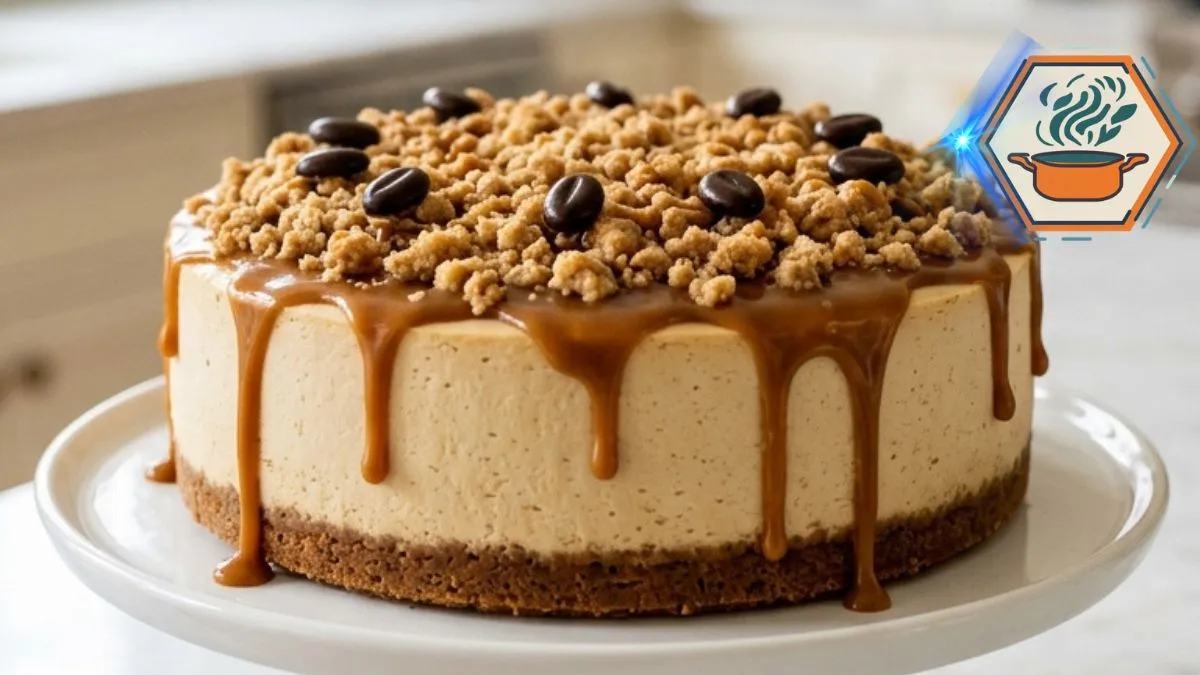
The first forkful of Coffee Crumble Cheesecake is all about contrast. The base is firm and buttery. The center is thick, smooth, and creamy. Then comes a layer of golden crumble and a glossy caramel-coffee sauce that slowly runs down each slice. A few chocolate-covered coffee beans on top give it the coffee-shop finish seen in our inspiration.
This recipe is built to make that result possible at home, not simply to look good in a photograph. Small details matter with cheesecake. Cream cheese should be softened before mixing. Eggs should be incorporated gently. The crust needs enough butter to hold together after slicing. According to the U.S. Food and Drug Administration’s egg-safety guidance, dishes containing eggs should be thoroughly cooked, and good handling practices are important when working with raw eggs.
Cooling matters just as much. A cheesecake should not go directly from a hot oven into a cold refrigerator. Give it time to cool, then chill it thoroughly before decorating and slicing. Once refrigerated, keep it at 40°F (4°C) or below, which is consistent with FDA guidance for dairy and egg foods.
The result is a dessert for anyone who loves coffee, caramel, cheesecake, and crunchy toppings in the same bite.
JUMP TO
Coffee Crumble Cheesecake
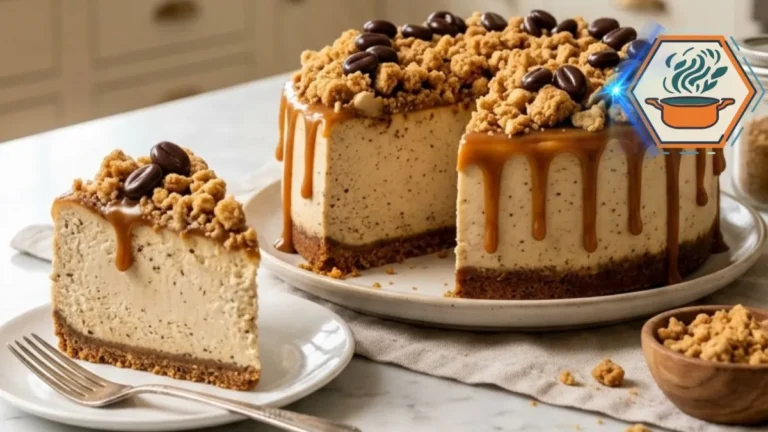
A rich Coffee Crumble Cheesecake with a firm buttery graham cracker crust, smooth espresso cheesecake filling, golden brown sugar crumble, and thick caramel-coffee drips.
- Total Time: 9 hours 30 minutes
- Yield: 1 9-inch cheesecake / 12 slices
Ingredients
Graham Cracker Crust
- 2 cups (200 g) fine graham cracker crumbs
- 2 tablespoons packed light brown sugar
- 1/4 teaspoon fine salt
- 7 tablespoons (100 g) unsalted butter, melted
Coffee Cheesecake Filling
- 24 oz (680 g) full-fat block cream cheese, softened
- 3/4 cup (150 g) granulated sugar
- 3/4 cup (180 g) full-fat sour cream, at room temperature
- 3 large eggs, at room temperature
- 2 teaspoons instant espresso powder
- 1 tablespoon hot water
- 1 teaspoon vanilla extract
- 1 tablespoon all-purpose flour
- 1 pinch fine salt
Golden Crumble
- 3/4 cup (95 g) all-purpose flour
- 1/3 cup (65 g) packed light brown sugar
- 1/4 teaspoon ground cinnamon
- 1 pinch fine salt
- 5 tablespoons (70 g) unsalted butter, melted and slightly cooled
Caramel-Coffee Sauce
- 3/4 cup thick caramel sauce
- 1 teaspoon instant espresso powder
- 1 teaspoon hot water
- 1 pinch fine salt
Decoration
- Golden crumble, as needed
- 8–12 chocolate-covered coffee beans, optional
- Caramel-coffee sauce, as needed
Instructions
Preheat the oven to 325°F (163°C).
Lightly grease a 9-inch springform pan. Line the bottom with parchment paper.
If you use a water bath, wrap the outside of the springform pan carefully with heavy-duty foil to reduce the risk of water entering the pan.
2. Make the graham cracker crustCombine the graham cracker crumbs, brown sugar, and salt.
Pour in the melted butter. Stir until every crumb looks evenly coated.
Squeeze a small amount between your fingers. It should hold together.
If your particular crackers are very dry and the mixture still falls apart, add 1 extra tablespoon of melted butter.
Press the mixture firmly and evenly into the bottom of the prepared pan.
Use the flat bottom of a measuring cup or glass to compact it.
Bake for 8–10 minutes.
Remove from the oven and allow the crust to cool slightly.
3. Dissolve the espressoCombine 2 teaspoons espresso powder with 1 tablespoon hot water.
Stir until dissolved.
Set it aside for a few minutes so it is no longer hot when added to the filling.
4. Prepare the cheesecake fillingBeat the softened cream cheese on low to medium-low speed until smooth.
Add granulated sugar, flour, and salt.
Mix only until combined.
Add sour cream, vanilla, and dissolved espresso.
Mix again on low speed.
Add the eggs one at a time.
Mix only until each egg disappears into the batter.
Avoid prolonged beating after adding the eggs.
5. Fill the panPour the coffee cheesecake batter over the cooled crust.
Smooth the surface gently with a spatula.
Tap the pan lightly on the counter several times to release larger trapped air bubbles.
6. BakeBake at 325°F (163°C) for about 60–75 minutes.
The outer area should appear set while the center still has a slight wobble.
For food safety, the FDA states that dishes containing eggs should reach 160°F (71°C). A food thermometer can be used to verify the temperature.
7. Cool graduallyTurn off the oven.
Leave the cheesecake inside with the oven door slightly open for about 30 minutes.
Remove it from the oven and allow it to continue cooling at room temperature.
Once cooled, cover and refrigerate.
8. ChillRefrigerate for at least 6 hours.
For the cleanest slices and best texture, chill overnight.
9. Make the crumblePreheat the oven to 350°F (177°C).
Combine flour, brown sugar, cinnamon, and salt.
Add the melted butter.
Mix with a fork until irregular clusters form.
Leave some medium-sized pieces rather than turning everything into fine crumbs.
Spread onto a parchment-lined baking sheet.
Bake for 10–14 minutes, or until golden brown.
Cool completely.
10. Make the caramel-coffee sauceDissolve 1 teaspoon espresso powder in 1 teaspoon hot water.
Stir it into the caramel sauce with a small pinch of salt.
The caramel should flow slowly from a spoon.
Do not use it while very hot.
11. DecorateRemove the chilled cheesecake from the springform pan.
Scatter golden crumble across the top, concentrating some of it around the outer edge.
Add several chocolate-covered coffee beans.
Spoon the caramel-coffee sauce close to the edge.
Gently push portions over the side to create thick drips of different lengths.
12. Slice and serveDip a sharp knife in hot water.
Dry it thoroughly.
Cut one slice.
Clean and warm the blade again before each following cut.
Serve chilled.
Notes
Use full-fat block cream cheese rather than whipped cream cheese for a dense cheesecake that holds its shape.
Bring the cream cheese, sour cream, and eggs close to room temperature before mixing. This helps create a smoother batter without requiring excessive beating.
Do not skip the butter in the crust. The butter binds the crumbs and helps the finished slice stay intact.
Do not put the crumble onto the cheesecake before its long baking period. Baking the crumble separately keeps the topping visibly crisp and golden.
The caramel should be fluid but not hot when it goes onto the chilled cake. Hot caramel can become too runny and soften the surface.
For the appearance of your reference image, use large irregular golden crumble pieces, a few dark chocolate-covered coffee beans, and thick caramel-coffee drips.
Keep the finished cheesecake refrigerated.
- Prep Time: 35 minutes
- Cook Time: 6 hours minimum
- Category: Dessert
- Method: Baking
- Cuisine: American
- Diet: Vegetarian
Why This Coffee Crumble Cheesecake Works
There are many ways to make a coffee cheesecake. Some versions are baked, while others set in the refrigerator. Search results also show versions made with chocolate cookie crusts, graham cracker crusts, coffee syrup, cocoa crumble, whipped cream, or chocolate-covered espresso beans.
For this recipe, we want something more specific.
The finished cake should resemble the inspiration photo: a tall pale coffee cheesecake, a thick brown biscuit crust, golden crumble pieces, dark chocolate-covered coffee beans, and dramatic caramel-colored sauce running over the edge.
That means every layer has a job.
The crust cannot simply be dry cookie crumbs. It needs melted butter to bind the crumbs, plus brown sugar for a deeper toasted flavor.
The filling needs enough cream cheese to create a tall cake. Sour cream adds softness without turning it into a mousse.
The crumble needs to remain separate from the cheesecake during baking. Adding it after chilling keeps those little pieces crisp.
Finally, the sauce should be thick enough to form visible drips rather than disappearing down the sides.
If you enjoy learning why small ingredient choices matter in desserts, our guide to mastering caramelized sugar is a useful companion.
Ingredients You’ll Need
This recipe makes one 9-inch cheesecake, about 12 slices.
For the Firm Graham Cracker Crust
- 2 cups (about 200 g) fine graham cracker crumbs
- 2 tablespoons packed light brown sugar
- 1/4 teaspoon fine salt
- 7 tablespoons (100 g) unsalted butter, melted
That last ingredient is important. A crust made from crumbs alone will fall apart when you lift a slice.
Butter coats and binds the crumbs. Pressing them firmly into the pan also makes a major difference.
For the Coffee Cheesecake Filling
- 24 oz (680 g) full-fat block cream cheese, softened
- 3/4 cup (150 g) granulated sugar
- 3/4 cup (180 g) full-fat sour cream, room temperature
- 3 large eggs, room temperature
- 2 teaspoons instant espresso powder
- 1 tablespoon hot water
- 1 teaspoon vanilla extract
- 1 tablespoon all-purpose flour
- Pinch of fine salt
Use block-style cream cheese, rather than a very soft spread, for the dense filling pictured here.
Instant espresso powder also works particularly well because it provides concentrated coffee flavor without adding much liquid.
For the Golden Crumble
- 3/4 cup (95 g) all-purpose flour
- 1/3 cup (65 g) light brown sugar
- 1/4 teaspoon cinnamon
- Pinch of salt
- 5 tablespoons (70 g) unsalted butter, melted and slightly cooled
For the Caramel-Coffee Sauce
- 3/4 cup thick caramel sauce
- 1 teaspoon instant espresso powder
- 1 teaspoon hot water
- Pinch of salt
For the Decoration
- Extra golden crumble
- 8–12 chocolate-covered coffee beans, optional
- Extra caramel-coffee sauce
Equipment
You don’t need professional pastry equipment.
Have these items ready:
- 9-inch springform pan
- Large mixing bowl
- Electric hand mixer or stand mixer
- Rubber spatula
- Measuring cups or kitchen scale
- Baking sheet
- Parchment paper
- Small bowl
- Flat-bottomed glass or measuring cup
- Roasting pan for the water bath
- Aluminum foil if your springform pan is not watertight
A kitchen scale gives the most consistent results, especially for the crust and crumble.
Step 1: Prepare the Pan and Oven
Preheat the oven to 325°F (163°C).
Grease the inside of a 9-inch springform pan lightly. Place a circle of parchment paper on the bottom.
If using a water bath, protect the outside of the pan carefully with heavy-duty foil. An alternative is to place the cheesecake on the center rack and a separate pan of hot water on the rack underneath. This avoids water leaking through the springform pan.
Step 2: Make a Crust That Actually Holds Together
Combine the graham cracker crumbs, brown sugar, and salt.
Pour in the melted butter.
Mix until every crumb looks evenly moistened. When you squeeze a spoonful in your hand, it should hold its shape.
If it immediately falls apart, the crumbs may be unusually dry. Mix in 1 additional tablespoon of melted butter.
Transfer the mixture to the pan.
Use the flat bottom of a glass to press it into a tight, even layer. Pay special attention to the outer edge, where loose crumbs often cause slices to break.
Bake for 8–10 minutes.
Remove it from the oven and let it cool while you prepare the filling.
This short pre-bake gives the finished cheesecake a firmer, cleaner crust.
Step 3: Build the Coffee Flavor
Stir the espresso powder into 1 tablespoon of hot water.
Let it cool for a few minutes.
This simple step prevents dry coffee granules from creating bitter spots in the filling.
You can adjust the coffee character slightly. Use a little less espresso powder for a gentle café flavor. Keep the full amount for a more distinct coffee finish.
Step 4: Make a Smooth Cheesecake Filling
Put the softened cream cheese into a large bowl.
Beat on low to medium-low speed until smooth. Scrape the sides and bottom of the bowl.
Add the sugar, flour, and salt. Mix just until combined.
Add the sour cream, vanilla, and dissolved espresso. Mix again at low speed.
Now add the eggs one at a time.
Stop mixing as soon as the final egg disappears into the batter.
This is one of the most important details in the recipe.
Aggressive beating after adding the eggs traps extra air. That air expands in the oven and can contribute to a cheesecake rising too quickly and then sinking or cracking.
The batter should be creamy and mostly free from lumps.
Pour it over the cooled crust.
Tap the pan gently on the counter a few times to release larger air bubbles.
Step 5: Bake Slowly
Place the cheesecake in the oven.
Bake for approximately 60–75 minutes. Oven performance and pan material can change the exact time.
Do not wait until the entire cake looks hard.
The outside should appear set. The center should still have a small, controlled wobble when the pan is moved gently.
Avoid repeatedly opening the oven door.
When the cheesecake is ready, turn off the oven. Crack the door open slightly and leave the cake inside for about 30 minutes.
Then remove it and continue cooling at room temperature.
This gradual temperature change is much gentler than moving a hot cheesecake straight into a cold environment.
For another dessert where controlling sugar and heat makes a major difference, see our guide explaining what crème brûlée is made of.
Step 6: Chill Before Decorating
Once the cheesecake has cooled, cover it and refrigerate it for at least 6 hours.
Overnight is even better.
This isn’t wasted time.
A freshly baked cheesecake may look ready while its center is still too soft for a neat slice. Chilling firms the filling and allows the flavors to settle.
Do not add the crumble before this stage. Keeping it separate protects its crisp texture.
Step 7: Make the Golden Crumble
While the cheesecake chills, prepare the part that gives Coffee Crumble Cheesecake its signature crunch.
Heat the oven to 350°F (177°C).
Mix the flour, brown sugar, cinnamon, and salt.
Pour in the melted butter.
Stir with a fork until irregular clumps form. Do not turn everything into fine crumbs. You want a mixture of small and medium clusters similar to those visible in the reference cheesecake.
Spread them across a parchment-lined baking sheet.
Bake for approximately 10–14 minutes, until golden.
Let the crumble cool completely.
It becomes crisper as it cools.
If crunchy desserts are your favorite, our article on the secret to crunchy cookies explains more about creating crisp textures.
Step 8: Make the Glossy Caramel-Coffee Drip
Mix the espresso powder with the hot water until dissolved.
Stir it into the caramel sauce with a tiny pinch of salt.
Now check the consistency.
The sauce needs to flow from a spoon in a thick ribbon. If it is very cold and stiff, warm it only enough to make it pourable.
Do not pour hot caramel over a cold cheesecake.
Hot sauce can soften the surface and produce thin, messy drips.
The goal is the thick caramel curtain seen in the inspiration: slow drips that stop at different points around the cake.
Step 9: Recreate the Finished Look
Remove the thoroughly chilled cheesecake from its springform pan.
Transfer it to a cake plate.
Spoon a generous amount of golden crumble around the top edge and scatter smaller pieces toward the center.
Add a few chocolate-covered coffee beans in small groups.
Then spoon the caramel-coffee sauce around the upper edge.
Encourage several drips with the back of a spoon. Some should be short. Others can travel almost to the crust.
Finish with a little more crumble.
This combination creates the creamy, crunchy, coffee-forward appearance we wanted from the beginning.
How to Cut Clean Cheesecake Slices
The first slice is often where a beautiful cheesecake loses its polished appearance.
Use a long, sharp knife.
Dip the blade in hot water and wipe it dry. Make one cut.
Clean the knife again before making the second cut.
Repeat for every slice.
The cold filling should reveal a dense, creamy interior sitting above the compact brown crust, while the sauce begins to run gently down the cut surface.
Common Coffee Cheesecake Mistakes
Using cold cream cheese: It tends to leave small lumps. Let the cream cheese soften before mixing.
Overmixing the eggs: More mixing isn’t better here. Once the eggs are incorporated, stop.
Making a dry crust: The crumbs need enough melted butter to bind them.
Skipping the crust pre-bake: A short bake creates a sturdier base.
Baking until completely rigid: Cheesecake continues to settle as it cools.
Decorating while warm: The crumble can lose crunch and the sauce may become too thin.
Cutting before chilling: Even a properly baked cheesecake needs time in the refrigerator to become cleanly sliceable.
Make-Ahead and Storage
This dessert is an excellent make-ahead recipe.
Bake the cheesecake the day before serving. Chill it overnight, then add the crumble and caramel closer to serving time.
Keep the cheesecake refrigerated at 40°F (4°C) or colder. FDA guidance also says not to leave cooked egg dishes at room temperature for more than two hours, or more than one hour when temperatures exceed 90°F (32°C).
For the best texture, keep extra crumble in a separate airtight container and add it shortly before serving.
What Does Coffee Crumble Cheesecake Taste Like?
Think of the flavor in layers.
First comes sweet caramel. Then you reach buttery crumble and cool, tangy cream cheese. Coffee provides a roasted, slightly bitter note that keeps the dessert from tasting one-dimensional.
Finally, the graham cracker base adds another toasted flavor and a firm bite.
That contrast is what makes the dessert memorable.
It isn’t simply coffee-flavored cheesecake with crumbs scattered over it. The crust, filling, crumble, and sauce have different textures, and each one contributes something to the finished slice.
For more baking inspiration, you can also visit RecipesMind and our guide to banana bread preparation.
Frequently Asked Questions
What is Coffee Crumble Cheesecake made of?
Coffee Crumble Cheesecake combines a buttery graham cracker crust, coffee-flavored cream cheese filling, baked brown-sugar crumble, and caramel-coffee sauce. This version is finished with chocolate-covered coffee beans for the visual style shown in the reference.
Can I use regular instant coffee instead of espresso powder?
Yes, but the flavor may be milder. Espresso powder is concentrated, so it gives the filling a noticeable coffee taste without requiring much extra liquid.
Why is my cheesecake crust falling apart?
It usually needs more binding or firmer packing. Mix the crumbs thoroughly with melted butter and press them firmly into the pan. Very dry crumbs may need an additional tablespoon of melted butter.
Why did my cheesecake crack?
Rapid temperature changes, too much incorporated air, and baking too aggressively can contribute to cracks. Mix gently after adding the eggs and cool the cheesecake gradually.
A crack also doesn’t mean the cheesecake is ruined. The crumble and caramel topping can naturally cover minor imperfections.
How long does cheesecake need to chill?
Give this cheesecake at least 6 hours in the refrigerator. Overnight chilling gives the filling more time to firm before slicing.
Should I put the crumble on before baking?
Not for this version.
The reference dessert has distinct, crunchy pieces on top. Baking those crumbs directly on a moist cheesecake for the full baking time could soften them. Baking the crumble separately gives you better control over its color and texture.
Can I make Coffee Crumble Cheesecake the day before?
Yes. In fact, making it one day ahead is useful because the cheesecake requires several hours of refrigeration.
Bake and chill the cheesecake first. Store the crumble separately. Add the crumble, chocolate-covered coffee beans, and caramel-coffee sauce before presentation.
How do I get thick caramel drips like the photo?
Start with a cold cheesecake and a thick, room-temperature or slightly warmed caramel sauce. Test one drip first.
If it runs straight to the bottom, the sauce is too warm or thin.
If it barely moves, it is too cold or thick.
Can I leave cheesecake at room temperature?
Only briefly. Cheesecake contains perishable dairy and eggs. FDA guidance says cooked egg dishes should not remain unrefrigerated for more than two hours under normal conditions.