
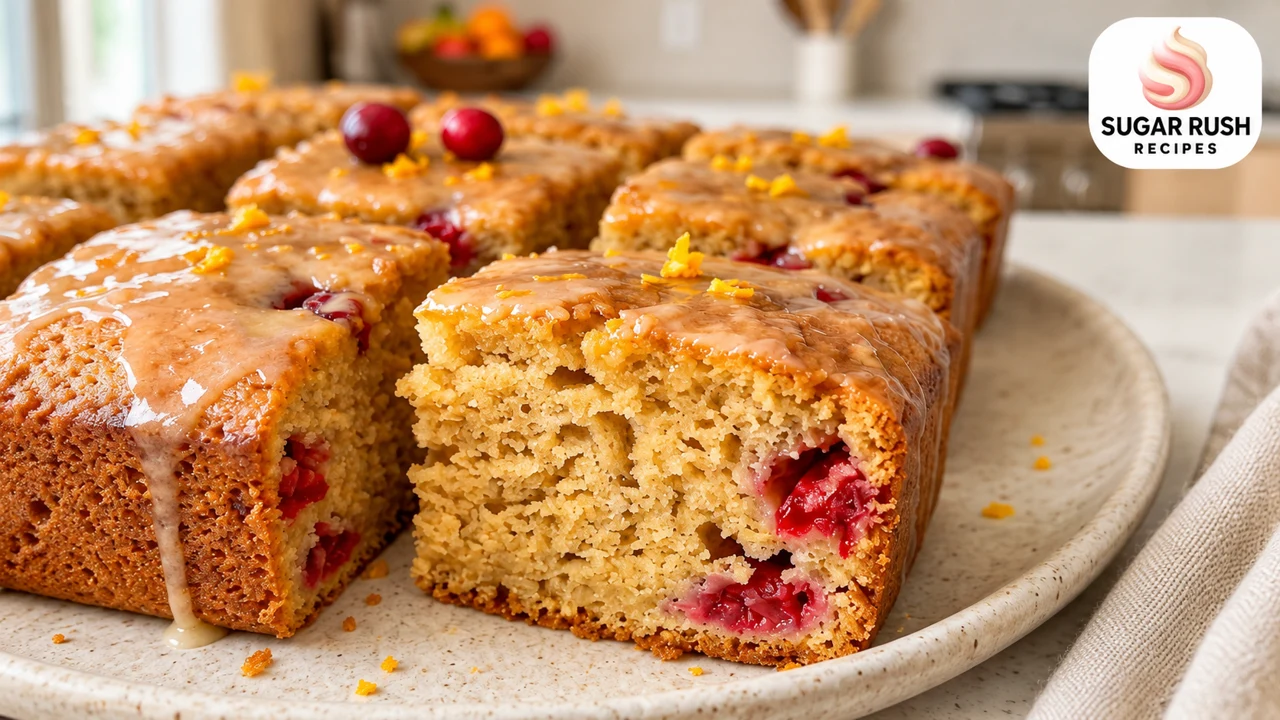
Cranberry orange cake squares pair a soft butter cake with tart red berries and a thin citrus glaze. Orange zest perfumes the crumb, while whole cranberries soften into little pockets of fruit as the cake bakes. Cut into generous squares, it is a simple dessert for a holiday platter, a coffee break, or an afternoon visit.
This version follows the Sugar Rush Recipes visual: golden cake with cranberries inside, a glossy orange glaze, and a few flecks of zest. It is a single-layer cake, without cheesecake filling or a crumb topping. The recipe is formulated to match the supplied AI-assisted photo and Reel; those visuals do not document a kitchen-tested batch.
Jump to the printable recipe for the full ingredient list. The guide below explains how to keep the batter thick, use frozen cranberries, check the center, and glaze the cake after it cools.
| Pan | Deep 9-inch square metal pan, at least 2 1/2 inches high |
|---|---|
| Yield | 9 generous squares or 16 smaller portions |
| Prep | 25 minutes |
| Bake | About 50 minutes; begin checking at 45 |
| Cooling and setting | At least 75 minutes |
| Total | About 2 hours 30 minutes; allow extra time for complete cooling |
In This Guide
- Ingredient Notes
- Pan and Baking Tools
- How to Make the Cake Squares
- Orange Glaze Tips
- Troubleshooting
- Storage and Freezing
- Frequently Asked Questions
- Printable Recipe
Ingredients for Cranberry Orange Cake Squares
Cranberries: Use fresh or frozen whole berries. Fresh berries should be firm; discard soft or damaged ones, rinse, and dry them. For frozen berries, separate any clumps and shake away loose ice. Add them while frozen rather than leaving them to release juice in a bowl. Frozen berries may extend the baking time.
Fresh and frozen cranberries behave differently from dried berries and cranberry sauce. Dried berries are chewier and often sweetened; sauce adds a different amount of liquid and sugar. Neither is a direct one-for-one replacement in this formulation. Penn State Extension’s cranberry guide includes information about freezing and using the berries.
Orange zest and juice: Zest supplies concentrated citrus aroma without adding much liquid. Wash and dry the oranges, then remove only the colored outer peel. Avoid the bitter white pith. Zest before juicing because a whole orange is easier to hold. Measure the juice rather than adding everything squeezed from a large orange.
Butter and sugars: Softened unsalted butter gives the cake its richness. Use butter that dents under a finger but is not greasy or melted. Granulated sugar keeps the flavor light, while a small amount of brown sugar adds a warmer note. This is a sweet cake that balances tart berries, not a low-sugar dessert.
All-purpose flour: Weigh the flour when possible. Too much can make the cake dry, while too little may leave it unable to support the fruit. Without a scale, loosen the flour, spoon it into the measuring cup, and level the top. King Arthur Baking’s flour-measuring demonstration shows the method.
Eggs, sour cream, and milk: Eggs help the cake set. Full-fat sour cream adds richness, and a measured amount of milk makes the batter spreadable. Bring chilled ingredients near room temperature so they blend more readily with the butter. Do not leave perishable ingredients out for an extended period.
Leaveners and vanilla: Measure baking powder and baking soda with level spoons. Use alcohol-free vanilla flavoring to keep the ingredient plan free of alcohol. There are no nuts, cream cheese, or extra fruit fillings in the base version.
The Pan and Tools You Need
Use a 9-inch square metal pan at least 2 1/2 inches deep. Check the inside measurements rather than the handles or outer rim. Line the greased pan with a parchment sling for easier removal, trimming excessive overhang. Keep paper away from oven heating elements.
A smaller pan makes the batter deeper and changes the time needed for the middle to set. Do not force the full recipe into an 8-inch pan. If your pan is shallower than specified or the mixture reaches above about two-thirds of its height, put excess batter in a separate small lined pan and check that portion earlier.
Gather a mixer, two bowls, a flexible spatula, a fine grater, measuring tools, a skewer, and a cooling rack. A small sieve is useful for powdered sugar. An offset spatula helps spread the glaze, but the back of a spoon works too.
As an Amazon Associate I earn from qualifying purchases. The following optional shopping link may earn a commission at no extra cost to you.
- Nordic Ware Natural Aluminum 9-by-9-inch Square Cake Pan — check the selected size and depth before ordering. Use a suitable pan you already own if you prefer.
The manufacturer’s pan page provides dimensions and care directions. Lift the cooled cake onto a board before cutting to protect the pan’s surface.
How to Make Cranberry Orange Cake Squares
1. Prepare the fruit and pan
Heat the oven to 350°F and prepare the lined square pan. Sort and dry fresh cranberries, or keep frozen berries ready in the freezer until the final folding step. Measure the zest and juice separately so no extra liquid slips into the batter.
Rub the cake’s orange zest into the granulated sugar with clean fingertips. This distributes the zest before the butter is added. The sugar should smell citrusy, with no large strips of peel.
2. Cream the butter and mix the batter
Beat the softened butter, zested sugar, and brown sugar until light and creamy, about three minutes. Scrape the bowl so no dense butter remains at the bottom. Beat in the eggs one at a time, then add the vanilla.
Whisk the flour, baking powder, baking soda, and salt separately. Stir together the sour cream, milk, and cake portion of orange juice. Add the dry mixture in three portions, alternating with the sour cream mixture in two. Start and finish with dry ingredients.
Use low speed and stop as soon as everything is combined. Finish with a spatula to check for flour pockets. The batter should hold soft folds rather than run like a drink. Adding extra juice at this stage changes more than the orange flavor.
3. Fold in the whole cranberries
Add all the berries once, at the end of mixing. Fold with broad, gentle strokes, reaching beneath the batter and turning it over the fruit. Avoid beating the berries with the mixer. A few red streaks are harmless, but repeated crushing can color the entire batter.
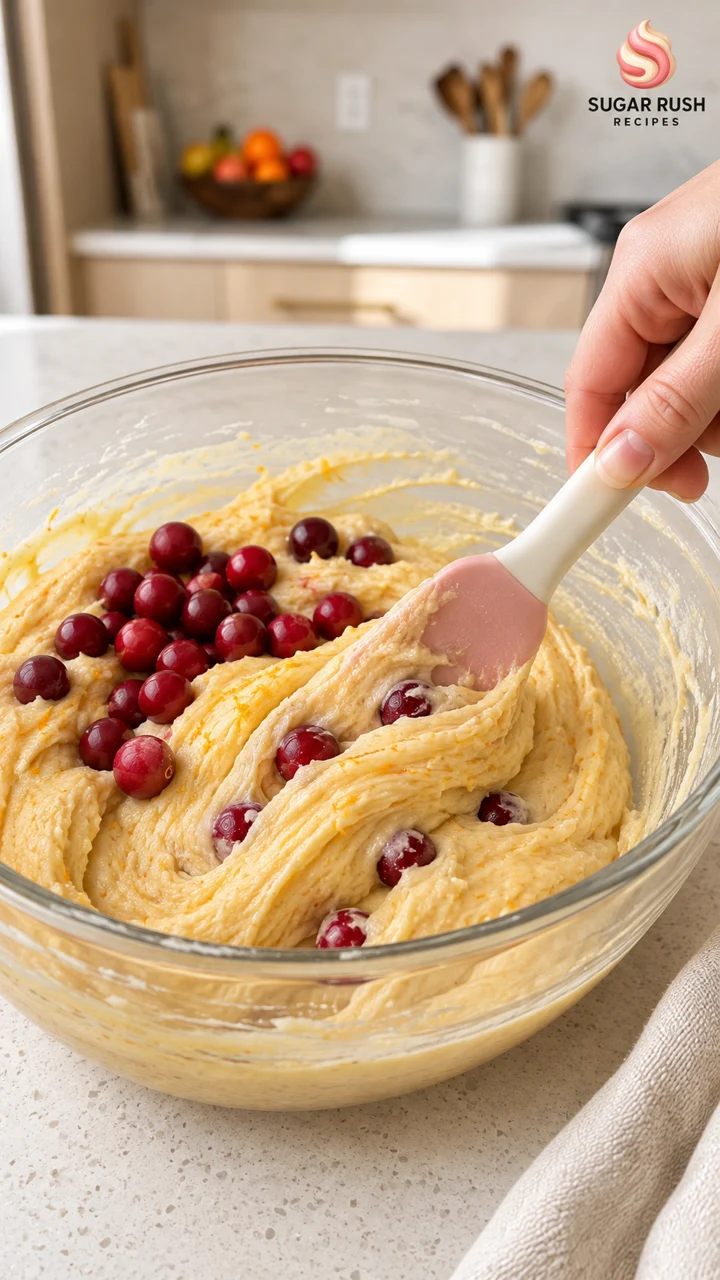
Spread the batter evenly into the prepared pan, reaching the corners. Check that berries are distributed rather than collected in one area. Do not add a second handful after the cake is baked to imitate fruit pockets in the cut surface.
4. Bake and check the center
Bake on the middle rack, beginning checks at forty-five minutes. The cake should be golden with a center that feels set. If the top is browning faster than the middle is baking, tent it loosely with foil and continue.
Insert a skewer into a central patch of cake. A juicy cranberry can leave a red mark even when the surrounding cake is done, so check another spot if necessary. Look for the absence of wet batter rather than demanding a perfectly dry skewer that has passed through fruit.
Frozen berries can slow the bake because they cool the batter. Use the doneness checks and allow more time when needed. The stated range is a starting point, not a reason to remove a cake whose center is still wet.
5. Cool before glazing and slicing
Set the pan on a rack for twenty minutes, then continue cooling until the cake is completely cool. Allow at least an hour total, and longer in a warm kitchen. Lift the cake only when it is firm enough to hold together; a parchment sling does not make hot cake strong.
For clean cranberry orange cake squares, use a sharp knife and wipe it between cuts. Cut nine generous portions or sixteen smaller ones. The orange glaze belongs on the cooled cake, and the finished glazed cake does not return to the oven.
Make a Thin, Glossy Orange Glaze
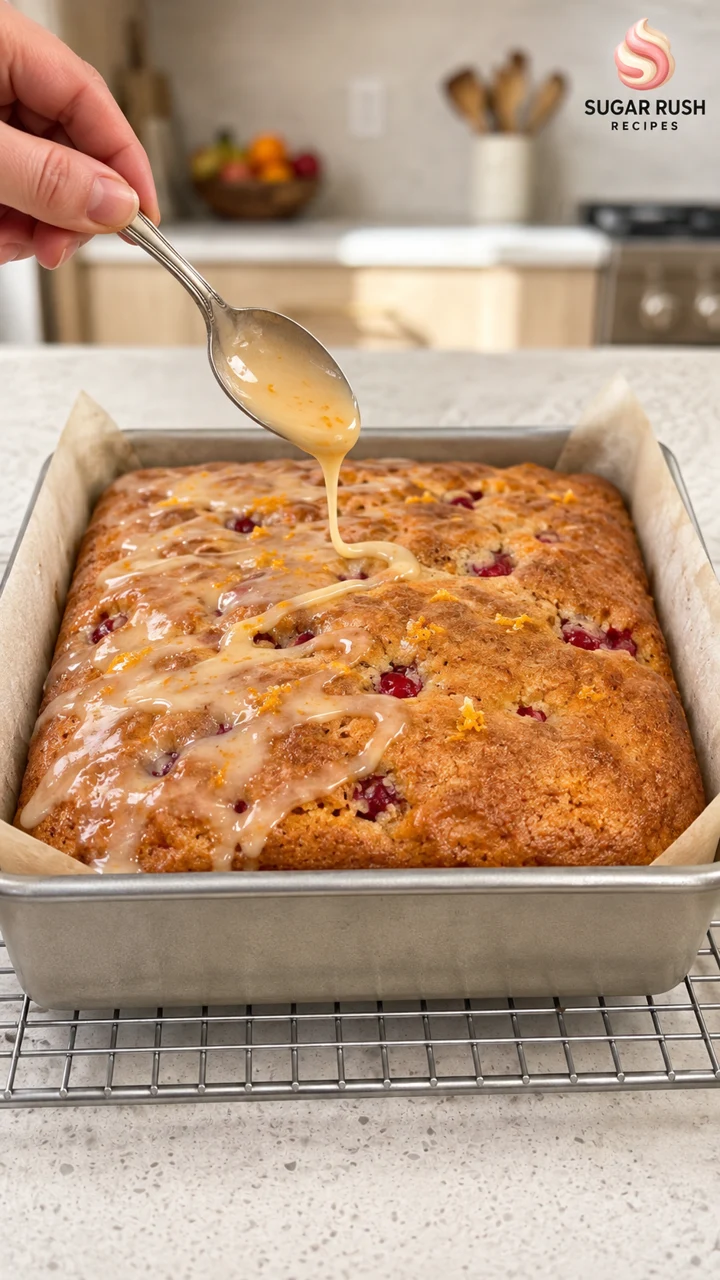
Sift the powdered sugar, then whisk in two tablespoons of orange juice and the glaze zest. Add more juice only a little at a time. The glaze should fall in a thick ribbon that spreads slowly. If it immediately runs off a spoon like water, stir in more powdered sugar.
Spoon it over the cooled cake and spread gently. A thin layer lets the golden top and cranberry spots show through. Finish with a small amount of zest if desired, then give it about fifteen minutes to settle before cutting.
The fresh cranberries resting on the reference platter are optional decoration. They are not a separate filling, and raw cranberries are quite tart. Leave them off the serving plate if you want every visible garnish to be ready for a sweet bite.
Troubleshooting Cranberry Orange Cake Squares
| Problem | Likely issue | What to adjust |
|---|---|---|
| Dry cake | Extra flour or too much baking time | Weigh flour and begin checks at the early end of the range |
| Wet center with a dark top | Center needs more time or pan is undersized | Tent with foil and check the actual pan dimensions |
| Many berries sink | Thin batter or excess liquid | Measure juice and milk, and keep the intended thick batter |
| Pink batter throughout | Berries crushed by vigorous mixing | Fold gently at the end with a spatula |
| Bitter orange flavor | White pith grated with zest | Remove only the colored peel |
| Glaze soaks in or runs off | Cake warm or glaze too thin | Cool fully and thicken the glaze |
Storage, Freezing, and Make-Ahead Advice
Let the cake cool completely before covering so steam does not collect beneath the lid. Keep it airtight at cool room temperature for up to two days, or refrigerate for up to five days total. Bring an individual portion toward room temperature before serving if you prefer a softer butter crumb.
Freeze unglazed squares, individually wrapped and placed in a rigid airtight container, for up to two months. Thaw while wrapped, then unwrap and add fresh glaze. Freezing before glazing also reduces smearing during handling.
You can measure dry ingredients and prepare the pan in advance. Mix the batter and bake when ready rather than holding finished batter overnight. If serving at a gathering, cut only what you need at first to keep the remaining cake from drying at the edges.
Cranberry Orange Cake Squares FAQ
Do I need to cook fresh cranberries first?
No. Whole fresh berries go directly into the batter after sorting, rinsing, and drying.
Should frozen cranberries be thawed?
For this formulation, use them frozen and separated, with loose ice removed. Expect the cake to need extra time if necessary.
Can I use dried cranberries or sauce?
They are not direct replacements here. Dried berries change sweetness and texture; sauce changes the liquid balance.
Can I skip the glaze?
Yes. The cake can be served plain. The orange glaze provides the glossy finish shown in the photo.
Can bottled orange juice work?
Plain orange juice can be measured for the liquid portion, but fresh zest is still important to the citrus aroma. Avoid sweetened orange drinks.
Is there a cheesecake layer?
No. These are butter-cake squares with cranberries distributed through the crumb.
Can I use a smaller pan?
Use the specified deep 9-inch square pan for this quantity. A smaller pan needs a separate adjustment rather than the same filled volume and timer.
More Fruit Desserts to Try
For another fruit-filled bake, see our cherry almond crumb cake. If you want a smaller treat for a cookie tray, try raspberry almond thumbprint cookies. Each recipe has its own filling method and timing.
Printable Cranberry Orange Cake Squares Recipe
Print
Cranberry Orange Cake Squares
Soft cranberry orange butter cake squares with whole berries, orange zest and a glossy orange glaze. Makes 9 generous squares in a deep 9-inch square pan.
- Total Time: 2 hours 30 minutes
- Yield: 9 generous squares
Ingredients
- 2 1/4 cups (270 g) all-purpose flour
- 2 teaspoons baking powder
- 1/4 teaspoon baking soda
- 1/2 teaspoon fine salt
- 3/4 cup (170 g) unsalted butter, softened
- 3/4 cup (150 g) granulated sugar
- 1/4 cup (50 g) packed light brown sugar
- 1 tablespoon finely grated orange zest, for the cake
- 3 large eggs, at room temperature
- 1 teaspoon alcohol-free vanilla flavoring
- 1/2 cup (120 g) full-fat sour cream, at room temperature
- 1/4 cup (60 ml) whole milk
- 1/4 cup (60 ml) freshly squeezed orange juice, for the cake
- 2 cups (200 g) fresh or frozen whole cranberries; keep frozen berries frozen
- 1 cup (120 g) powdered sugar, sifted, for the glaze
- 2 to 3 tablespoons freshly squeezed orange juice, for the glaze
- 1 teaspoon finely grated orange zest, for the glaze
- 1 teaspoon finely grated orange zest, optional, for finishing
Instructions
- Heat the oven to 350°F (175°C). Grease a 9-inch square metal pan at least 2 1/2 inches deep. Line with a parchment sling, trimming overhang away from heating elements.
- Sort fresh cranberries, discard soft or damaged berries, rinse and dry thoroughly. For frozen berries, use loose berries straight from frozen, shaking away ice crystals. Wash and dry the oranges, then zest before juicing.
- Whisk flour, baking powder, baking soda and salt in a bowl. In a measuring jug, stir together sour cream, milk and the 1/4 cup orange juice.
- Rub the tablespoon of orange zest into the granulated sugar. Beat butter, zested sugar and brown sugar for about 3 minutes until light and creamy. Add eggs one at a time, scraping the bowl after each. Mix in vanilla.
- With the mixer on low, add dry ingredients in three additions, alternating with the sour cream mixture in two additions. Begin and end with dry ingredients. Mix just until combined, then scrape and fold gently to remove flour pockets.
- Fold in all the cranberries with a spatula, using a few broad strokes. Spread the thick batter evenly in the prepared pan. Do not fill a pan above about two-thirds of its height; bake any excess separately if your pan is shallower than specified.
- Bake on the center rack for 45 to 60 minutes, beginning checks at 45 minutes. Frozen berries may extend the time. If the top browns early, tent loosely with foil. A skewer inserted into cake near the center should show no wet batter; check a second spot if the first hits a cranberry.
- Cool in the pan on a rack for 20 minutes, then continue cooling until completely cool, allowing at least 60 minutes total and longer as needed. Lift out only when the cake is firm enough to support itself.
- Whisk powdered sugar with 2 tablespoons orange juice and the teaspoon of glaze zest. Add more juice a little at a time until thick but spreadable. Spoon over the cooled cake and spread gently. Add the optional finishing zest.
- Allow the glaze to settle for about 15 minutes. Cut into 9 generous squares or 16 smaller pieces with a sharp knife. Serve on a platter; fresh whole cranberries on the reference platter are optional decoration, not an additional cake ingredient.
Notes
Prep 25 minutes; bake about 50 minutes (45–60 minutes or longer as needed); cooling at least 60 minutes; glaze setting about 15 minutes. Total about 2 hours 30 minutes, with complete cooling taking longer in a warm kitchen. Yield 9 generous squares or 16 small portions. Use a deep 9-inch square metal pan; an 8-inch pan is not a direct substitute. Do not replace fresh or frozen cranberries with sauce or dried berries one-for-one. Store fully cooled cake airtight at cool room temperature up to 2 days, or refrigerate up to 5 days total. Freeze unglazed portions up to 2 months; thaw wrapped, then glaze. Contains wheat, eggs and dairy. Recipe formulated to match the supplied AI-assisted photo and Reel; not documented as kitchen-tested. Use alcohol-free vanilla flavoring.
- Prep Time: 25 minutes
- Cook Time: 50 minutes
- Category: Dessert
- Method: Baking
- Cuisine: American
- Diet: Vegetarian