
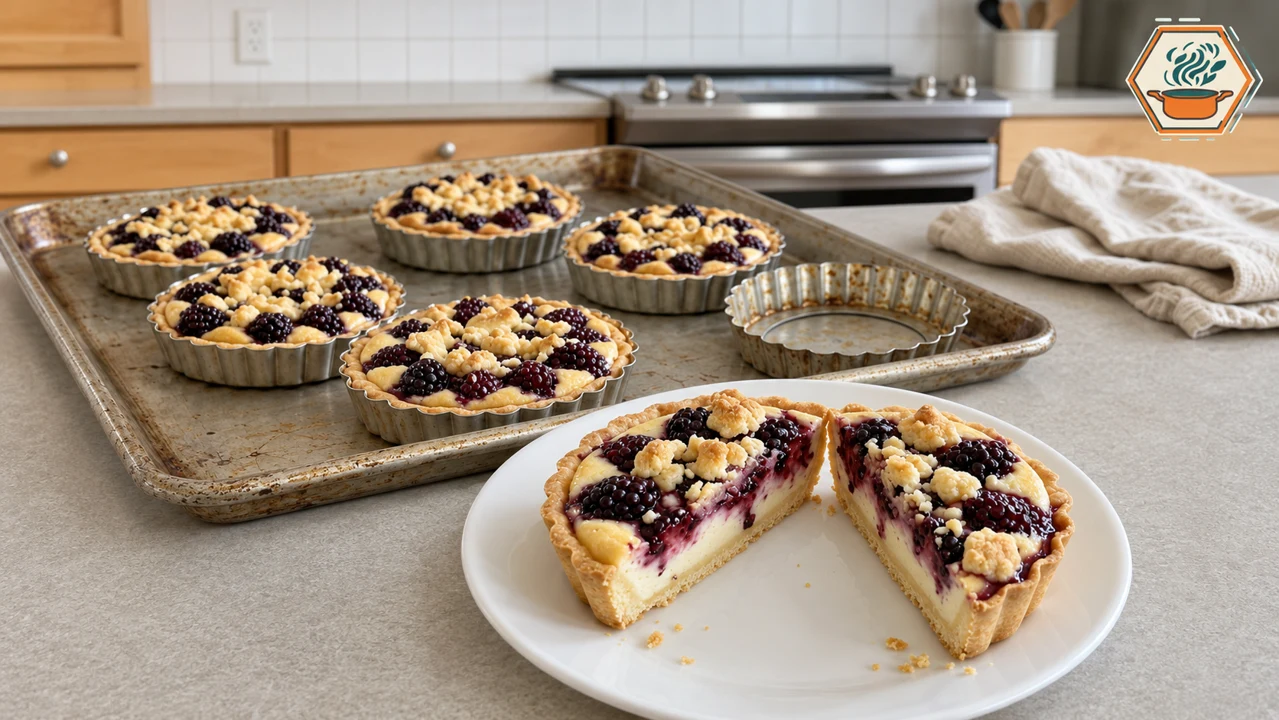
Blackberry cheesecake crumble tartlets bring together three textures in one little pastry shell: a buttery shortbread base, a smooth baked vanilla cheesecake center, and a golden crumb topping scattered around juicy blackberries. Each tartlet is made in its own fluted metal pan, so you can serve individual desserts without cutting a large cheesecake.
The RecipesMind Reel shows dough being pressed into small pans, followed by the cheesecake filling, berries, crumble, and the finished dessert. This written version includes the steps a short video cannot show clearly: chilling and parbaking the shells, mixing the filling gently, and refrigerating the baked tartlets before removing their rings.
This is an original editorial recipe inspired by the supplied visual. The AI-assisted process illustrations explain the sequence; they are not a record of kitchen testing. Use the pan size, measured quantities, and doneness cues below rather than trying to reproduce an exaggerated filling height from an image.
| Yield | 6 individual 4-inch tartlets, about 1 inch deep |
|---|---|
| Active preparation | About 30 minutes, plus ingredient softening |
| Shell chilling | 15 minutes |
| Parbake | 15–18 minutes, then about 15 minutes cooling |
| Filled bake | About 25–32 minutes |
| Cooling and refrigeration | About 45 minutes on a rack, then at least 2 hours refrigerated |
| Total planning time | About 4 hours 35 minutes using upper estimates; some work overlaps |
In This Recipe
- Ingredients and Pan Size
- How to Make the Tartlets
- Baking and Doneness Cues
- Helpful Baking Tools
- Common Problems and Fixes
- Make-Ahead and Storage
- Frequently Asked Questions
- Printable Recipe Card
Ingredients for Blackberry Cheesecake Crumble Tartlets
Buttery shortbread shells
- 1 1/2 cups (180 g) all-purpose flour
- 1/4 cup (50 g) granulated sugar
- 1/4 teaspoon fine salt
- 1/2 cup (113 g) unsalted butter, softened but not melted
- 1/2 teaspoon alcohol-free vanilla flavoring
Vanilla cheesecake filling
- 12 ounces (340 g) full-fat block cream cheese, softened
- 1/3 cup plus 1 tablespoon (about 80 g) granulated sugar
- 1 large egg, room temperature
- 1/4 cup (60 g) sour cream, room temperature
- 1 teaspoon alcohol-free vanilla flavoring
Blackberries
- 1 1/2 cups (about 210 g) fresh blackberries, washed and thoroughly dried
- 1 tablespoon (12 g) granulated sugar
- 1 teaspoon cornstarch
Crumble topping
- 1/2 cup (60 g) all-purpose flour
- 1/4 cup (50 g) granulated sugar
- Pinch of fine salt
- 3 tablespoons (43 g) cold unsalted butter, diced
Keep the four ingredient groups separate while measuring. The shell butter is softened so it mixes into a press-in dough. The topping butter stays cold so it forms crumbs. There is one egg in the recipe, and it belongs in the cheesecake filling. The crust contains no egg, and no baking powder or yeast is required.
Use full-fat block cream cheese rather than a whipped or spreadable tub product. Let it soften enough to blend smoothly, without melting or becoming warm. Sour cream and the egg should lose their refrigerator chill while you prepare the shells, but do not leave dairy and eggs sitting out for an extended period.
Choose plump, sound blackberries and discard damaged or moldy fruit. Wash gently, drain well, and spread on a towel until dry. Large berries can be halved; pat their cut surfaces dry. The recipe uses measured fresh fruit, not a cooked jam layer, canned pie filling, or an additional fruit topping after baking.
The cornstarch coats the berries with their small amount of sugar shortly before assembly. It helps manage released juice but does not make unlimited extra fruit safe to add. A crowded pile of wet berries can still overwhelm the shallow cheesecake layer and slow the bake.
Choose Six Matching 4-Inch Tartlet Pans
Use six round metal tartlet pans measuring approximately 4 inches across and 1 inch deep, ideally with removable bottoms. Set them on a rimmed baking sheet before filling. Check the actual internal dimensions: products labeled mini tart pans vary considerably in width, depth, and capacity.
A standard muffin pan is a different shape and volume. The dough portions, filling depth, and oven times here are written for the shallow individual tartlet pans. Likewise, do not transfer the whole recipe to one large pan and assume the same timing will apply.
Lightly grease the pans, including the fluted sides. Their removable bases make unmolding easier after chilling, but they can slide upward if you press underneath while carrying a filled pan. Move the baking sheet rather than lifting hot individual pans by their bases.
How to Make Blackberry Cheesecake Crumble Tartlets
1. Mix the press-in shortbread
Heat the oven to 350°F (175°C), with a rack in the middle. Combine the shell flour, sugar, and salt in a bowl. Work in the softened butter and shell vanilla until the mixture forms moist clumps that hold together when squeezed.
This is a press-in pastry, so there is no need to knead it or roll six delicate circles. If it seems sandy at first, keep mixing and press a little between your fingers before deciding it needs anything else. Avoid adding milk or water automatically; that would change the dough.
2. Divide, shape, and chill the shells
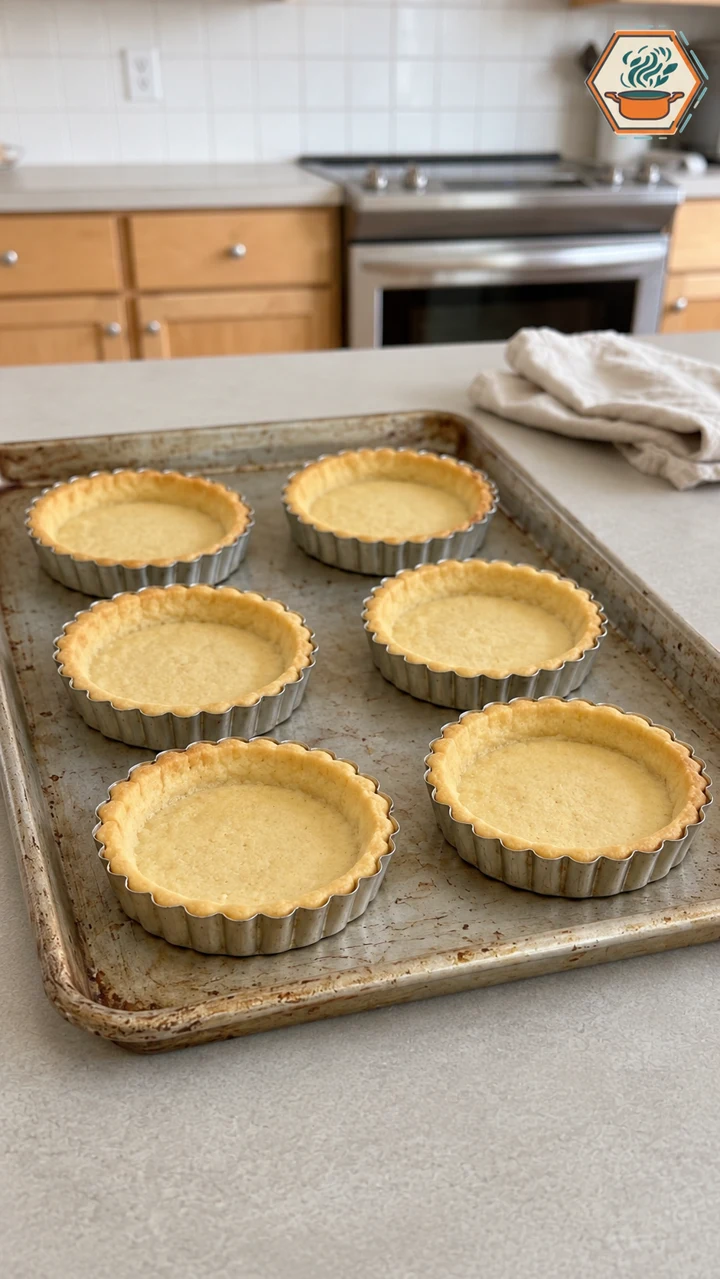
Divide the dough evenly among the six prepared pans, about 58 grams each. Press it across each base and up the sides in an even layer about 1/8 inch thick. Work a little dough into the base-to-side corner without leaving a heavy ridge.
Keep the top edge level and supported by the pan rim. Lightly prick the bases with a fork, then freeze the shaped shells for 15 minutes. Keep all six pans on the sheet so their thin walls are not distorted while moving them.
The aim is a small shell with enough room for filling. A thick pad of dough at the bottom may look sturdy but can leave little capacity for cheesecake. Divide first, then shape, rather than using most of the dough in the first few pans.
3. Parbake before adding cheesecake
Bake the chilled shells for 15–18 minutes, until dry-looking and lightly golden at the edges. They will bake again after filling, so do not aim for a deep brown finish at this stage. If a base puffs, gently flatten it with the back of a spoon while it is warm.
Cool the shells on their sheet for about 15 minutes. Leave the oven at 350°F. The dough becomes a lightly baked shell before it receives wet filling; do not pour batter into raw dough simply because the Reel cuts quickly from one shot to another.
For a related pastry technique, King Arthur Baking’s cream cheese tart also uses a baked crust before adding its filling. Its pan size, formula, and fruit finish differ from these individual crumble tartlets.
4. Make and chill the crumble
Mix the topping flour, sugar, and pinch of salt. Rub in the cold diced butter until you have small crumbs with a few pea-sized clumps. Refrigerate while preparing the cheesecake.
The topping is a separate mixture, not dough scraped from the shells. Do not press it into a solid disk. Small scattered pieces leave room to see the blackberries and allow the cheesecake surface to set between them.
5. Mix the cheesecake gently
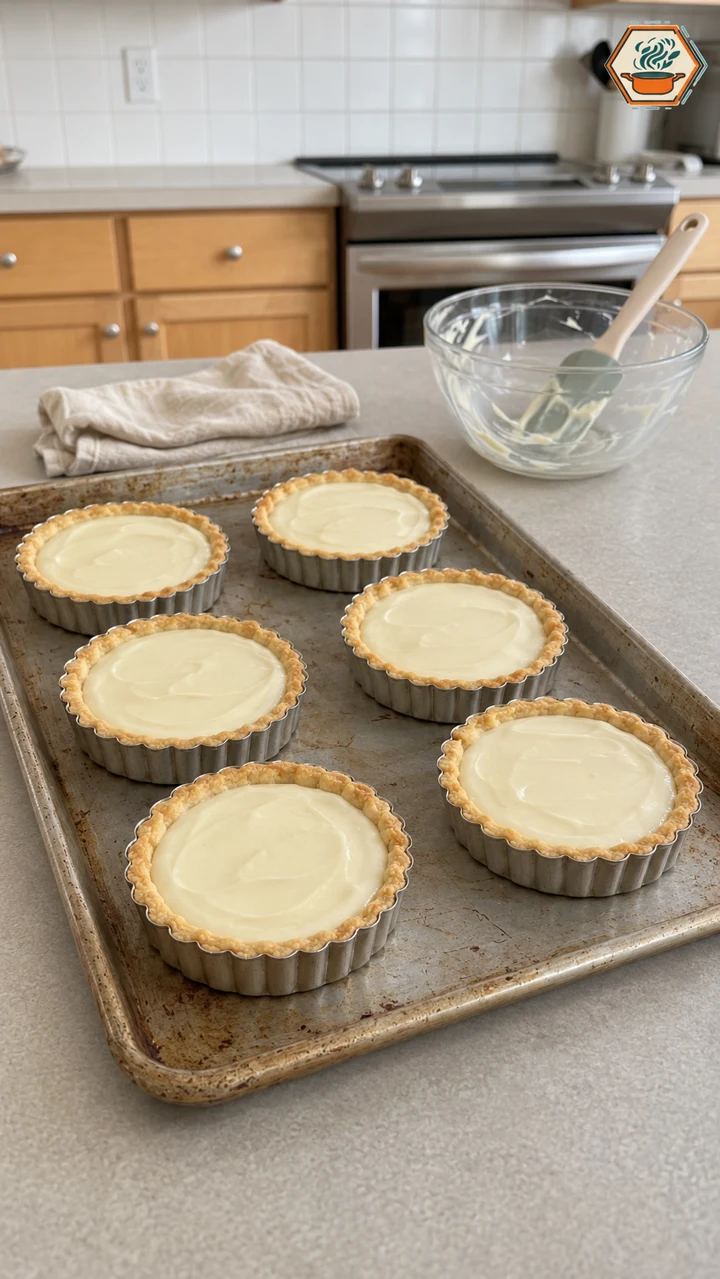
Beat the softened cream cheese and filling sugar on low until smooth. Scrape the bottom and sides of the bowl, then blend in the sour cream and filling vanilla. Add the one egg last and mix on low only until incorporated.
Check for cream cheese lumps before adding the egg. If you keep beating aggressively afterward to remove lumps, the batter can become unnecessarily airy. A spatula is useful for the final scrape and gentle stir.
Divide the batter evenly among the cooled parbaked shells, approximately 1/3 cup per pan. The batter should sit below the rims with room for the fruit and crumbs. If your pans are smaller than specified, do not force all the filling into them; use the stated pan size for this formula.
6. Add blackberries, then raw crumble
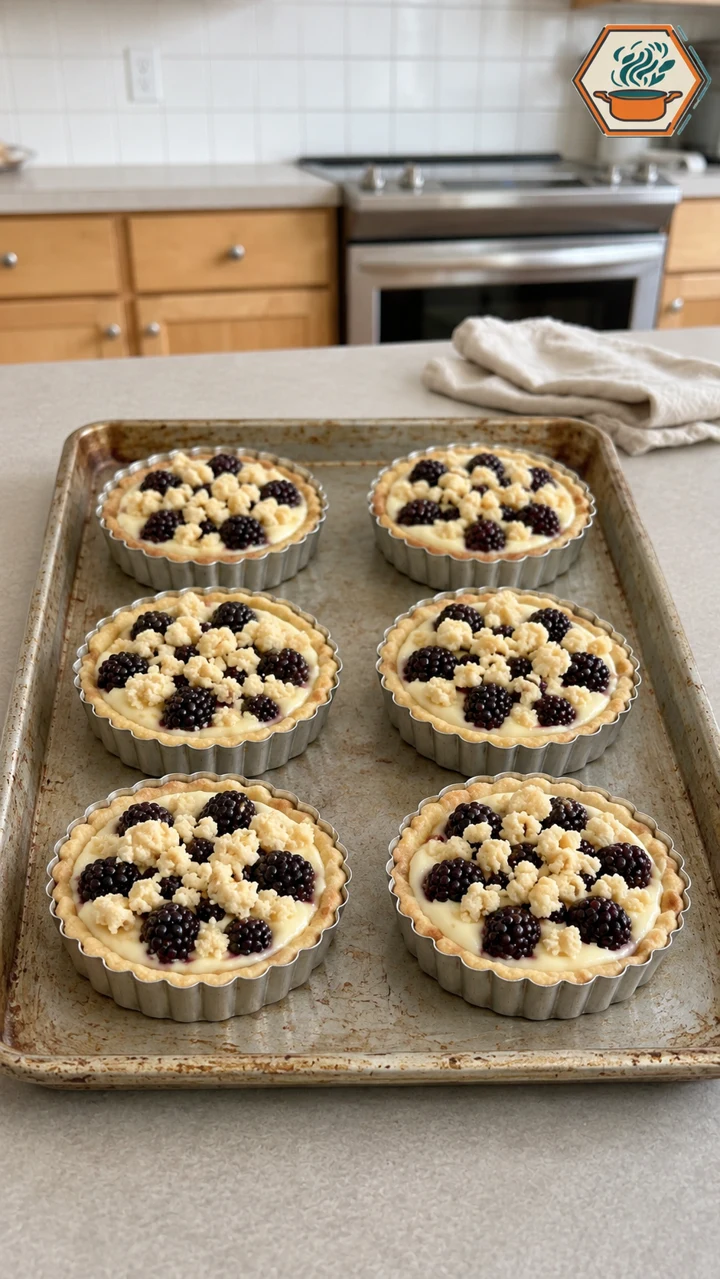
Just before assembly, toss the dry fresh blackberries with their tablespoon of sugar and teaspoon of cornstarch. Divide among all six filled shells. Use a similar amount in each pan so none ends up with a heavy wet mound.
Scatter the chilled raw crumble over the berries and visible filling. Keep some dark fruit and pale cheesecake showing. The berry layer and crumble are added once, before the filled bake. There is no second batch of berries, no glaze, and no extra crumb topping added after the oven.
7. Bake until the filling sets
Bake on the rimmed sheet at 350°F for about 25–32 minutes, checking toward the early end. The crumble should become golden, the outer filling should look set, and each center should give a small unified wobble rather than a liquid ripple.
Ovens and metal pans vary, so the timer is a guide. Continue if the centers are still fluid. If the pastry edges darken before the filling sets, loosely shield those edges with foil. Do not repeatedly open the oven or poke every tartlet to judge progress.
8. Cool, refrigerate, and unmold
Set the sheet on a rack and leave the tartlets in their pans for about 45 minutes. Transfer them to the refrigerator and chill for at least 2 hours, until cold and firm. Do not leave them on the counter until fully cold; refrigerate within 2 hours of coming out of the oven, or within 1 hour when the room is above 90°F.
To unmold a chilled tartlet, put its removable base over a stable narrow support and gently lower the outer ring. Slide the tartlet off its base with a thin server. If the pastry resists, loosen the edge gently rather than forcing the ring down through the shell.
Serve one tartlet per person for a generous dessert, or cut each in half for twelve smaller portions. A clean, thin knife gives a neater view of the vanilla filling. Let a chilled portion stand only briefly if you prefer a less cold center, and keep the rest refrigerated.
Read the Shell, Filling, and Crumble Separately
The pastry begins browning during its first bake, while the filling and topping enter the oven later. That means a brown rim alone does not prove the center is ready. Look at the filling’s movement and the crumble color together.
Juice around a berry can remain glossy after the surrounding cheesecake sets. Judge the pale filling between berries rather than expecting every purple spot to look dry. On the other hand, a wave of loose batter across the center needs more time.
Chilling firms the dessert for serving; it does not replace baking a liquid egg-containing filling. Avoid unmolding warm tartlets to check their bottoms. The fragile shells need time to cool and the centers need refrigeration before handling.
Helpful Tools for Small Cheesecake Tartlets
As an Amazon Associate I earn from qualifying purchases. These optional links may earn a commission at no extra cost to you. The essential equipment is six correctly sized removable-bottom tartlet pans, a rimmed sheet, mixing bowls, a mixer or sturdy whisk, and a cooling rack.
- OXO digital kitchen scale — weigh flour and divide shell dough evenly.
- OXO silicone everyday spatula — scrape the cream cheese bowl and distribute batter gently.
- OXO bench scraper — divide the press-in dough before shaping.
Choose the pans by dimensions and construction rather than the word mini on the package. A small digital scale is helpful for this recipe because unequal shell portions can produce a thick crust in one tartlet and a fragile base in another. No water bath or springform cake pan is required.
Common Problems and Fixes
| Problem | Likely cause | What helps |
|---|---|---|
| Thick, heavy base | Uneven dough distribution | Weigh six portions and press evenly into corners |
| Puffy shell base | Expansion during parbaking | Prick lightly, chill first, and gently flatten warm puffing |
| Lumpy filling | Cold cream cheese | Soften first and scrape the bowl before adding the egg |
| Watery fruit layer | Wet berries or excess fruit | Dry the measured fresh berries and coat just before assembly |
| Dark rim, loose center | Pastry browns before filling sets | Shield the rim and continue baking as needed |
| Shell breaks while unmolding | Handled warm or lifted by its base | Chill fully and lower the ring over stable support |
Make-Ahead and Storage
For a gathering, bake the tartlets the day before and refrigerate them in their pans after the initial rack cooling. Once cold, cover without pressing wrapping into the crumble. Unmold close to serving for easier handling.
Refrigerate covered at 40°F (4°C) or colder for up to 3 days for best quality. The shortbread and crumble soften as they absorb moisture, so the freshest texture is earlier in that window. Keep refrigerated until shortly before serving.
The FDA’s food-storage guidance explains prompt refrigeration of perishables and the two-hour room-temperature limit, reduced to one hour above 90°F. These dairy-and-egg tartlets should not be stored on the counter like plain cookies.
For longer storage, freeze individually wrapped, fully chilled tartlets for up to one month for quality. Thaw in the refrigerator rather than on the counter. Expect softer pastry and some moisture around the berries after thawing; freezing is a convenience option rather than a promise of freshly baked texture.
Frequently Asked Questions
Are these no-bake cheesecakes?
No. The shells are parbaked, then the egg-containing filling, blackberries, and crumble bake together. Refrigeration follows the filled bake.
Can I use frozen blackberries?
The written formula uses fresh, dry berries. Frozen fruit can release considerably more juice, so it is not a direct substitution with the same timing and texture.
Can I replace the blackberries with cherry pie filling?
Canned pie filling has a different sugar, liquid, and thickener balance. This recipe is designed around measured fresh blackberries rather than a direct pie-filling swap.
Do I need to roll the dough?
No. Mix until it forms moist clumps, divide into six portions, and press into the pans. Keep the bases and sides evenly thin.
Why chill before removing the rings?
The filling firms as it chills, and the cooled pastry is easier to handle. Removing a warm ring can break the sides or smear the center.
Can I make twelve muffin-sized cheesecakes instead?
That changes the pan shape, dough thickness, filling depth, and timing. Use six shallow 4-inch tartlet pans for the written recipe.
More Individual and Fruity Cheesecake Ideas
If you enjoy small desserts with a creamy center, save the blueberry cheesecake cookie cups. For a different style of fruit-filled baking, try the raspberry cheesecake pull-apart loaf, which uses layered yeast dough rather than a shortbread shell.
Printable Blackberry Cheesecake Crumble Tartlets Recipe
Print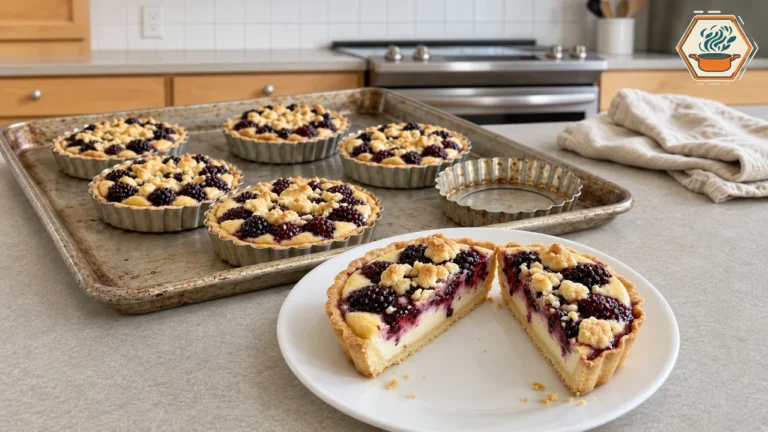
Blackberry Cheesecake Crumble Tartlets
Six individual shortbread tartlets with baked vanilla cheesecake filling, juicy blackberries, and a buttery crumble topping. Chill before unmolding for clean slices.
- Total Time: 4 hours 35 minutes
- Yield: 6 tartlets
Ingredients
Shortbread shells
1 1/2 cups (180 g) all-purpose flour
1/4 cup (50 g) granulated sugar
1/4 teaspoon fine salt
1/2 cup (113 g) unsalted butter, softened but not melted
1/2 teaspoon alcohol-free vanilla flavoring
Cheesecake filling
12 ounces (340 g) full-fat block cream cheese, softened
1/3 cup plus 1 tablespoon (about 80 g) granulated sugar
1 large egg, room temperature
1/4 cup (60 g) sour cream, room temperature
1 teaspoon alcohol-free vanilla flavoring
Blackberry layer
1 1/2 cups (about 210 g) fresh blackberries, washed and thoroughly dried
1 tablespoon (12 g) granulated sugar
1 teaspoon cornstarch
Crumble topping
1/2 cup (60 g) all-purpose flour
1/4 cup (50 g) granulated sugar
Pinch of fine salt
3 tablespoons (43 g) cold unsalted butter, diced
Instructions
Set six 4-inch round, approximately 1-inch-deep removable-bottom metal tartlet pans on a rimmed baking sheet. Lightly grease. Heat the oven to 350°F (175°C), with a rack in the middle.
Mix shell flour, sugar, and salt. Work in softened butter and shell vanilla until moist clumps form. Divide evenly among the six pans, about 58 g each. Press evenly over the bases and up the sides, about 1/8 inch thick. Prick the bases lightly with a fork. Freeze 15 minutes.
Bake the chilled shells for 15–18 minutes, until dry-looking and lightly golden at the edges. If a base puffs, gently flatten it with the back of a spoon while warm. Cool the shells on the sheet about 15 minutes. Leave the oven at 350°F.
Mix the crumble flour, sugar, and pinch of salt. Rub in the cold diced butter to make small crumbs and a few pea-sized clumps. Refrigerate while preparing the filling.
Beat softened cream cheese and filling sugar on low until smooth, scraping the bowl. Blend in sour cream and filling vanilla. Add the egg and mix on low only until combined. Do not whip air into the batter.
Divide filling evenly among cooled parbaked shells, about 1/3 cup per shell, leaving room below the rims for fruit and crumble. Do not force excess filling into a smaller pan.
Just before topping, toss the dry fresh blackberries with their tablespoon of sugar and teaspoon of cornstarch. Divide once among all six tartlets, then sprinkle with the chilled raw crumble. Keep berries and some filling visible; do not pack on a solid crumb lid.
Bake on the rimmed sheet at 350°F for about 25–32 minutes, checking early. The crumble should be golden, the outer filling set, and each center should give a small unified wobble rather than a liquid ripple. Continue as needed for your oven; loosely shield darkening pastry edges with foil.
Cool in the pans on a rack about 45 minutes, then refrigerate for at least 2 hours, until cold and firm. Refrigerate within 2 hours of leaving the oven; within 1 hour if the room is above 90°F. Do not wait on the counter until completely cold.
When chilled, place a pan over a stable narrow support, gently lower the outer ring, then slide the tartlet off its removable base onto a plate using a thin server. Handle the ring rather than pressing the base while carrying a filled pan. Serve cold or briefly tempered.
Notes
Yield: six 4-inch tartlets, about 1 inch deep. One tartlet is one generous serving; cut in half for 12 smaller portions. Smaller muffin wells or deeper mini pans are not equivalent.
Timing uses the upper baking estimates: 30 minutes active preparation, 50 minutes total oven time, and 3 hours 15 minutes for shell chilling, cooling between stages, rack cooling and final refrigeration. Total about 4 hours 35 minutes; softening ingredients is additional preparation. Some work overlaps.
Use fresh, thoroughly dried blackberries for the written method. Very large berries can be halved and patted dry. Frozen fruit is not a direct swap because excess juice changes the filling and bake. Do not add extra fruit or crumble after baking to imitate the photo.
Refrigerate covered at 40°F (4°C) or below for up to 3 days for best quality. Freeze individually wrapped, chilled tartlets up to 1 month for quality; thaw in the refrigerator. Crust and crumble soften during storage.
Contains wheat, milk and egg. Use alcohol-free vanilla. This original recipe is inspired by the supplied RecipesMind visual; AI-assisted illustrations are not a record of kitchen testing. Baking times are guides; use the stated doneness cues.
- Prep Time: 30 minutes
- Chilling and Cooling: 3 hours 15 minutes
- Cook Time: 50 minutes
- Category: Dessert
- Method: Baking
- Cuisine: American